
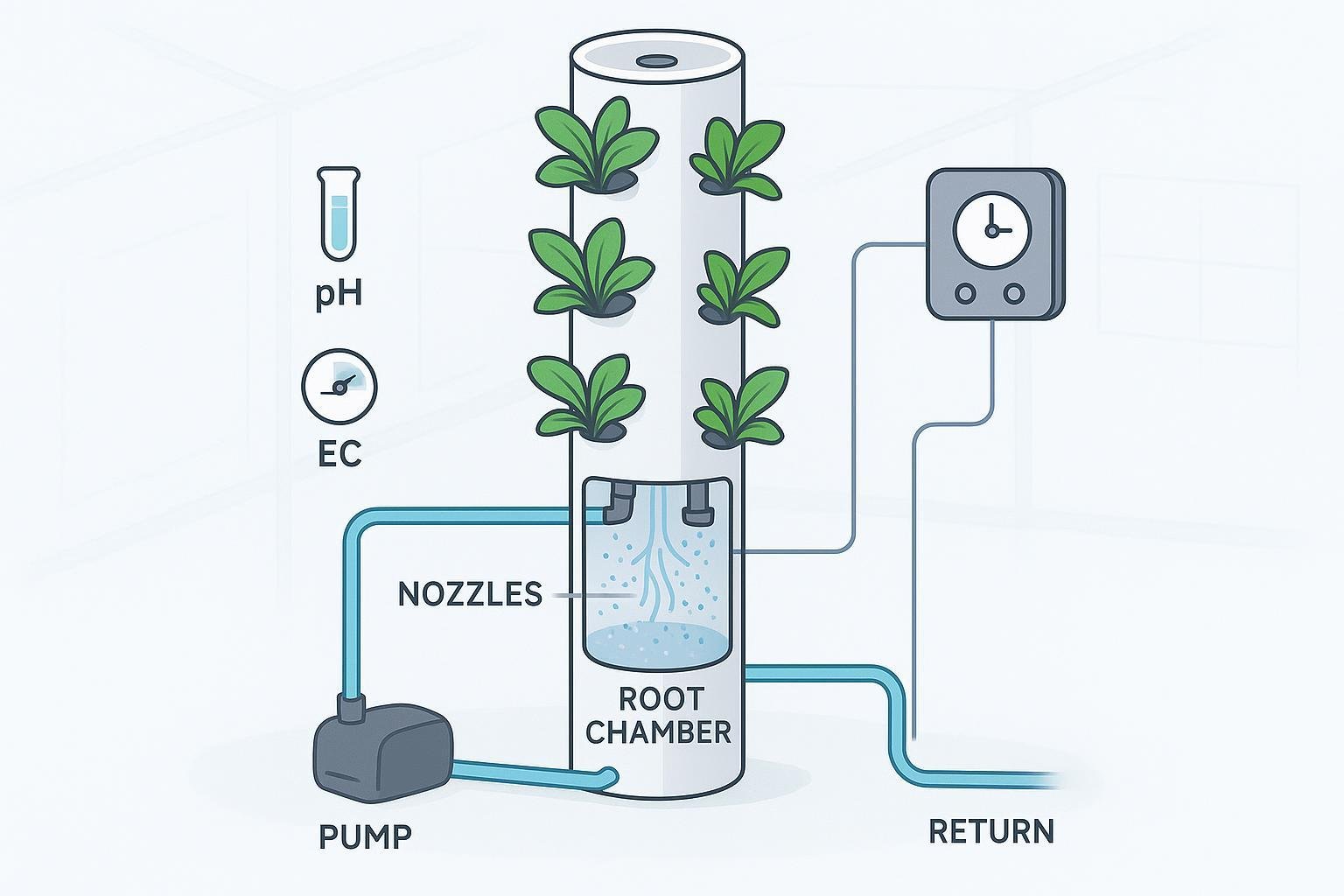
An air garden is an aeroponic growing system: plants are supported above a reservoir, their roots hang in an oxygen-rich chamber, and a fine nutrient mist hydrates them at set intervals. In plain terms, the roots live in air, not in soil or standing water, and get fed by timed sprays. This guide explains what an air garden is, how it works, practical parameters, maintenance, and who should consider it—whether you’re running a greenhouse, teaching plant science, or starting a home vertical garden.
Key takeaways
An air garden is best defined as aeroponics: roots suspended in air, fed by periodic nutrient mist.
Core components include a root chamber or tower, a reservoir, pump, misting nozzles/atomizers, timers/controllers, and basic environmental controls.
Benefits: high root oxygenation and water-efficient recirculation; Constraints: higher complexity, sanitation needs, and reliability requirements.
Mist-cycle timing, nutrient pH/EC, solution temperature, and humidity/airflow all influence plant performance.
Aeroponics differs from hydroponics (roots in solution/media) and aquaponics (plant + fish integration).
Suitable for commercial/institutional growers, home beginners, and educators—with different setup and maintenance expectations.
Qualifications
The information in this guide was prepared by the SPRINGS FAITH technical editorial team. Our contributors include engineers and CEA practitioners with hands-on experience designing, installing, and supporting commercial vertical hydroponic systems; the company reports over five years of operational experience and offers installation and training services. For more on the team and company background, see SPRINGS FAITH’s About page: About SPRINGS FAITH.
Air garden (aeroponics) — the clear definition
Technically, an “air garden” is an aeroponic system: plant roots are suspended in air inside a chamber or tower, and a water-based nutrient solution is delivered as a fine mist on a schedule. This places air gardens within the broader family of soilless culture methods. Authoritative overviews of controlled environment agriculture and vertical farming recognize aeroponics as one of the principal approaches used indoors without soil, alongside hydroponics and aquaponics. See the general framing in Encyclopaedia Britannica’s vertical farming overview (2025) and the basic definition in Wikipedia’s aeroponics entry.
Disambiguation: In everyday consumer language, some people use “air garden” to refer to countertop planters or vertical towers of various types. In this guide, we use the term precisely: an air garden is aeroponics-first—roots-in-air, nutrient mist delivery—whether the format is a compact chamber or a vertical tower.
Why the roots-in-air approach matters: roots require both water and oxygen. Aeroponics aims to balance hydration and oxygenation by delivering short, frequent mists and keeping roots in air the rest of the time. Think of it this way: the mist feeds and cools; the air lets roots breathe.
How an air garden works
Most air gardens share a simple loop:
A reservoir holds the nutrient solution (water plus dissolved mineral nutrients).
A pump moves the solution through distribution lines to misting hardware inside the root chamber or tower.
Nozzles or atomizers create fine droplets aimed at the root zone during short, timed cycles.
Excess solution drips to return lines and flows back to the reservoir for recirculation.
Timers/controllers manage mist intervals; advanced setups add pH/EC sensors, temperature monitoring, and alarms.
Environmental controls (lighting, air temperature, humidity, and airflow) support healthy growth under indoor or greenhouse conditions.
These system elements and principles are consistently described in vertical farming and aeroponics resources, including Britannica’s vertical farming page and ATTRA/NCAT’s vertical farming publication (2024).
Practical parameters for an air garden
There is no single “best” setting. Parameters depend on crop species, growth stage, system design, and local environment. The ranges below consolidate guidance from extension materials and peer-reviewed exemplars.
Parameter | Typical guidance or example | Notes & sources |
|---|---|---|
Nutrient solution pH | ~5.5–6.2 for many leafy greens and herbs | Hydroponic/aeroponic chemistry overlaps; see UF/IFAS guidance and Penn State Extension |
Nutrient solution EC | ~1.5–2.0 dS/m for many leafy greens (adjust by crop/stage) | Monitor and adjust; see UF/IFAS and Penn State Extension |
Solution temperature | ~64–72°F (18–22°C) | Warmer solutions can increase pathogen risk; keep reservoirs shaded/covered |
Mist-cycle (propagation) | Continuous or very frequent cycles often favored | E.g., continuous spray outperforming intermittent cycles in some cuttings; Weingarten et al., 2024 |
Mist-cycle (vegetative) | Short pulses spaced minutes apart | Examples include 10 s ON every 5 min in research simulations; Lin et al., 2023; other crops used 15 s every 20 min during daytime; Mabitsela et al., 2023 |
Nozzle/atomizer notes | Low-pressure sprayers, high-pressure atomizers, or ultrasonic transducers | Droplet characteristics and sanitation practices differ; use filters and regular cleaning; see general framing in Wikipedia |
A 2025 educational build documented an aeroponic unit with a simple tub-and-lid root chamber, net cups, and recirculating reservoir—useful as a classroom exemplar: Hutchinson (2025).
Maintenance and sanitation SOPs
Aeroponics rewards discipline. Reliable cycles and clean plumbing prevent most problems.
Daily
Check pump operation and timer/controller status.
Confirm solution level and temperature; top off with clean water as needed.
Quick visual: roots should look white/cream, not brown; nozzles should spray evenly.
Weekly
Inspect/clean intake screens and in-line filters; replace if worn.
Remove and rinse nozzles; soak in manufacturer-approved cleaner if performance drops.
Test and record pH and EC; adjust nutrient stock solutions carefully to avoid precipitation.
Monthly (or between crop turns)
Drain and clean the reservoir, lines, and chamber surfaces; disinfect per local guidance.
Review water quality tests (pH, alkalinity, hardness, sodium/chloride). Consider UV/ozone or other disinfection options if contamination is suspected.
Audit nozzle sets and critical components; replace any that show clogging or wear.
Sanitation references emphasize water quality, pathogen prevention (e.g., Pythium), and equipment care across recirculating systems. See Penn State Extension’s Pythium guidance and Interpreting Irrigation Water Tests.
Pro tip: Separate calcium-containing stock solutions from phosphates and sulfates; mixing them directly can precipitate solids that clog lines and nozzles. See Penn State Extension’s nutrient formulation guidance.
Aeroponics vs hydroponics vs aquaponics
Aeroponics (air garden): Roots in air; nutrient mist delivered intermittently. Strengths: high oxygenation, precise control, water-efficient recirculation. Considerations: equipment reliability and sanitation are non-negotiable.
Hydroponics: Roots in solution or inert media with continuous or periodic irrigation. Strengths: simpler hardware and often lower maintenance. Considerations: lower inherent root oxygenation unless aerated.
Aquaponics: Plants integrated with fish culture; nutrients come from fish waste processed by biofilters. Strengths: integrated system and educational value. Considerations: added complexity and biological balancing.
These distinctions are widely summarized in authoritative overviews, such as Britannica’s vertical farming page and ATTRA/NCAT’s vertical farming publication.
Who an air garden is for
Commercial/institutional growers
Value: vertical stacking, precise nutrient delivery, potential water savings, and high oxygenation for fast growth under control.
Priorities: redundancy (backup pumps/power), robust sanitation SOPs, sensor integration (pH/EC/temp), and trained operators.
Home beginners
Value: compact footprint, engaging learning curve, and visible roots for observation.
Priorities: simple timers, easy-access filters/nozzles, clear pH/EC routines, and realistic maintenance schedules.
Educators
Value: roots-in-air are visually compelling and demonstrate plant physiology, environmental control, and nutrient management.
Priorities: reproducible builds, transparent parameters, and safety/cleaning protocols suitable for classrooms.
The educational and CEA context for aeroponics is reflected in institutional resources such as USDA ARS’s controlled environment plant research summaries and Wikipedia’s vertical farming overview.
A neutral example of a tower air garden workflow
Disclosure: SPRINGS FAITH is our product.
A modular vertical tower can be configured as an air garden by using a closed-loop reservoir at the base, a commercial-grade pump and filtration, and misting nozzles positioned inside a hollow root chamber. Timers run short pulses (for example, several seconds per cycle) spaced minutes apart during daylight hours, with adjustments based on crop stage and local humidity. Excess solution returns to the reservoir through internal channels. In practice, commercial setups prioritize stable circulation, predictable energy use, and accessible maintenance points for filters and nozzles. See the company homepage for general product context: SPRINGS FAITH.
Compact case study — small tower aeroponic trial
Background: A university-scale tower trial monitored short-cycle lettuce/leafy-green production to measure water uptake and service needs.
Method: Plants ran a daytime mist schedule (short pulses spaced minutes apart) in a recirculating reservoir; whole-plant transpiration and nutrient uptake were logged over a 30–45 day cycle per experimental protocols.
Results: Measured transpiration and water uptake tracked expected CEA rates in the study; operators documented nozzle servicing every 3–6 months and noted that pump/power failures can stress roots within 30–60 minutes (operational risk). (Weingarten et al., 2024; Hutchinson, 2025).
Takeaway: Short mist pulses with regular nozzle maintenance delivered predictable water-use patterns; reliability planning (backup power/duplicate pumps) is essential.
FAQ
Is an air garden the same as aeroponics?
Yes. In technical usage, an air garden is an aeroponic system where roots are suspended in air and fed by nutrient mist.
Can an air garden be hydroponic?
Aeroponics is often considered a subset of hydroponics because nutrients are delivered in water solution. However, the mechanism differs: aeroponics mists roots in air, while hydroponics typically keeps roots in solution or inert media.
How often should aeroponic nozzles be cleaned?
Inspect weekly and clean when spray patterns degrade or flow drops. Many operators soak nozzles in manufacturer-approved cleaners during weekly maintenance and perform a full system clean between crop cycles. Filtration upstream of nozzles helps prevent clogging.
Glossary
Aeroponics: Plant cultivation with roots in air/mist without soil or inert media.
EC (electrical conductivity): A measure of nutrient concentration in solution; used to guide feeding strength.
pH: Acidity/alkalinity of the nutrient solution; affects nutrient availability.
VPD (vapor pressure deficit): The dryness of air relative to leaf saturation; influences transpiration and misting schedules.
Root chamber: The enclosed area (tower or box) where roots hang and receive mist.
Nozzles/atomizers: Hardware that creates fine droplets for the root zone.
References and further reading
Authoritative overview of indoor vertical farming methods, including aeroponics: Encyclopaedia Britannica — “Vertical Farming” (2025)
Aeroponics definition and context within soilless systems: Wikipedia — “Aeroponics”
Vertical farming practice and policy considerations (includes aeroponics): ATTRA/NCAT — “Vertical Farming” (2024)
Controlled environment plant research context relevant to aeroponics: USDA ARS — “Growing Plants in Space” (2025)
Nutrient solution management for hydroponic/aeroponic contexts: UF/IFAS — Hydroponic production methods (pH/EC guidance) and UF/IFAS slides — solution properties
Sanitation and water quality guidance for recirculating systems: Penn State Extension — Pythium prevention and Interpreting Irrigation Water Tests
Peer-reviewed mist-cycle exemplars for aeroponic regimes: Weingarten et al., 2024; Lin et al., 2023; Mabitsela et al., 2023; Hutchinson, 2025
Institutional overview of vertical farming within CEA: USDA ARS — “Vertical Farming – No Longer a Futuristic Concept” (2025)
Foundational hydroponics principles from a university CEA program: University of Arizona CEAC — “Basic Principles of Hydroponics” (2023)
Related Posts
 Hydroponic vs Aeroponic Towers (2026): Which System Is Better for Your Plants?
 What Can You Grow in a Hydroponic Tower? 15 Best Plants for Vertical Growth
 Hydroponic Tower Cost Analysis: Is It Worth the Investment? (Plus DIY Options)