
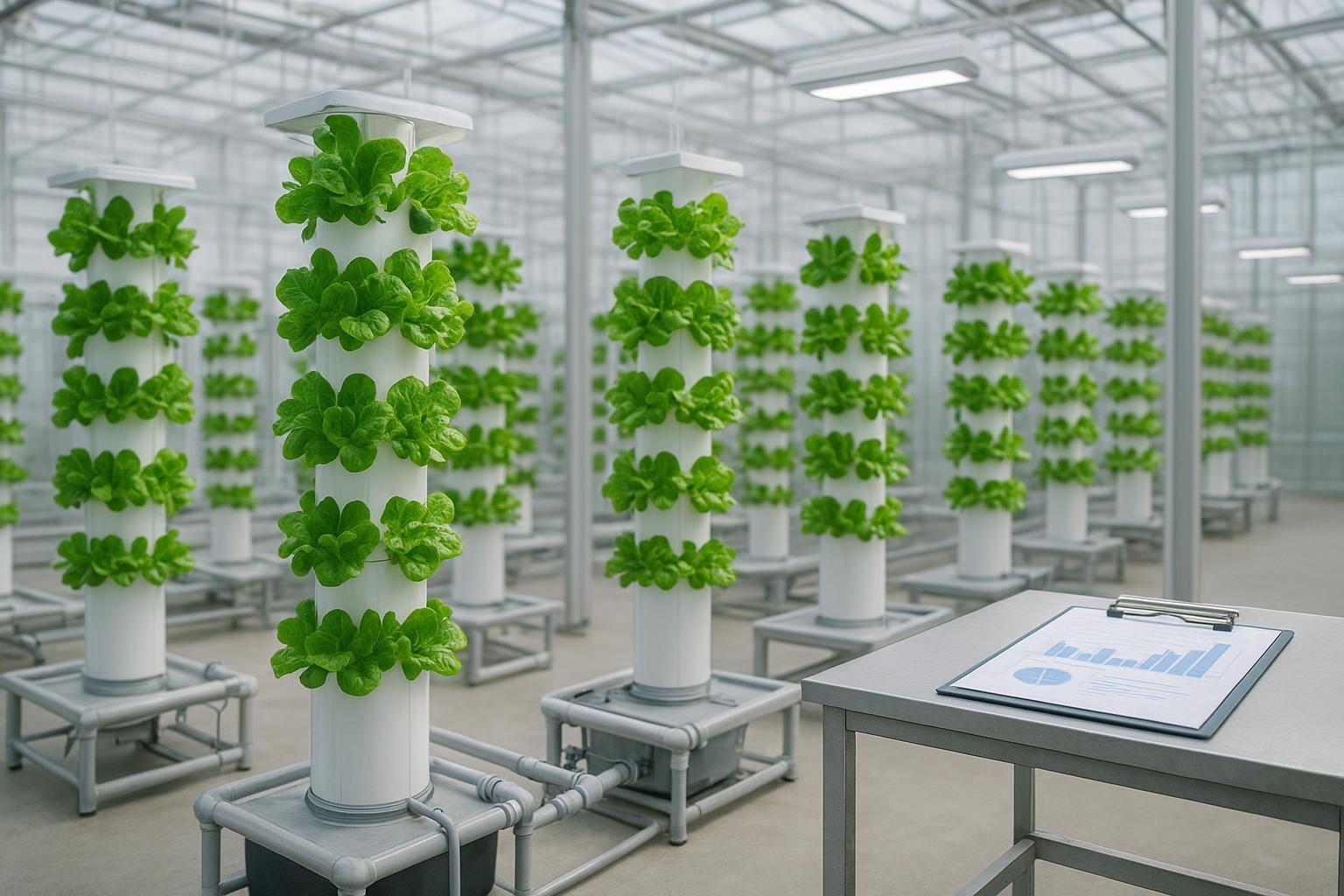
Evaluating a hydroponic tower project isn’t just about the sticker price of a tower kit. For a serious pilot (10–30 towers) or a scale-up plan (100+ towers), the right question is: what’s the total cost to own and operate the system for years—and at what risk? In other words, what’s your full-stack cost per kilogram of saleable produce and how sensitive is it to electricity, yield, wage rates, and downtime?
This ultimate guide dissects Hydroponic Tower Cost from the ground up—equipment (CAPEX), electricity, nutrients, water, labor, and maintenance—using replicable math and current, citable anchors for the U.S., EU, and U.K. It also provides three practical DIY tower pathways at $200, $500, and $1,000. Wherever we reference time-sensitive inputs (like power prices), we state the period and source so you can update your model later.
Time window for data in this guide: latest sources published through February 2026 (see inline anchors). Crop scope: leafy greens and herbs in recirculating vertical/tower configurations under greenhouse or indoor conditions.
Last updated: February 27, 2026
Methods (how to use this guide): This guide is a modeling framework with time-stamped, citable anchors. Where numbers vary by site (electricity, wages, yields, and downtime), we give ranges and show the unit math so you can swap in your measured values.
Vendor examples: Any brand or product mentioned is used only as an illustrative example. No endorsement is implied, and you should validate specifications and performance with current datasheets and on-site measurements.
Key takeaways
Hydroponic Tower Cost must be modeled as TCO: CAPEX amortization plus OPEX (electricity, nutrients, water, labor, maintenance), not just kit price.
Electricity assumptions should be region-specific and time-stamped. As a working anchor, the U.S. commercial sector has averaged around the mid‑teens cents per kWh in late 2025 per the Energy Information Administration; EU and U.K. business rates trend higher in recent periods—always run sensitivity bands of ±25–50% using current data from authoritative publishers such as the U.S. EIA, Eurostat, and the U.K. government series.
Water use in modern recirculating leafy‑green systems is typically an order of magnitude lower than field production; credible studies place it roughly in the mid‑teens to mid‑20s liters per kilogram, depending on setup and climate, which keeps water OPEX modest but relevant for dehumidification load estimates.
Labor frequently dominates OPEX in smaller or less automated operations; plan for rigorous SOPs and, at scale, selective automation to push $/kg down and stabilize quality.
DIY hydroponic towers are viable and educational. Entry ($200), advanced ($500), and near‑commercial ($1,000) builds can produce real food, but reliability, food safety, and uptime hinge on parts quality, sanitation, and electrical safety.
Hydroponic Tower Cost framework and defensible assumptions
Hydroponic Tower Cost = CAPEX amortized across a planning horizon + OPEX. The core OPEX buckets are electricity, nutrients, water, labor, and maintenance/consumables. For commercial decision‑making, you’ll also track packaging, distribution, QA, and overhead, but this guide focuses on the production system itself.
Electricity price anchors (update in your locale/time):
United States (commercial sector): The Energy Information Administration provides end‑use updates with recent averages in the mid‑teens cents per kWh around December 2025, as shown in the agency’s Electricity Monthly Update released in February 2026; consult the exact commercial figure on the EIA page at publication time for precision. See the U.S. EIA’s summary on the end‑use update pages for current numbers and historical context: the publisher’s Electricity Monthly Update — End‑Use (2026‑02‑24 release) is the canonical source: Energy Information Administration — Electricity Monthly Update, End‑Use.
European Union (non‑household): Eurostat reported roughly €0.1899/kWh including non‑recoverable taxes (second half of 2024). The agency’s Electricity price statistics article is the authoritative landing: Eurostat — Electricity price statistics (2024 update).
United Kingdom (non‑domestic): Government series summarized by the ONS placed business rates at about 25.97 p/kWh in Q4 2024. Verify current quarters using the government’s data portal: UK Government — Quarterly Energy Prices collection.
Water and yield anchors to convert ingredients into $/kg and to anticipate dehumidification:
Greenhouse recirculating lettuce water use has been documented near the tens of liters per kilogram; Barbosa and colleagues reported about 20 ± 3.8 L/kg under greenhouse hydroponics compared with far higher field baselines: Barbosa et al. (2015) — Water use in hydroponic vs. field lettuce.
A separate recirculating lettuce study reported water‑use efficiency around 0.071–0.073 kg/L (≈ 13.7–14.1 L/kg). Treat this as a secondary cross‑check (verify applicability to your crop, climate, and system boundaries) and rely on the broader 14–25 L/kg range plus your own measurements for decisions: Abdelhamid et al. (2025) — Recirculating hydroponics water‑use.
Yield ranges for vertical systems vary by configuration and cultivar. For modeling, meta‑analysis and vertical‑vs‑horizontal trials offer bounded expectations; use conservative midpoints and stress‑test your ROI against low‑yield cases. See, for example, the vertical yield advantage reported in 2016 trials and broader CEA lettuce meta‑analysis in 2023: Touliatos et al. (2016) — Vertical vs horizontal floor‑area yields and Gargaro et al. (2023) — CEA lettuce meta‑analysis.
Assumptions & data anchors (quick reference)
| Input (what you'll plug into your model) | Working anchor or range | Region / scope | Period (time-stamped) | Why it matters | Source |
|---|---|---|---|---|---|
| Electricity price (commercial average) | Use current local rate; run ±25–50% sensitivity | United States (commercial) | Dec 2025 (released 2026-02-24) | Lighting, HVAC/dehu, and pumps are typically the largest controllable OPEX lever | U.S. EIA – Electricity Monthly Update |
| Electricity price (non-household) | ≈ €0.1899/kWh (incl. non-recoverable taxes) | European Union (non-household) | 2H 2024 | Region-specific OPEX anchor for EU scenarios | Eurostat – Electricity price statistics |
| Electricity price (non-domestic) | ≈ 25.97 p/kWh | United Kingdom (non-domestic) | Q4 2024 | Region-specific OPEX anchor for UK scenarios | UK Government – Quarterly Energy Prices |
| Water use (recirculating lettuce) | ~14–25 L/kg (working range) | Leafy greens/herbs in recirculating hydroponics | Multi-study range | Converts nutrient $/L → $/kg and helps estimate latent load | Barbosa et al. (2015) |
| Water-use efficiency (secondary anchor) | 0.071–0.073 kg/L (≈ 13.7–14.1 L/kg) | Recirculating lettuce study | 2025 (verify) | Cross-check on same order of magnitude; treat as secondary anchor | Abdelhamid et al. (2025) |
| Yield anchors (context, not guarantees) | Use conservative midpoints; stress-test low-yield cases | Vertical / CEA lettuce outcomes | 2016, 2023 | Yield assumptions dominate $/kg and payback | Touliatos et al. (2016); Gargaro et al. (2023) |
Note on water-use citations: The Barbosa (2015) figure is a stable peer-reviewed anchor for greenhouse hydroponics. The 2025 study above is included as a secondary cross-check; verify applicability to your crop, climate, and system design, and rely on the overall 14–25 L/kg range (plus your own measurements) for decisions.
How hydroponic towers work (and why cost modeling needs the physics)
A tower system lifts nutrient solution from a reservoir to the top of vertical grow columns. The solution trickles or sprays past root zones and returns to the reservoir in a closed loop. That loop has two primary energy drivers: the pump that overcomes total dynamic head (TDH) and the lighting plan (if greenhouse light is insufficient) that achieves target Daily Light Integral (DLI). A third, often hidden, driver is HVAC/dehumidification, because plants transpire the same water you must later remove from the air.
Pump power (conceptual) follows irrigation physics: Water horsepower (WHP) ≈ (GPM × TDH in feet × specific gravity)/3960. Brake horsepower adds pump and motor inefficiencies; multiply by 746 to convert horsepower to watts. With duty hours per day, you have pump kWh/day. For lighting, kWh/day is simply fixture power (kW) × photoperiod hours; the art is choosing the right PPFD/DLI and fixture efficacy (µmol/J) to hit crop targets without waste. Dehumidification load maps back to transpiration: every kilogram of water vapor you must remove requires roughly 2,500 kJ of latent heat handling and some electrical work in the dehumidifier or HVAC.
Pump sizing primers: practical guidance from Upstart Farmers and ZipGrow; for power math, agricultural extensions explain WHP/BHP relationships in irrigation pump selection: Upstart Farmers — Pump sizing and NDSU Extension — Irrigation Water Pumps.
Lighting optimization: consider leafy‑green DLI bands in the ~12–17 mol/m²/day range and evaluate fixture efficacy and optics using peer‑reviewed horticultural lighting studies, e.g., Frontiers review on greenhouse lighting optimization (2021).
CAPEX — itemized components, ranges, and lifecycles
You’ll want to structure CAPEX as a bill of materials (BOM) plus soft costs and then amortize each line by realistic service life. Typical categories for 10–30 towers (pilot) and 100+ towers (scale):
Towers and plant hardware: Columns or modular tower sections, plant sites, internal distribution hardware/drippers, and optional rotation features. Service life often 5–10 years for food‑grade polymer towers under greenhouse conditions; UV exposure outdoors reduces that life unless stabilized.
Pump(s) and reservoir(s): Duty‑rated submersible or inline pump, sized for total dynamic head and redundancy (keep a spare on the shelf); covered reservoir(s) with bulkhead fittings, unions, and a sight tube. Small submersible pumps in 24/7 service can last 1–3 years; size your amortization accordingly and plan proactive replacements around 12–24 months in pilots.
Lighting (where needed): LED fixtures specified by target PPFD/DLI. Track system wattage, driver replacements (often 5–10 years for quality gear, but check warranty and L90 claims), and mounting hardware.
Dosing, sensing, and controls: pH/EC meters, dosing pumps, data logging, and simple automation (timers, relays, smart plugs, or a small controller). pH probes frequently last 1–2 years with good care; budget calibration solutions and spares.
Plumbing and filtration: Manifolds, valves, hose barbs, unions, inline strainers/filters. Include a filter element replacement program to protect emitters.
Racking/frames and installation: A‑frames or racks, fasteners, anchors, labor to assemble and align, and optional wheel kits for mobility.
Electrical work and permitting: GFCI outlets, drip‑loop‑friendly cable runs, weather‑protected enclosures where splashes are possible; consult local codes and a licensed electrician for permanent installs.
Contingency: 10–15% for your first build; this falls as your team standardizes.
A practical approach is to model two towers per pump at pilot scale (to limit blast radius if a pump fails) and to consolidate to higher‑efficiency pumps at scale with carefully engineered manifolds and isolation valves.
OPEX — electricity, nutrients, water, labor, maintenance
Electricity
Pumps: Estimate average draw from duty cycles, not plate ratings. If a 90 W pump actually averages 75 W at your TDH and runs 24/7, that’s 0.075 kW × 24 = 1.8 kWh/day per pump. Multiply by pump count and price per kWh.
Lighting: If each tower needs 100 W of LED power for 16 hours/day to supplement greenhouse light, that’s 1.6 kWh/day/tower. In a 30‑tower pilot, lighting alone contributes 48 kWh/day. If you’re fully indoor, lighting dominates and must be planned with DLI and fixture efficacy in mind.
HVAC/dehumidification: Convert estimated transpiration (which tracks your water‑use L/day) into latent load. If the crop transpires 300 L/day across your system, you’re handling ~300 kg/day of water vapor. Removing that moisture requires significant energy; dehumidifiers and HVAC with heat‑recovery can improve kWh per liter removed. Always monitor real‑world runtime and amperage to calibrate your model.
Nutrients
Use a recipe‑driven method: pick a target EC band (e.g., 1.6–1.8 mS/cm for lettuce grow‑out), translate to g/L of salts for macro and micro elements, look up current prices per kilogram of each salt from a reputable supplier, compute $/L of working solution, and multiply by liters consumed per kilogram of produce. Penn State Extension’s nutrient solution programs provide authoritative baselines and calculators for formulation: Penn State Extension — Nutrient Solution Programs and Recipes.
Branded concentrates vary by dilution and are convenient but can be costlier per liter of working solution. Price them the same way: $/L concentrate → mL/L working solution → $/L working → $/kg produce based on L/kg benchmarks. Revisit your choices when buying in 25 kg bags vs. 1 L bottles.
Water
With modern recirculating systems, water OPEX is usually modest. Here’s the unit chain so you can audit the math:
$3.50 per 1,000 gal = $0.0035/gal
1 gal ≈ 3.785 L → $0.0035/3.785 ≈ $0.00092/L
At 20 L/kg, water makeup cost ≈ 20 × $0.00092 = $0.018/kg (excluding sanitation purges)
However, water use drives dehumidification load. Even if water is cheap, the latent load isn’t—and it shows up on your electricity bill. Treat any dehumidification estimate as a first-pass model until you validate with real runtime, amperage, and liters removed (equipment COP and climate matter).
Labor
Map labor to tasks: seedling propagation, transplant, pruning/trellising (for herbs), daily checks and data logging, harvesting, QA, and pack‑out. Labor share in CEA can be 20–30% of COGS at maturity and considerably higher in small, manual pilots. Industry and educational sources consistently flag labor as a dominant cost driver in small hydroponic operations. See, for example, a DOE Better Buildings analysis lens on CEA costs: DOE Better Buildings — CEA operations notes.
Maintenance and consumables
Include filter elements, sanitation chemicals (e.g., peracetic acid or hypochlorite as per food‑safety guidance), pH/EC calibration solutions, replacement probes (budget 1–2 years lifespan), spare pumps, emitter/unions, and occasional tubing replacement.
Probe maintenance expectations from instrument makers (Hanna, Bluelab, Atlas Scientific) are clear: calibrate regularly and replace when drift persists despite proper care: Hanna Instruments — pH electrode lifespan and care, Bluelab — Care and calibration, Atlas Scientific — When to replace pH probes.
Scenario modeling — 10, 30, and 100+ towers
Anchor your model to towers, then roll up to projects. For illustration, consider conservative, mid, and high cases for yield and power price. Keep a small, readable table for a single sensitivity axis; your downloadable model should handle multidimensional what‑ifs.
Example: electricity sensitivity for a 30‑tower supplemental‑light greenhouse pilot
Assumption | Low | Mid | High |
|---|---|---|---|
LED power per tower | 80 W | 100 W | 120 W |
Photoperiod (h/day) | 14 | 16 | 18 |
Price ($/kWh) | 0.12 | 0.18 | 0.25 |
kWh/day (lighting) | 33.6 | 48.0 | 64.8 |
$/day (lighting) | $4.03 | $8.64 | $16.20 |
Interpretation: at 30 towers, lighting OPEX can swing 4× across plausible settings. This is why “Hydroponic Tower Cost” must be framed with sensitivity analysis, not single‑point estimates.
For 100+ towers, economies of scale appear in procurement (better per‑unit CAPEX), process (labor per tower falls), and energy (optimized layout reduces wasted light; manifolds reduce pump count). But risk concentration rises; redundancy, spares, and monitoring become mandatory line items.
DIY hydroponic tower — three realistic tiers
DIY is often the fastest route to hands‑on understanding of OPEX drivers and maintenance realities. If you want a step‑by‑step walkthrough focused on construction, see Building a hydroponic tower. For a vendor‑neutral plan with a clear bill of materials, the Oklahoma State University Extension also offers a well‑documented vertical tower build: see OSU Extension — Building a Vertical Hydroponic Tower (HLA‑6724).
Tier A — Entry ($200 target)
Concept: Minimal tools, accessible materials, and a simple timer. Expect to hand‑mix nutrients and test pH/EC with strips or a basic pen. Reliability is fair if you respect sanitation and check daily.
Core BOM highlights: vinyl fence post (tower body), 3″ PVC pipe for the feed, net pots, small submersible pump (~300–400 GPH class), plastic tote as reservoir with lid, mechanical timer, flexible tubing, and a few fittings. Reuse safe food‑grade containers where possible.
Assembly notes: Cut planting pockets carefully, deburr edges, and seal penetrations. Use a bulkhead fitting for the reservoir outlet to avoid siphon accidents. Provide a drip loop on every cord. Keep all electrical on a GFCI outlet and off the floor.
Performance: Suitable for leafy greens and herbs. Keep expectations modest for uniformity and uptime; visit the system daily. Sanitize weekly.
Tier B — Advanced maintainable ($500 target)
Concept: Same core as Tier A but upgrade everything you’ll eventually wish you had: better pump with headroom, inline filter to protect emitters, unions and valves for quick service, a sturdier reservoir with a proper bulkhead, and a more accurate pH/EC meter.
Core BOM upgrades: duty‑rated pump, inline strainer (e.g., 100–200 mesh), unions and isolation valves, a silicone‑sealed lid with access port, hose clamps, and a reliable pH/EC combo pen with calibration solutions. Consider a basic Wi‑Fi smart plug for alerts and schedule.
Assembly notes: Add a removable manifold for cleaning. Color‑code or label your lines and record flow rates after commissioning. Introduce a written sanitation SOP with a rotating schedule for lines and reservoir.
Performance: Higher uptime and serviceability. You’ll still hand‑dose nutrients but with better control; daily checks remain essential.
Tier C — Near‑commercial ($1,000 target)
Concept: Prioritize uptime, maintainability, and food safety. Introduce dosing pumps for pH and nutrients (at least A/B base additions), a simple controller or data logger, float valves for reservoir makeup (where code allows), and better plumbing. Use food‑safe materials and keep a spare pump.
Core BOM upgrades: peristaltic dosing pumps (two to four channels), pH and EC probes with calibration kit, a small controller or Wi‑Fi plugs with rules and alarms, quick‑disconnects, isolation valves, bulkhead‑mounted level indicator, and a sanitation kit (brushes, dedicated totes, labeled chemicals). If indoors, add a purpose‑built LED bar with known efficacy and a measured photoperiod.
Assembly notes: Mount electrical in a splash‑resistant enclosure. Route cables with drip loops. Install a high‑water and low‑water cutoff if possible. Document firmware versions, calibration logs, and SOPs for staff handover.
Performance: Substantially improved reliability and data fidelity. This tier teaches habits that scale to 10–30 towers and beyond.
Food safety and electrical safety apply to all tiers. Work near water demands GFCI protection, drip loops, and, for permanent installs, a licensed electrician. Food safety in hydroponic greenhouses requires sanitation cycles, water testing, and worker hygiene consistent with extension guidance: see Virginia Tech Extension — Hydroponic greenhouse food safety.
ROI, TCO, and payback with transparent math
Here’s a replicable approach for cost per kilogram (COGS) and payback:
Compute monthly CAPEX amortization by component: for example, towers over 7 years, pumps over 2 years, LEDs over 7–10 years depending on warranty, sensors over 2 years. Add a reasonable residual or replacement cycle for drivers and probes.
Compute monthly OPEX: electricity by subsystem (pumps, lights, HVAC/dehumid), nutrients using $/L working solution × L/kg yields, water and sewer by local tariff × consumption, labor by task and FTE, and maintenance consumables.
Estimate monthly output: kg of saleable produce based on your plant count, target fresh weight per plant, cycle length, and loss rate (shrink, QC rejects). Use conservative, mid, and high scenarios.
COGS/kg = (Monthly amortized CAPEX + Monthly OPEX) / Monthly kg output. Run sensitivity on power price, wage rate, yield per plant, and failure rate.
Payback = Total CAPEX / Monthly net margin, where net margin = (Average realized sell price $/kg − COGS/kg) × kg/month. Present a range rather than a single number; avoid guarantees.
Yield references to anchor ranges (convert to your tower’s footprint and site count): peer‑reviewed work in vertical systems indicates strong potential versus horizontal layouts, but real farms must discount for learning curves, downtime, and climate. See Touliatos et al. (2016) for comparative floor‑area yields and Gargaro et al. (2023) for lettuce outcomes in controlled environments. Always document assumptions in your model notes.
Practical, neutral example — pump power using a representative tower spec
As a neutral, real‑world reference point, imagine a single commercial tower column similar in form factor to those offered by SPRINGS FAITH (modular vertical towers with closed‑loop recirculation). Suppose your pilot loop serves 10 such towers with a single inline pump and a reservoir at floor level. The manifold rises 2.5 m to reach the distribution header, with minor losses adding the equivalent of 0.5 m for a total dynamic head of roughly 3.0 m (≈ 9.8 ft). Target initial flow is 3 gallons per hour per tower (GPH/tower) for leafy‑green trials, so 10 towers require 30 GPH (0.5 GPM) at 9.8 ft TDH.
Using the water horsepower relationship, WHP ≈ (GPM × TDH ft)/3960. That is (0.5 × 9.8)/3960 ≈ 0.00124 HP at the water. Assume 45% combined pump + motor efficiency at this tiny duty point; brake horsepower ≈ 0.00275 HP. In watts, that’s roughly 2.75 × 746 ≈ 2,050 mW or about 2 W. Real‑world selection will be higher due to pump curve realities and part‑load inefficiency, so you might select a 40–60 W pump and expect perhaps 15–30 W average draw at your flow and head. If it runs 24 hours, pump energy is roughly 0.36–0.72 kWh/day. At $0.18/kWh, that’s $0.06–$0.13/day for this 10‑tower circuit.
Practical note: At very low flows, the final wattage is often dominated by the pump curve and part‑load behavior (not the idealized WHP math). For any investment decision, treat this example as illustrative and validate with a plug-in watt meter (or panel submeter) on your actual loop.
Two lessons drop out of this example:
Pumping energy for short, low‑head loops is modest; don’t overspend on over‑sizing, but do budget for spares and isolation design.
Lighting and dehumidification usually dominate electricity cost, so optimize DLI and latent load control first.
For sizing methods and sanity checks on flow/TDH assumptions, see agricultural and CEA primers on pump selection and flow targets: Upstart Farmers — Pump sizing for hydroponics/aquaponics and NDSU Extension — Irrigation Water Pumps (WHP/BHP math). For leafy‑green light planning, align with peer‑reviewed DLI/PPFD guidance such as the horticultural lighting reviews that translate efficacy and spectrum into production outcomes: Frontiers review on greenhouse lighting optimization (2021).
Case snapshots — what operators learn the hard way
Pilot to 30 towers (success path): A greenhouse operator started with 12 towers, supplemental LED bars (100 W/tower, 14 h/day), and manual nutrient dosing. After commissioning, they instituted weekly sanitation and daily EC/pH logging. Over three months, uniformity improved and COGS/kg fell by ~12% as harvest loss dropped. Energy usage matched projections within 10%. Key move: adding inline filtration prevented emitter clogs that had been stalling growth on two columns.
Early scale attempt at 100+ towers (challenge path): Another team consolidated too many towers on a single pump without isolation valves. When maintenance hit, they had to shut down an entire section. Latent load was also underestimated; dehumidification ran constantly, raising kWh/kg by 18% over plan. Their corrective actions—adding manifolds with unions, installing a second dehumidifier with higher coefficient of performance, and revising the DLI schedule—brought costs back into an acceptable band.
These stories aren’t prescriptions, but they expose universal levers: redundancy, filtration, sanitation discipline, realistic latent load planning, and measured lighting.
Compliance, safety, and risk management
Electrical near water: Use GFCI‑protected circuits, drip loops on all cords, elevated power strips or enclosures, and weather‑resistant covers where splashes or humidity are expected. Permanent installations should be inspected by a licensed electrician and meet local codes.
Food safety: Follow greenhouse hydroponic sanitation SOPs, test water routinely, and maintain worker hygiene standards consistent with recognized guidance. For a practical reference, see Virginia Tech Extension — Hydroponic greenhouse food safety and sanitation.
Outage planning: Pumps and controllers need continuity. A small UPS can ride through brief outages; longer blackouts require a generator plan. Practice restart procedures so you’re not writing an SOP in the dark.
FAQs
What’s the biggest hidden cost in Hydroponic Tower Cost models?
Latent load and dehumidification. People often account for lighting and pumps but ignore the energy required to remove plant‑generated moisture.
How often should I replace pH probes in commercial service?
Many instrument makers suggest typical lifespans of 1–2 years with proper storage and regular calibration. Watch for drift or failure to hold calibration as signs to replace. See manufacturer care guides for details.
Is water cost meaningful in recirculating systems?
Makeup water cost is usually small per kilogram of produce, but water use drives latent load, which drives electricity costs. Don’t dismiss water just because the bill is low—model the knock‑on effects.
What’s a sane starting DLI for lettuce under LEDs?
Mid‑teens mol/m²/day (e.g., 12–17) is a common starting range reported in horticultural lighting literature. Tune with crop feedback and avoid overshooting—excess light becomes heat and kWh without proportional yield gains.
Do DIY towers pay back?
In most cases DIY is a learning platform rather than an ROI machine. If your goal is commercial supply, use DIY to learn and de‑risk, then standardize on reliable, maintainable designs at pilot scale before leaping to 100+ towers.
Glossary (quick)
DLI (Daily Light Integral): Total photons received per square meter per day, measured in mol/m²/day.
PPFD (Photosynthetic Photon Flux Density): Instantaneous photon flux at the canopy, µmol/m²/s.
EC (Electrical Conductivity): Used as a proxy for total ion concentration in nutrient solution.
TDH (Total Dynamic Head): Effective height the pump must overcome including friction losses.
WHP/BHP (Water/Brake Horsepower): Power at the water vs. input to the pump/motor; BHP accounts for inefficiencies.
COP (Coefficient of Performance): Efficiency metric for HVAC/dehumidifiers; higher COP means less electricity per unit of heat removed.
kWh/kg: Energy consumed per kilogram of saleable produce; a useful KPI for CEA benchmarking.
L/kg: Liters of water consumed per kilogram of produce; useful for OPEX and latent-load planning.
Next steps
If you’re planning a 10–30 tower pilot, build your cost model now with conservative yield and aggressive electricity sensitivity, then validate with real meters and logs for 60–90 days; for a specification reference when you’re ready to compare commercial‑grade options, you can contact SPRINGS FAITH to request current tower and pump/reservoir specifications to plug into your model.
References and data anchors cited in this guide
Electricity prices: Energy Information Administration — Electricity Monthly Update, End‑Use (Dec 2025; released 2026‑02‑24); Eurostat — Electricity price statistics (2H 2024); UK Government — Quarterly Energy Prices collection.
Water/yield: Barbosa et al., 2015 — Hydroponic greenhouse lettuce water use; Abdelhamid et al., 2025 — Recirculating lettuce WUE; Touliatos et al., 2016 — Vertical vs horizontal yields; Gargaro et al., 2023 — CEA lettuce meta‑analysis.
Pump and lighting methods: Upstart Farmers — Pump sizing for hydroponics/aquaponics; NDSU Extension — Irrigation Water Pumps; Frontiers review — Greenhouse lighting optimization (2021).
Nutrients and food safety: Penn State Extension — Nutrient Solution Programs and Recipes; Virginia Tech Extension — Hydroponic greenhouse food safety;
Instrument care: Hanna Instruments — pH electrode lifespan, Bluelab — Care and calibration, Atlas Scientific — Replace pH probes.
Related Posts
 Hydroponic vs Aeroponic Towers (2026): Which System Is Better for Your Plants?
 What Can You Grow in a Hydroponic Tower? 15 Best Plants for Vertical Growth