
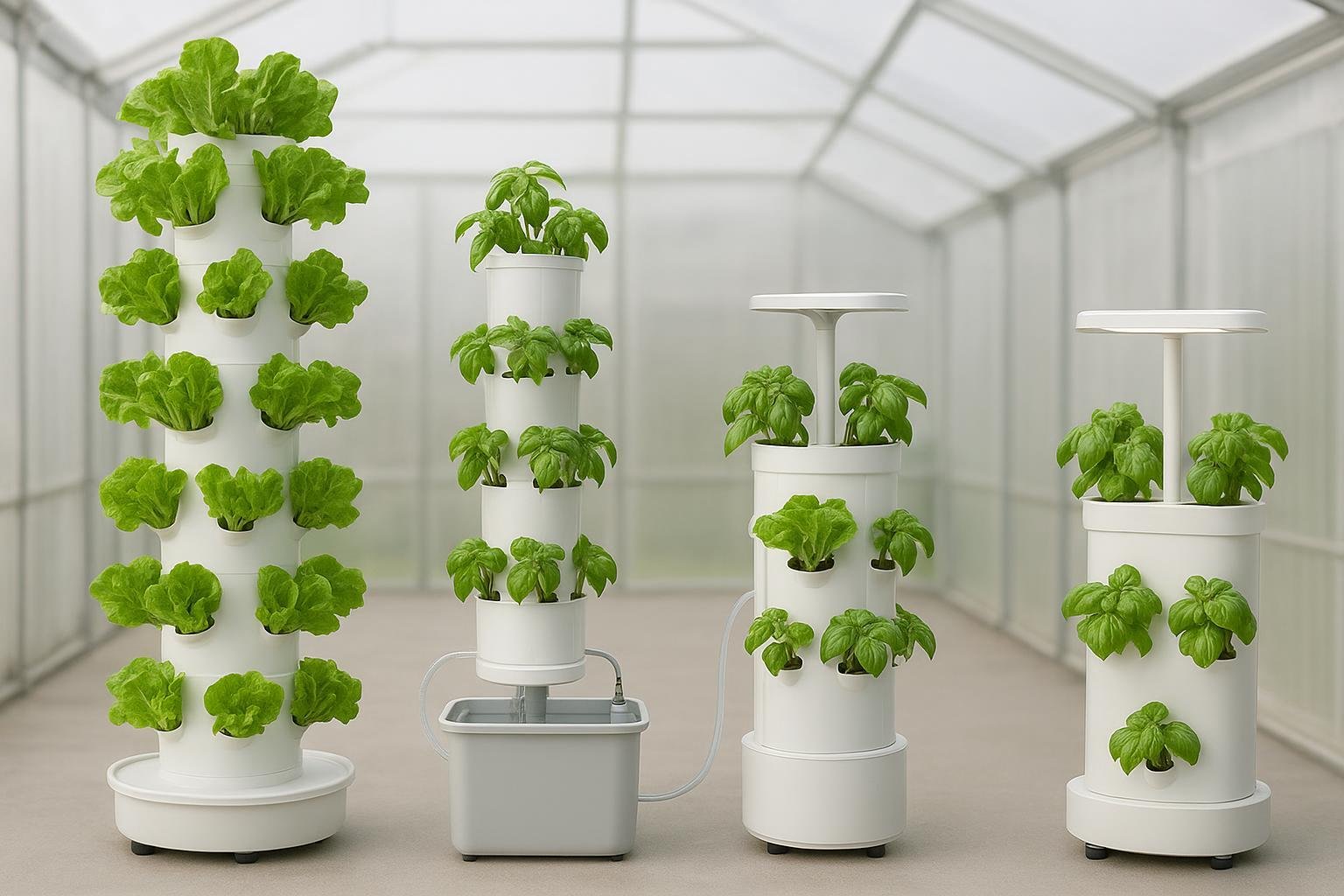
You’re weighing significant CAPEX with tight OPEX targets, limited floor space, and audit requirements. This comparison distills what matters for commercial and institutional buyers: yield density and crop uniformity, total cost of ownership (CAPEX + OPEX), reliability and maintenance burden, modular scalability and footprint efficiency, and food-safety operations. Because multiple products target different segments, we use scenario-based recommendations rather than a single “best overall.”
Key takeaways
Scenario-first beats brand-first: the right hydroponic tower depends on your yield-per-square-meter goals, labor model, energy rates, and audit needs. A one-size-fits-all winner would be misleading.
Greenhouse yield density: Tower Garden/Tower Farms regular and high-density arrays offer high plant-site counts per tower and established deployments; strong choices when maximizing plant sites per m² with predictable workflows.
Commercial reliability and linear scaling: SPRINGS FAITH emphasizes closed-loop water efficiency, stable operation, and modular growth—well-suited to expansion roadmaps where uptime and standard service clearances matter.
Turnkey containerization: ZipGrow’s ZipPod provides a packaged environment with known electrical/climate loads and a posted price, simplifying remote or harsh-climate deployments.
Low-risk pilots and training: Aerospring and Gardyn bundle lighting/enclosures/apps for indoor starts; Lettuce Grow’s compact footprint helps where space is at an absolute premium.
Pricing is volatile in 2026: most commercial offerings are quote-based and vary by region, shipping, and accessory bundles. Treat the ranges here as directional and validate before procurement.
Quick verdicts by scenario
| Scenario | Top Pick | Why It Fits |
|---|---|---|
| Max plant sites per m² in a greenhouse | Tower Garden / Tower Farms | High plant-site density per tower and proven multi-row deployments support m² output and predictable labor. |
| Modular commercial scaling with uptime focus | SPRINGS FAITH | Closed-loop stability, commercial-grade components, and modular expansion support consistent service clearances. |
| Containerized, climate-controlled production | ZipGrow (ZipPod) | Turnkey container with defined electrical/HVAC envelope and published pricing simplifies deployment and financing. |
| Indoor pilot, education, or small training lab | Aerospring or Gardyn | Integrated lighting, enclosures, and apps reduce setup complexity and operator error for pilot programs. |
| Ultra-compact prosumer footprint | Lettuce Grow (Nook / Original) | Tight footprint with tiered plant counts and straightforward operation for constrained spaces. |
Full comparison of leading hydroponic tower systems
Two notes before the table: 1) Public, vendor-verified numbers for yield (kg/m²), water intensity (L/kg), and energy (kWh/kg at target DLI) are limited; use the TCO modeling guidance below to adapt assumptions. 2) Price ranges and configurations shift frequently; confirm inclusions (lighting, sensors, dosing, installation) in quotes.
| Product | Target Segment | Plant Sites per Unit | Reservoir / Pump | Footprint & Layout | Automation & Monitoring | Deployment Envelope | Compliance & Sanitation | Price Scope | Best For |
|---|---|---|---|---|---|---|---|---|---|
| SPRINGS FAITH Commercial Hydroponic Tower System | Commercial greenhouse / urban farm | 24 sites in <1㎡ (model dependent) | 10-gallon reservoir; closed-loop circulation | Modular towers; scalable rows | Timer-based circulation; lighting integration | Greenhouse / indoor | Food-grade PP materials | Quote-based | Commercial scaling |
| Tower Garden / Tower Farms | Commercial greenhouse | 28–52 sites; high density | ~50L reservoir; submersible pump | Multi-row layouts | Timer control; fertigation & lighting | Outdoor / greenhouse | BPA-free; SOP required | Quote-based | High-density greenhouse |
| ZipGrow (Towers + ZipPod) | Containerized turnkey | Up to 240 towers per unit | Integrated irrigation system | Container or rack-based layout | Sensors optional | Harsh-climate capable | Clean-in-place steps | Premium pricing | Turnkey container farm |
| Aerospring (Indoor/Outdoor) | Pilot / Education | 9–27 sites | 13-gallon bucket | Freestanding compact kits | Bundled lighting | Indoor / Outdoor | Food-grade plastics | Retail pricing | Low-risk pilot |
| Lettuce Grow Farmstand | Prosumer / Education | 18 / 24 / 36 sites | ~9 gallon; 75W pump | Ultra-compact footprint | Optional lighting | Indoor / Outdoor | Consumer-grade | Consumer tiers | Compact pilots |
| Gardyn Studio / Home | Prosumer | 16–30 sites | Integrated reservoir | 1.4–2 sqft footprint | App controlled | Indoor only | Consumer safety | Financing options | Indoor smart growing |
Product capsules
SPRINGS FAITH — commercial hydroponic tower system
SPRINGS FAITH focuses on water-efficient closed-loop circulation, commercial-grade components, and modular tower architecture designed to scale linearly with consistent service clearances. This orientation supports predictable maintenance windows and uniform crop quality for leafy greens and herbs. Learn more on the SPRINGS FAITH homepage.
Pros: emphasizes circulation stability and uptime; modular rows aid expansion planning; compatible with standard dosing/sensor stacks.
Constraints: public, A-level spec sheets (pump models/flow, EC/pH stability logs, MTBF tables) are not widely published; pricing is quote-based with regional variance.
Tower Garden / Tower Farms
Regular towers offer roughly 28–52 plant sites depending on sections, while high-density configurations can exceed 100–196+ sites per tower. Operators often cite low pump wattage with duty cycling, which supports predictable energy baselines in greenhouse contexts. Pump guidance is detailed by Agrotonomy’s operations content—see the explanation of a widely used 45 W pump and timing cycles in the 2024–2025 range in the article on pump duty cycles for Tower Farms.
Pros: strong plant-site density; broad deployment history; simple timer-based irrigation; predictable workflows in rows.
Constraints: consolidated manufacturer spec PDFs for farm towers are not always public; reservoir volumes vary by region (a UK FAQ references ~50 L) and accessories/lighting are add-ons you must scope explicitly—see the UK Tower Garden FAQ for a regional reference.
ZipGrow (Towers + ZipPod container)
ZipGrow’s vertical towers run drip irrigation with overhead emitters and recirculation, while the ZipPod provides a defined 40-foot container with integrated nursery, fertigation, lighting, HVAC, and power envelope—listed at a posted price point, helpful for financing and pro forma modeling. Review the container specs and listed price on the official ZipPod page.
Pros: turnkey container simplifies deployment; manuals document cleaning steps; integrator-friendly for sensors and controls.
Constraints: audited yield-per-area and food-contact certifications aren’t prominently published online; per-tower site counts vary by deployment and need quoting.
Aerospring (Indoor/Outdoor, plus Pinch)
Aerospring packages indoor/outdoor towers with lighting and accessories for low-complexity starts. The Pinch model centers on a 13-gallon bucket with UV-stable plastics and an indoor kit including full-spectrum lights (availability and final retail details vary as models iterate).
Pros: bundled lights reduce setup friction; approachable for pilots and training; clear parts kits.
Constraints: long-horizon commercial certifications and audited yield/energy data are limited; MSRPs shift by model and region; verify availability.
Lettuce Grow Farmstand (Original & Nook)
The Original offers 18/24/36 sites on a 22-inch footprint for tight spaces, while the Nook provides 20 sites with integrated lighting and an ~9-gallon tank—useful where an ultra-compact footprint matters. See Nook specifications on the official Nook overview.
Pros: very compact; fast to set up; optional subscriptions streamline seedlings and nutrients.
Constraints: consumer-focused materials rarely include audit-grade certificates; long-cycle commercial throughput is limited by scale and ergonomics.
Gardyn (Studio 2/Home 4)
Gardyn emphasizes app-driven automation with cameras, sensors, and guided care cycles. Studio 2 accommodates 16 plants in about 1.4 square feet, making it a tidy pilot or education platform. Explore the product details on the Gardyn Studio 2 page.
Pros: strong software layer; integrated lighting/watering; compact indoor footprint.
Constraints: indoor-only; commercial audit requirements typically exceed consumer documentation; throughput per m² is modest compared to greenhouse towers.
How hydroponic tower systems work in commercial settings
At heart, a hydroponic tower recirculates nutrient solution through vertical grow sites, bathing roots on timed cycles. Think of it like a well-tuned heartbeat: short, regular pulses keep roots oxygenated and fed without drowning them. Stable EC/pH, balanced flow rates, and even distribution across levels are what separate consistent harvests from tip-burn and patchy heads. Most commercial operators pair towers with greenhouse sunlight or high-efficacy LEDs to hit a target daily light integral (DLI) for lettuce and herbs.
Flow and stability: Many farms run submersible pumps on timers (e.g., minutes on/off) to maintain root moisture and DO without overheating solutions. A closed-loop with adequate reservoir volume dampens swings in EC/pH.
Lighting pairings: For indoor or shoulder seasons, plan LEDs around DLI targets (common lettuce range ~14–18 mol/m²/day) and efficacy assumptions (e.g., 2.8–3.2 µmol/J) to model kWh/kg.
Sanitation cycles: Between crops, clean-in-place steps, smooth food-contact surfaces, and accessible internals keep biofilm in check and support audit readiness.
TCO and ROI modeling (5-year view)
A practical TCO stack includes: equipment (towers, pumps, reservoirs, lights), installation and commissioning, energy (pumps + lighting + HVAC where applicable), water and nutrients, labor (seeding, harvest, sanitation), spares/consumables, and training/support. For ROI, model three scenarios—pilot (e.g., 20 towers), production (e.g., 200 towers), and containerized (e.g., one ZipPod)—then sensitivity-test yield, crop price, and energy rate assumptions.
Example assumptions to pressure-test:
Energy: model pump duty cycles using nameplate wattage and on/off schedules; for LEDs, use your local $/kWh and DLI targets.
Water: start with closed-loop baselines and meter real cycles (L/kg) for your crops and climate.
Labor: log hours per batch for seeding, transplanting, harvest, and changeover; this is often the swing factor.
Yield: record kg per tower and normalize to kg/m² per cycle to compare layouts fairly.
Tip: Build a simple calculator with toggles for greenhouse vs indoor, DLI targets, labor rates, and crop prices to avoid optimistic overreach.
Food safety and sanitation
For audited buyers, specify and verify: food-contact materials and any third-party certifications (e.g., NSF statements where applicable); accessible, smooth surfaces without dirt traps; documented clean-in-place procedures; and traceability support for seed-to-sale records. Ask vendors for SOP templates, material datasheets, and maintenance schedules, and ensure your team trains to those documents. Even when consumer systems look tidy, they may not come with the documentation auditors expect—build that into your vendor due diligence.
Reliability and maintenance
Uptime is a function of component quality, spares strategy, and SOP discipline. Look for commercial-grade pumps/valves with published duty expectations, accessible manifolds and filters, and parts lists you can stock locally. Define maintenance windows per week and per harvest cycle (filters, sanitation, sensor checks), and set changeover standards so crews can clean and reassemble towers with consistent results. If you’re scaling, prioritize systems that keep service clearances and workflows consistent from 20 to 200+ towers—your labor model will thank you.
How to choose and migrate
Start with your constraint: space, labor, or energy. If you need maximum plant sites per m² in a greenhouse and you’re comfortable with timer-driven irrigation and row ergonomics, high-density Tower Farms arrays are a strong baseline to evaluate. If you prioritize predictable uptime and linearly scalable layouts with standard service clearances, evaluate modular commercial towers such as SPRINGS FAITH with an eye on closed-loop stability and documented SOPs. If you need a packaged, climate-controlled environment with a posted price, a ZipGrow ZipPod can simplify financing and deployment.
Migrating from rack/NFT: map your water loop (reservoirs, filtration, dosing), lighting DLI targets, and sanitation cadence first. Pilot a small tower block to validate labor standards and harvest uniformity, then grow in increments that preserve your aisle and service clearances. Document what changes in your SOPs and retrain crews before each scale step.
FAQ
What hydroponic tower gives the highest yield per m² for leafy greens?
In greenhouse contexts, high-density Tower Farms arrays are commonly selected when the priority is plant-site density per m² and predictable row workflows. Public, vendor-verified kg/m² figures are scarce; treat site counts as a proxy and validate with harvest logs. For pump energy reference, see Agrotonomy’s explanation of a widely used 45 W pump and duty cycles in their 2024–2025 article on Tower Farms pump duty cycles.
How much water does a commercial hydroponic tower use per kg of lettuce?
Published liters-per-kg figures are limited. Start with a closed-loop baseline and meter actual cycles; reservoir size hints at damping capacity (e.g., Tower Garden regional FAQs reference ~50 L per unit) but not consumption. Use your meters and batch records, and reference the UK Tower Garden FAQ to see an example of official reservoir guidance.
What’s a realistic 5-year TCO comparison?
Build three models—pilot, production, and containerized—with sensitivity tests on yield, price per kg, energy, and labor. Use posted prices where available (e.g., ZipGrow’s ZipPod lists a container price on the official ZipPod specs page) and confirm what’s included (lighting, installation, dosing, training) before finalizing pro formas.
Which systems fit an ultra-compact, indoor pilot?
Consumer-oriented towers are compact and app-guided. Lettuce Grow’s Nook (20 sites, integrated lights, ultra-tight footprint) and Gardyn’s Studio 2 (16 sites with strong app support) are frequent picks for education or small pilots; see the Nook overview and the Gardyn Studio 2 page for official specs.
Methodology and sources
We prioritized primary sources (official product pages, manuals, and vendor blogs) and used scenario-based recommendations to reflect distinct target segments. Quantitative gaps (kg/m², L/kg, kWh/kg) were handled via modeling assumptions you can adapt to your site. Key references include Agrotonomy’s pump duty-cycle article (2024–2025), Tower Garden’s UK FAQ for reservoir context, ZipGrow’s ZipPod specs and price page, Lettuce Grow’s Nook overview, and Gardyn’s Studio 2 product page. All prices, bundles, and specifications are subject to change in 2026; confirm with vendors before procurement.
Related Posts
 Hydroponic vs Aeroponic Towers (2026): Which System Is Better for Your Plants?
 What Can You Grow in a Hydroponic Tower? 15 Best Plants for Vertical Growth
 Hydroponic Tower Cost Analysis: Is It Worth the Investment? (Plus DIY Options)