As a leading Hydroponic Tower Manufacturer, we often receive inquiries from commercial vertical farming investors asking: “Can I save money by using standard fertilizers like Miracle-Gro in my system?” While cutting operational costs is essential for any business, using non-specialized nutrients is a “false economy.” Our engineering tests prove that unsuitable fertilizers do more than just lower your yield—they actively destroy your hydroponic tower system and hardware infrastructure.
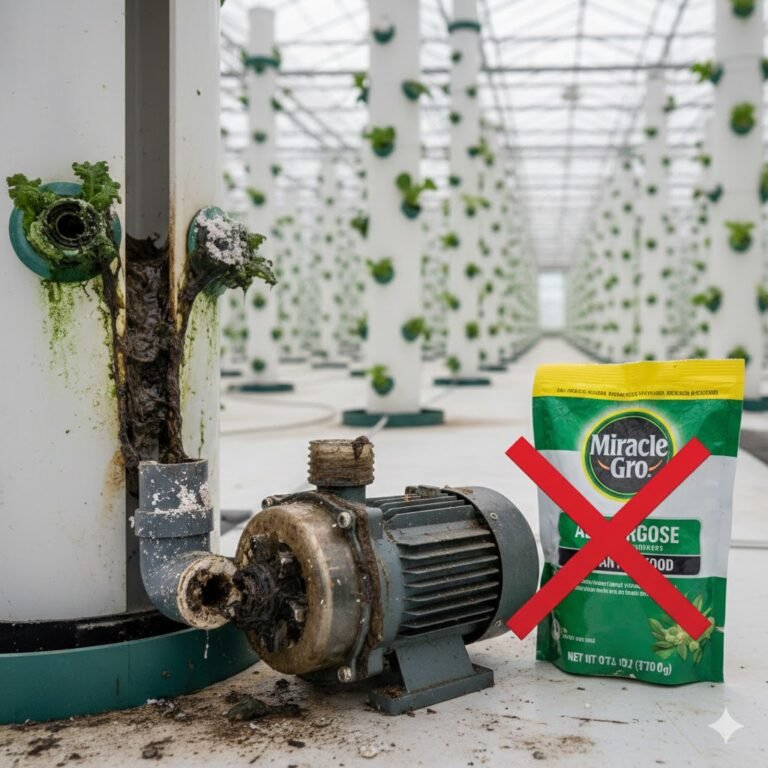
Figure 1: Equipment damage observed by our technical team: (Left) Algae and biofilm in a vertical pipe, (Center) A pump seized by mineral deposits, (Right) Incompatible soil-based fertilizer.
Here are the three “invisible killers” that cheap fertilizers unleash on the systems provided by a professional Hydroponic Tower Manufacturer:
1. Salt Accumulation: The Silent Threat to Commercial Vertical Farming
Traditional soil fertilizers contain high levels of non-water-soluble salts and impurities. In a recirculating vertical system, these substances trigger a destructive reaction:
The Scaling Effect: As water evaporates, insoluble salts form a rock-hard calcified layer on the pump impeller and internal bearings.
Hardware Impact: This increases friction and operating temperature, eventually leading to motor burnout. For any commercial vertical farming operation, a single pump failure can cause the dehydration and death of an entire row of crops within hours.
2. Urea-Induced Biofilm: The "Arterial Clogs" of Pipelines
Most budget fertilizers utilize Urea as a nitrogen source. In a vertical tower system—which lacks soil microbes—urea cannot be efficiently converted into plant-available nutrients. Instead, it becomes a breeding ground for harmful bacteria.
Biofilm Outbreaks: Urea stimulates the growth of thick, slimy biofilm inside the delivery pipes and distribution plates of your hydroponic tower system.
Clogged Nozzles: The precision of vertical farming relies on uniform dripping. Biofilm clogs these small orifices, leading to “dry spots” where plants receive zero water.
3. pH Volatility and Material Degradation
Professional-grade hydroponic nutrients contain expensive Buffering Agents designed to maintain chemical stability. Cheap fertilizers lack these, causing the system’s pH to swing wildly.
Commercial Operator’s Insight: “You are buying a production tool, not a disposable commodity.” Saving $100 on fertilizer could result in the premature failure of $5,000 worth of hardware.
💡 Expert Advice: How to Protect Your Investment?
Stick to 100% Water-Soluble Nutrients: Ensure the nitrogen source is primarily Nitrate Nitrogen, not Urea.
System Flush Protocols: Perform a clear-water cycle every 4-6 weeks to dissolve and remove residual salt buildup.
Monitor Hardware Health: Regularly inspect pump filters for slime or white mineral crusts to ensure the longevity of your commercial vertical farming setup.
About Us
As a premier Hydroponic Tower Manufacturer, we provide more than just high-quality hardware. We deliver comprehensive sustainable production solutions for commercial growers worldwide, ensuring your commercial vertical farming project is both profitable and durable.
Looking for our “Vertical Farm Maintenance Manual” or a wholesale quote? [→Contact Our Engineering Team Today ]

 Hydroponic vs Aeroponic Towers (2026): Which System Is Better for Your Plants?
 What Can You Grow in a Hydroponic Tower? 15 Best Plants for Vertical Growth
 Hydroponic Tower Cost Analysis: Is It Worth the Investment? (Plus DIY Options)