
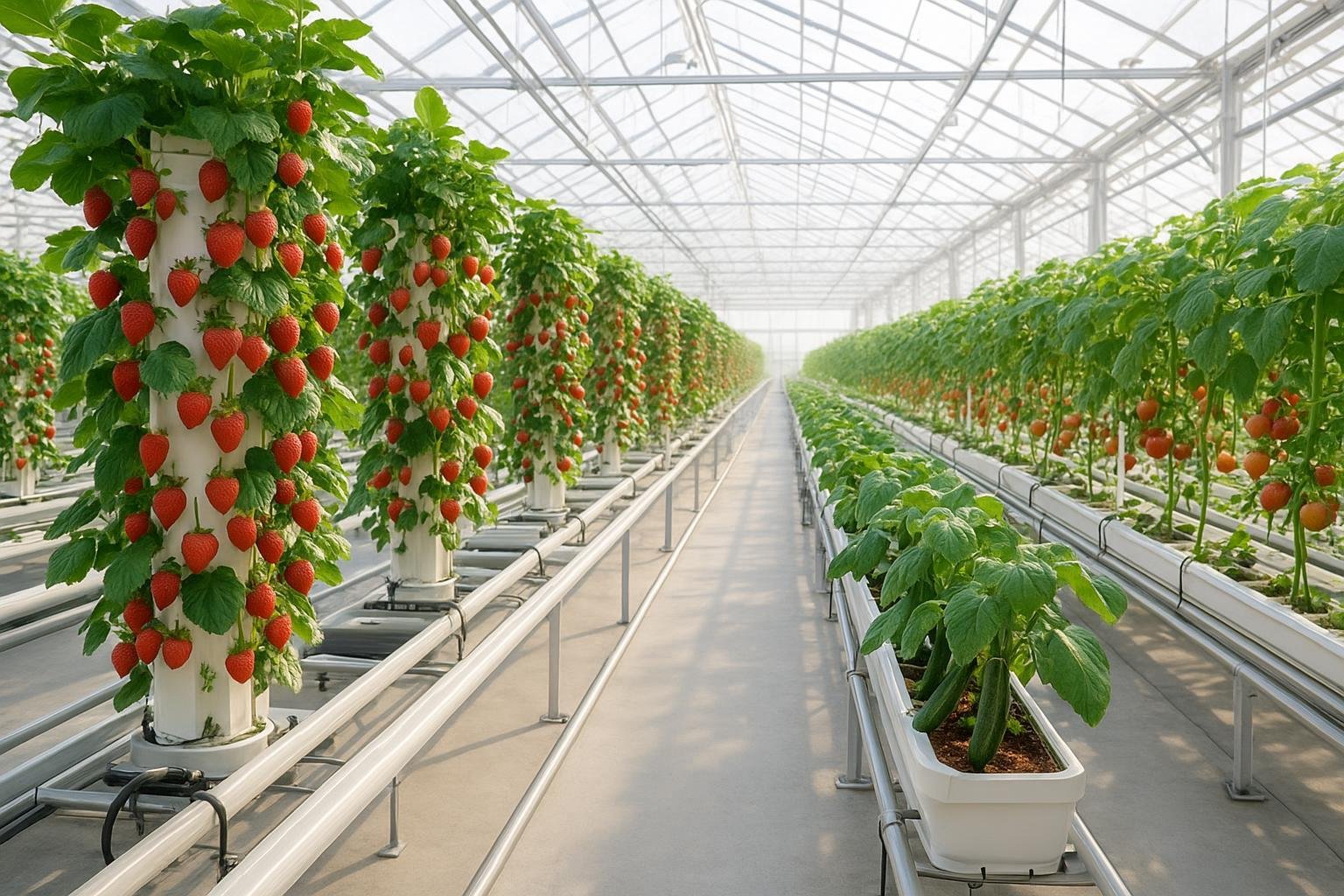
If you’re running a greenhouse or vertical farm in 2026, fruiting crops can be a smart way to diversify beyond leafy greens—provided you choose the right systems, cultivars, and SOPs. This guide cuts through hobby advice to focus on what matters commercially: yield per area and cycle speed, market demand, energy and water efficiency, labor intensity, and system compatibility across towers, NFT, and Dutch buckets. Where numbers exist, we cite them; where they don’t, we share operational guardrails you can use today. For macro context on potential area-use efficiency in stacked systems, see the USDA ARS overview of vertical farming describing significant gains for suitable crops under controlled environments.
Scope and assumptions (read this first): The DLI, EC, and pH ranges in this guide reflect common starting bands used in controlled-environment hydroponics (greenhouses and vertical farms). Your optimal setpoints will vary with cultivar, substrate vs. water culture, climate strategy, water quality, and whether you run recirculating or drain-to-waste fertigation. Treat these numbers as planning inputs—not performance guarantees—and calibrate them with local extension guidance and your own crop logs. For food safety, worker safety, and crop protection products, follow your local regulations and integrated pest management requirements.
Key takeaways
Strawberries are the most tower-friendly choice, offering compact architecture, fast time to first harvest, and strong demand. Evidence from high-tech trials shows continual yields under optimized lighting and fertigation.
Tomatoes deliver high revenue potential but demand heavy labor and strong support; they fit Dutch buckets or slab culture best.
Cucumbers shine in NFT with parthenocarpic cultivars that remove pollination labor and show strong water-use efficiency in studies.
Peppers are steady performers with moderate labor; compact types can work in towers with added support but typically prefer Dutch buckets.
Blueberries are feasible in acidic soilless culture for advanced operators; treat them as a long-horizon perennial rather than a quick ROI play.
Quick decision matrix: which hydroponic fruits fit towers, NFT, or Dutch buckets
Strawberries
Best fit: Towers and NFT (Dutch buckets: possible but usually not necessary)
Why it fits: Compact crowns suit vertical density; steady flow supports root oxygenation.
Labor/pollination notes: Mostly self-pollinating, but bumblebees improve set; expect routine canopy cleaning and runner control.
Tomatoes
Best fit: Dutch buckets (towers/NFT: limited for most commercial tomato programs)
Why it fits: Heavy fruit load and vine architecture need strong trellis support and media buffering.
Labor/pollination notes: High-wire training and weekly pruning are non-negotiable; bumblebees or vibration help stabilize set.
Cucumbers
Best fit: NFT (towers/Dutch buckets: workable with trade-offs)
Why it fits: Continuous flow and high root oxygenation in NFT support fast throughput.
Labor/pollination notes: Parthenocarpic cultivars reduce pollination labor; trellising and pruning for airflow are still required.
Peppers
Best fit: Dutch buckets (towers: possible for compact types with added support)
Why it fits: Bushy habit and fruit mass pair well with drip-to-media control and stable root-zone volumes.
Labor/pollination notes: Mostly self-pollinating; gentle vibration or bumblebees can increase uniformity; prune to open the canopy.
Blueberries
Best fit: Containers with drip fertigation (towers/NFT: generally poor fit)
Why it fits: Shrub architecture and strict pH requirements favor containerized, media-based control.
Labor/pollination notes: Lower training needs, but multi-year establishment and tight acidic chemistry management are the real workload.
Strawberry — the tower workhorse for hydroponic fruits in 2026
Strawberries check nearly every commercial box for vertical operations: compact crowns, fast cycles, and premium pricing. They also slot neatly into towers and gutter systems without heroic engineering.
Strawberry yield and cycle. In high-tech trials under optimized lighting and fertigation, day-neutral programs have demonstrated continual winter fruiting and strong area efficiency. A well-documented collaboration reported robust production under LEDs and controlled climates, underscoring year-round potential when conditions are right; the Grodan–Fluence–Wageningen team summarized continual yields in their update.
Light targets and photoperiod. Fruiting strawberry programs commonly aim for roughly 20–25 mol·m⁻²·day⁻¹ DLI in production. Research on LED photoperiods shows significant gains when extending to long days; Park and colleagues found large increases in fruit production under 16-hour photoperiods versus 12 hours in ‘Albion’ strawberries; see Park et al., 2023 for details. For DLI methodology and conversions between PPFD and DLI, see Virginia Tech’s daily light integral explainer.
EC, pH, and fertigation. Operational setpoints often sit near pH 5.5–6.5 (≈6.0 midpoint). EC strategy varies with stage; a practical band of about 1.2–1.8 mS/cm during fruiting is common in tower and gutter operations. Recent CEA strawberry studies highlight the value of dynamic, sensor-guided fertigation over fixed recipes.
Pollination and labor. While many cultivars self-pollinate, bumblebee hives increase reliability, especially in larger bays and low-light seasons. For placement and density in artificially lit houses, follow Koppert’s greenhouse pollination best practices. Routine tasks include EC/pH checks, de-leafing, runner control, and strict sanitation between cycles; Oklahoma State Extension shares practical tower sanitation guidance.
System fit. Excellent in towers or gutters; ensure consistent irrigation, drainage, and airflow. Avoid overcrowding crowns at the same vertical height to reduce humidity pockets and botrytis risk.
Field note (operator checklist): In strawberry towers, the most common preventable yield hit isn’t nutrition—it’s microclimate. If you see persistent condensation inside the canopy, slow-drying leaf surfaces, or uneven airflow between vertical levels, assume you’re building Botrytis pressure. First-response SOPs are usually (1) reduce canopy density (de-leaf/runner control), (2) increase horizontal airflow across the tower face, (3) avoid late-day irrigation that leaves foliage wet overnight, and (4) tighten sanitation between harvest passes. Use scouting notes to track where “humidity pockets” recur and adjust spacing or fan placement accordingly.
Tomatoes — high value, high touch best in Dutch buckets
Tomatoes are revenue drivers but come with exacting labor and support requirements. Treat them as a flagship crop only if your team is trained for high-wire systems and intensive pruning.
Yield and cycle. Peer-reviewed greenhouse studies report roughly 24–32 kg/m² in high-tech operations, with significant drops under salinity or suboptimal regimes. Consider long-cycle programs with continuous harvests and staged replanting for consistent volume.
Light and climate. Commercial tomato programs often target 20–40 mol·m⁻²·day⁻¹ DLI, depending on cultivar and economics. Maintain tight temperature and VPD bands to prevent blossom drop.
EC, pH, and fertigation. pH commonly 5.5–6.5; EC spans about 2–5 mS/cm depending on stage and cultivar in controlled studies. Active monitoring and feedback control improve nutrient-use efficiency compared to fixed setpoints.
Pollination and labor. Bumblebee hives are widely used to stabilize fruit set. Labor includes weekly pruning, cluster management, and drop-and-lean high-wire training—plan capacity at the crop-planning stage.
System fit. Dutch buckets or slab culture are preferred for large-fruited indeterminates thanks to media buffering and robust trellising. Compact cherry or determinate lines can be adapted to towers with auxiliary supports, but this is a niche path rather than a mainstream commercial standard. For system fundamentals, see University of Missouri Extension’s hydroponic farming overview (G6986).
Cucumbers — fast turns and parthenocarpic advantage in NFT
Cucumbers can move quickly from transplant to first pick and maintain steady throughput with the right cultivars.
Yield, water efficiency, and cycle. Comparative research shows higher yields under hydroponic regimes than soil when nutrients are well managed; see Roosta et al., 2025 for an open-access comparative study. Some NFT case studies report water-use efficiency on the order of ~25 L/kg of fruit under optimized conditions, but results are highly sensitive to climate (VPD), cultivar, irrigation strategy, and recirculation/blowdown practices—treat this as a benchmarking reference, not a design spec.
Cultivar selection and pollination. Parthenocarpic, gynoecious lines (e.g., European greenhouse and Beit Alpha types) remove pollination labor and improve uniformity. Trellis to a single or double leader and prune for airflow and ease of harvest.
Light, EC, pH. Many commercial programs operate near pH 5.5–6.5 and EC around 1.8–2.8 mS/cm by stage; confirm with your extension or supplier guidelines. DLI targets commonly fall in the 20–30 mol·m⁻²·day⁻¹ band.
System fit. Strong fit in NFT and gutters, where continuous flow supports oxygenation and stable nutrient delivery. Towers can host compact minis with additional clips and training; Dutch buckets are viable when you prefer media buffering or need to manage root-zone temperature more tightly.
Peppers — consistent set with gentle pollination support
Peppers tend to be steady rather than flashy, offering a longer harvest window and predictable routines when climate and nutrition are stable.
Yield and cycle. Commercial greenhouse programs often run extended harvest windows far beyond field systems, enabling steady weekly output. Build schedules that match market cadence and labor availability.
EC, pH, and salinity management. Productive hydroponic settings often report pH around 5.5–6.0 and EC in the neighborhood of 2.8–2.9 dS/m, with clear growth penalties as salinity rises. Keep a close eye on sodium and chloride accumulation in recirculating systems.
Pollination and labor. Flowers are largely self-fertile, but gentle vibration or bumblebees can increase set uniformity in enclosed houses. Pruning to open the canopy improves airflow and reduces disease pressure.
System fit. Strong fit in Dutch buckets or slabs; compact varieties can be trialed in towers with clips and light trellising. NFT is less common for heavier-fruited cultivars but can be engineered for compact types.
Blueberries — advanced, acidic root-zone specialists
Blueberries are a different beast from the annual vining and bushy fruit crops above. They can work in soilless systems, but success hinges on acidic chemistry and patience.
Timeline and yield profile. Expect a multi-year establishment before meaningful yields. Treat plants as capital assets whose productivity increases with maturity.
Substrate, pH, and fertigation. Blueberries require an acidic root zone—commonly targeted around pH 4.5–5.5 depending on system and media; Penn State Extension outlines pH and establishment practices that translate conceptually to soilless culture with appropriate adjustments. Containerized soilless culture with drip fertigation is standard; keep a close watch on iron and micronutrient availability at low pH.
How to choose your system for hydroponic fruits in 2026
Let plant architecture and fruit mass make the first cut, then map labor, fertigation control, and capex.
Towers maximize vertical density and work brilliantly with compact crowns and moderate fruit mass such as strawberries. They shine when space is constrained, water recirculation is a must, and you’re prepared to enforce rigorous sanitation between cycles.
NFT gutters provide continuous flow and high root oxygenation, which cucumbers love. They also suit strawberry lines that tolerate steady-flow root zones. Because solutions are shared, precision dosing and filtration are critical.
Dutch buckets and slab culture handle heavy vines and fruit loads—your go-to for tomatoes and larger peppers. Individualized containers add buffering and simplify root-zone temperature and EC management at the plant or row level. For fundamentals and system comparisons, see the University of Missouri’s hydroponic farming overview (G6986).
Pollination and IPM playbook for fruiting crops
Pollination in enclosed houses typically relies on bumblebee hives for tomatoes, peppers, and sometimes strawberries and cucumbers. Follow lit-crop guidance on hive orientation, seasonal density, and thermal protection to maintain consistent set across the calendar; Koppert’s best-practice pages provide operational tips.
For IPM, maintain target VPD and avoid persistent leaf wetness, especially in dense canopies. Strict sanitation between cycles, combined with airflow management and scouting, reduces botrytis and powdery mildew pressure. Land‑grant extension primers on hydroponic farming (see Missouri G6986) offer useful operational context and sanitation reminders.
Numbers that matter — ROI inputs for hydroponic fruits
Profitable programs quantify a few variables before the first transplant. Here’s a practical way to turn public pricing data into an ROI model without guessing:
Use the USDA AMS Fruits and Vegetables market news hub to pick the commodity you’re targeting (e.g., strawberries, tomatoes, cucumbers, peppers, blueberries).
In My Market News, filter for the report type that matches your sales path:
Terminal market reports if you sell into wholesale/terminal channels.
Shipping point reports if you sell close to origin or track grower/shipper pricing.
Select a matching package/grade (that’s where pricing spreads usually come from) and record the reported low–high range (or weighted average when provided) as your price band.
Plug that band into a simple sensitivity table: revenue = (expected weekly harvest volume) × (low / mid / high price). Keep the harvest volume assumption separate so you can swap cultivars or densities without rebuilding the whole model.
From there, model energy from your DLI target and fixture efficacy—converting between PPFD and DLI (see Virginia Tech above) lets you compare lighting scenarios apples-to-apples. Track labor for pruning, trellising, pollination checks, harvest, and sanitation, and log water/nutrient costs based on recirculation efficiency and blowdown frequency. Finally, document EC/pH drift trends so your dosing strategy improves over time instead of staying static.
Practical workflow example — configuring a strawberry tower bay
A vertical greenhouse bay assigns towers to day-neutral strawberries. You seed in rockwool, transplant to mesh pots at crown-safe depth, and stage density so crowns aren’t stacked directly over one another. Daily routines include EC/pH checks, quick de-leafing passes, and runner removal. Bumblebee hives are installed per lit-crop guidance, and supplemental LEDs target a production DLI near the low-to-mid 20s. A closed-loop irrigation circuit recirculates nutrient solution through a central reservoir, with weekly sanitation checks and scheduled deep cleans between cycles. A modular tower system such as SPRINGS FAITH supports stackable configurations and closed-loop fertigation while keeping footprint tight; review their specifications to match bay height, plant count, and service access.
Editorial note (how this guide was built)
Evidence-first: When specific numbers are included (e.g., photoperiod effects, study-reported yield bands, or water-use efficiency case figures), they are tied to the cited peer-reviewed or extension sources.
Operational ranges, not promises: Setpoints like EC/pH/DLI are presented as common commercial starting bands and should be validated with cultivar trials and facility-specific logs.
Disclosure: Any product or brand mention is provided as an operational example. If you have a commercial relationship with any vendor, disclose it here; otherwise, state that the reference is non-sponsored. Regardless of brand, comparable system approaches include vertical towers, NFT gutters, and Dutch-bucket/drip-to-media setups.
Selected sources
Related Posts
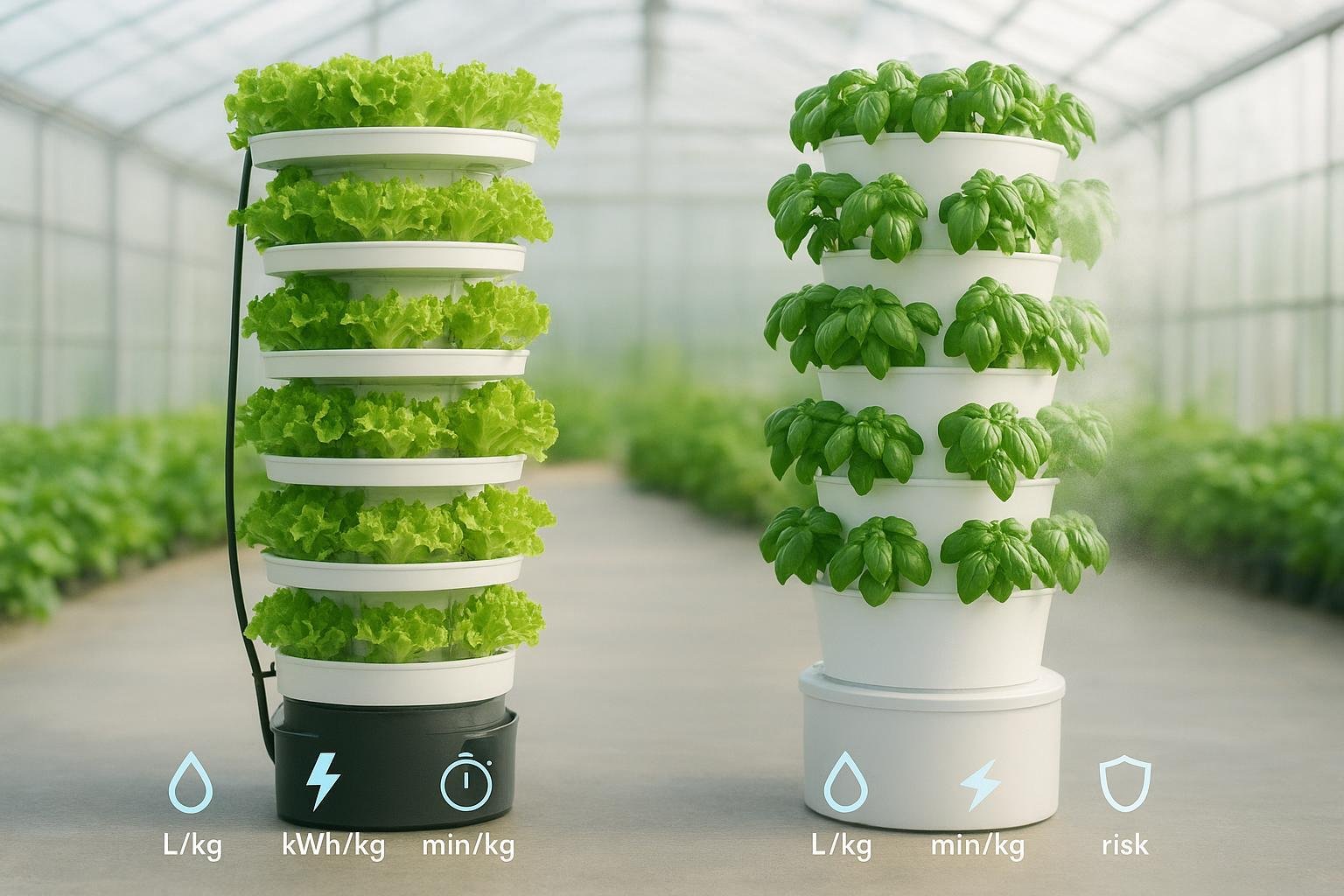 Hydroponic vs Aeroponic Towers (2026): Which System Is Better for Your Plants?
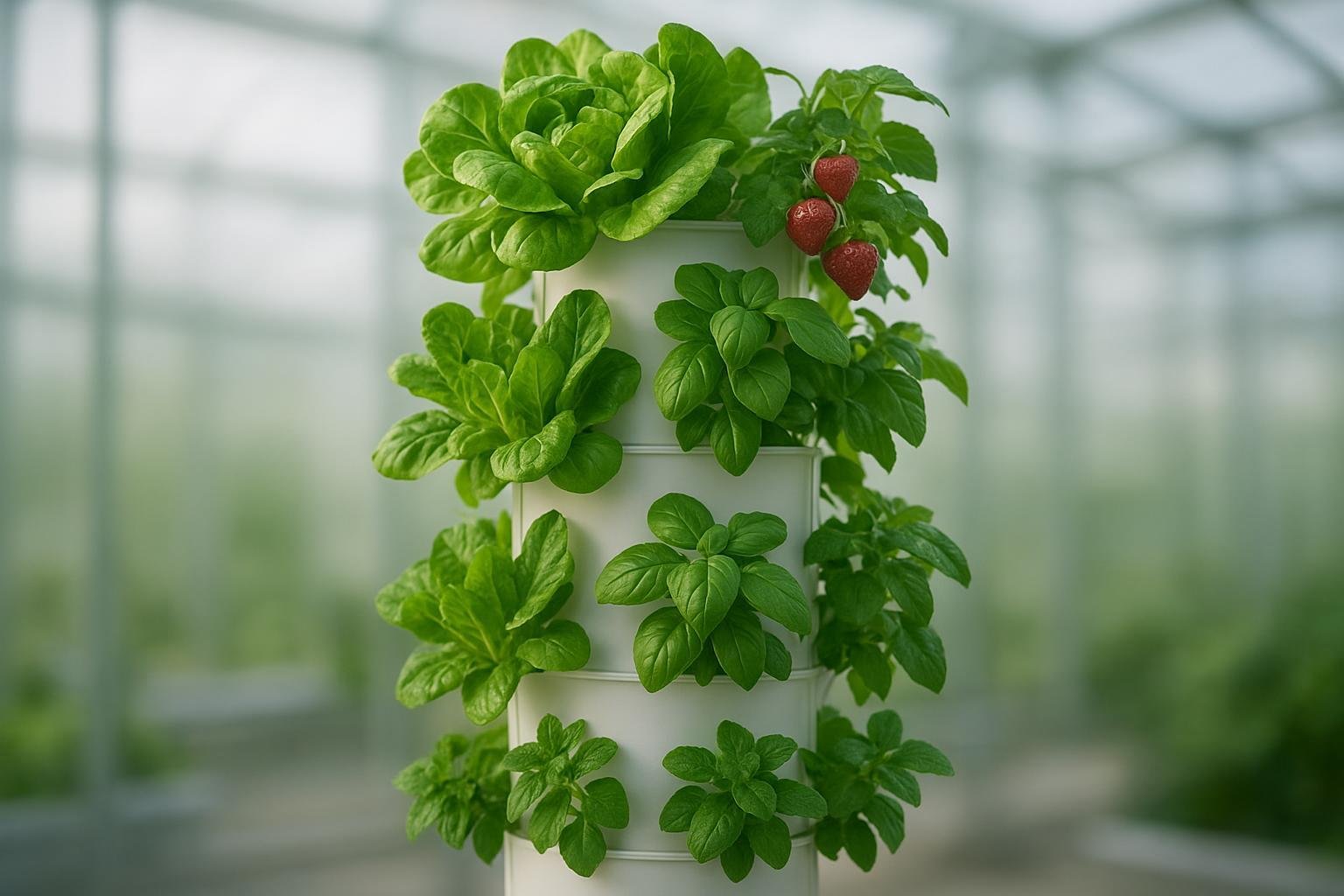 What Can You Grow in a Hydroponic Tower? 15 Best Plants for Vertical Growth
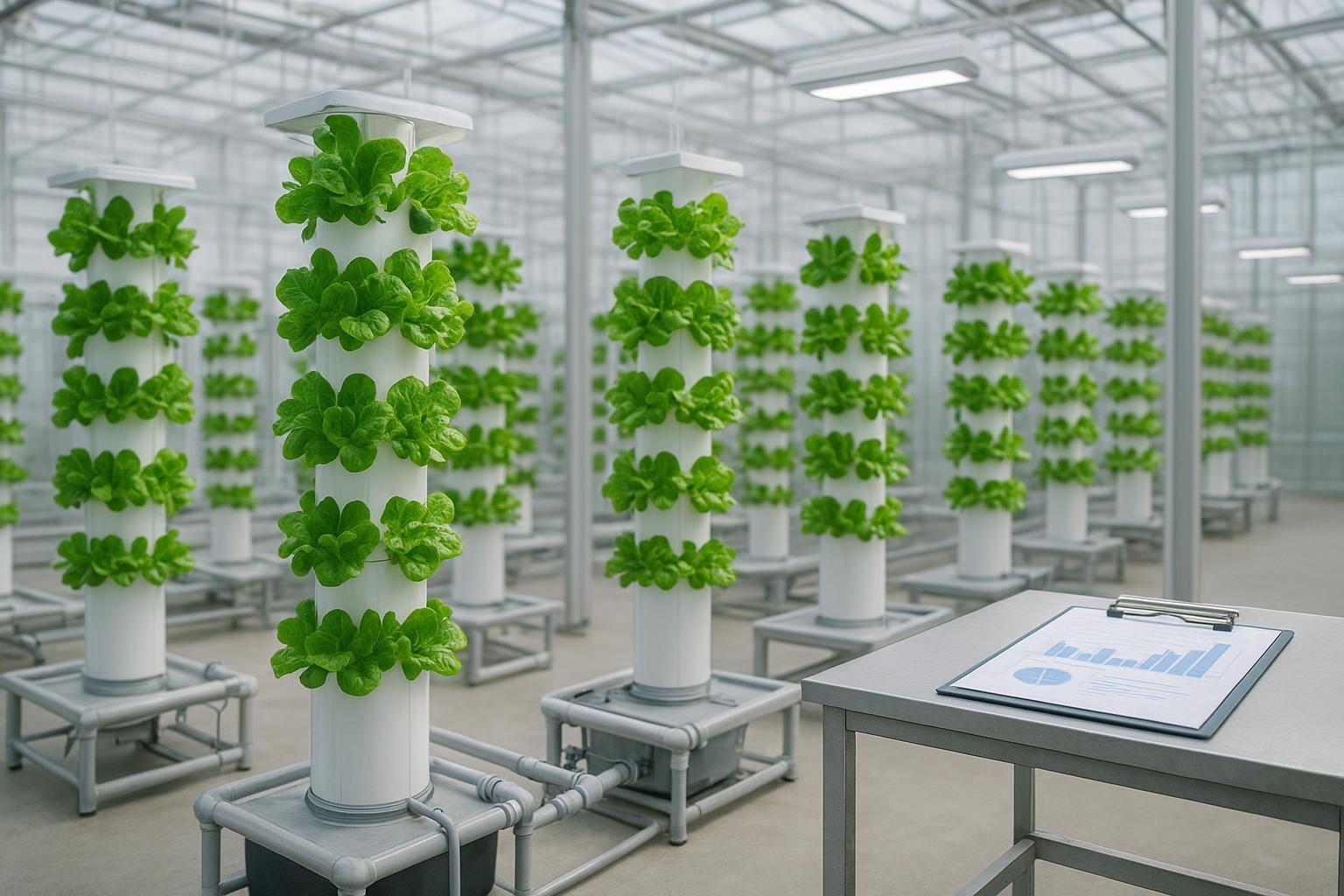 Hydroponic Tower Cost Analysis: Is It Worth the Investment? (Plus DIY Options)