
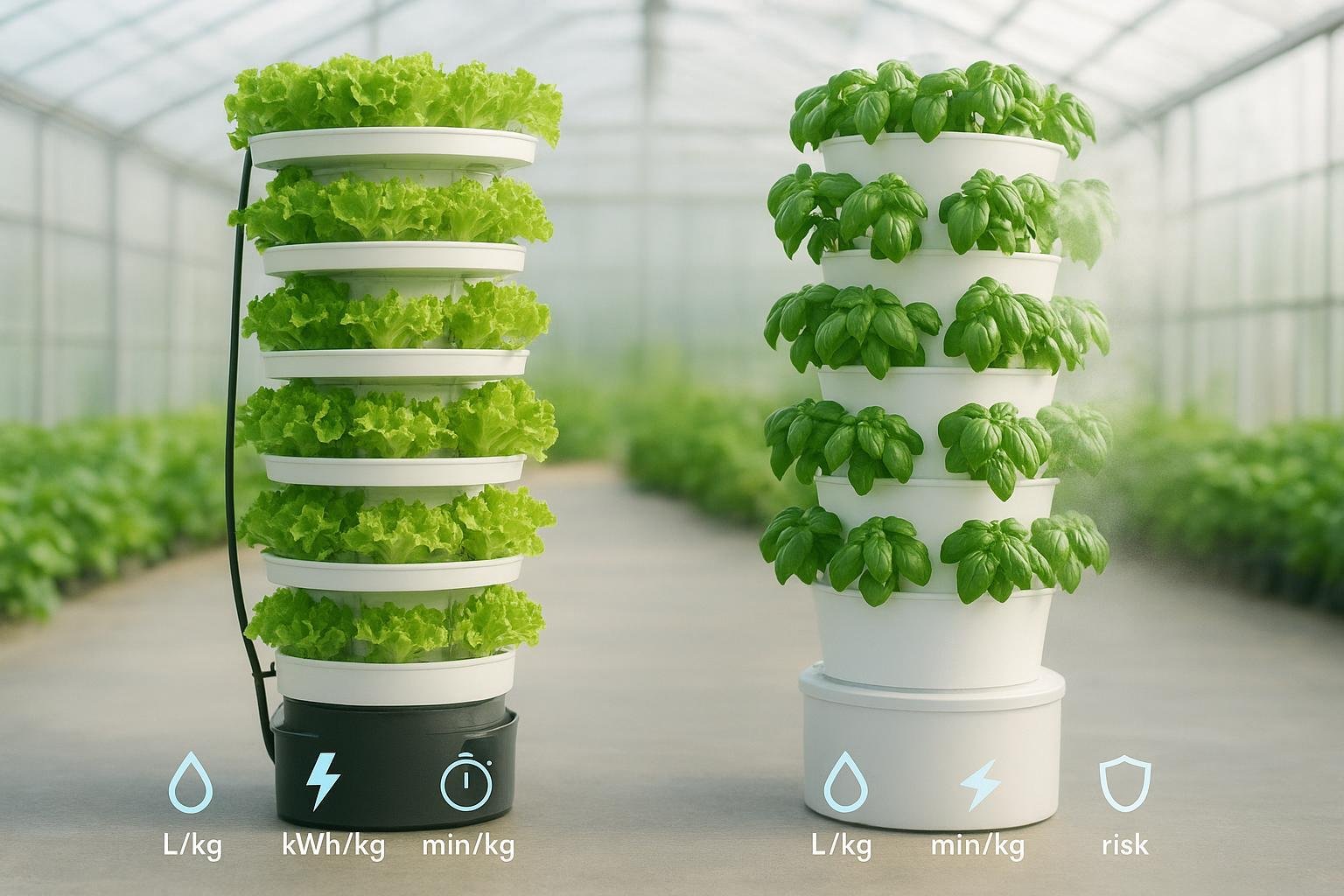
Time scope and pricing note: Specifications, pricing snapshots, and model references in this comparison represent the state of the market as of 2026‑02‑28 and are subject to change by vendors without notice. Always verify the latest data before purchasing.
How this comparison was built (and what it is not): This guide is a methods-first comparison of system types (hydroponic NFT/drip towers vs aeroponic mist towers), not a lab-verified performance ranking of specific brands. Wherever you see numbers, they come from either (1) peer-reviewed syntheses (for broader energy context), or (2) vendor/industry reports that are clearly labeled as directional. For decisions that affect CAPEX or crop risk, the only reliable tie-breaker is a short, metered side-by-side pilot in your own climate using the measurement playbook below.
Disclosure: A single “also consider” example vendor is mentioned later as a related option. It’s included for reader completeness, not as an endorsement, and you should independently verify any performance or pricing claims with current documentation and your own measurements.
TL;DR verdict: Choose by scenario, not hype. If your priority is squeezing the most throughput and water savings from a tight footprint for fast‑turn leafy greens—and you can handle redundancy for outages—an Aeroponic Tower is often the stronger pick. If you need quieter operation, simpler upkeep, and better tolerance to power interruptions—especially for education/home, fruiting crops, or conservative ops—go with a Hydroponic Tower (NFT/drip). In fully indoor farms, lighting/HVAC dominate energy use either way; in greenhouses, pump differences matter a bit more but still trail crop and climate choices.
Key Takeaways
Hydroponics vs Aeroponics is not one-size-fits-all. Match the physics (mist vs film/drip) to your crop physiology and outage tolerance.
Prioritize five decision drivers: yield density (kg/m²/month), water intensity (L/kg), energy per output (kWh/kg), labor per output (min/kg), and downtime/disease risk.
Aeroponic Tower systems can excel on root oxygenation and water intensity for leafy greens, but require mist nozzle maintenance and outage redundancy.
Hydroponic Tower systems (NFT/drip) are typically quieter, simpler to maintain, and more forgiving during power interruptions; they pair well with heavier fruiting crops.
If you’re operating a Hydroponic Tower at home, in a classroom, or in a micro-farm, routine upkeep matters as much as the method choice. For a step-by-step maintenance checklist, see our Hydroponic tower care guide.
For indoor farms, expect lights/HVAC to dominate kWh/kg; pump differences between methods are secondary.
Treat vendor “X% better” claims cautiously. Run a 30‑day, metered pilot before committing capital.
Hydroponics vs Aeroponics and the Tower Garden System: how tower systems actually differ
Hydroponic Tower System (NFT/drip)
What’s happening at the roots: Plants sit in modules or channels where a thin nutrient film flows (NFT) or solution drips through media, bathing roots with moisture while allowing air exchange. It’s steady and forgiving, especially for larger root masses.
Why it works: The continuous film or periodic drip keeps roots moist without starving them of oxygen, provided flow rates and channel geometry are engineered correctly.
Aeroponic Tower System (low‑pressure vs high‑pressure)
What’s happening at the roots: A network of nozzles mists nutrient solution onto aerial roots. The magic is droplet size: true high‑pressure aeroponics (HPA) runs roughly 80–100 psi to produce finer droplets (commonly cited bands ~20–50 µm or 30–100 µm) that cling to roots and maximize oxygen exposure between cycles. Low‑pressure aeroponics (LPA) uses coarser sprays (>~50–100 µm) with simpler hardware and lower cost.
What the literature says: Multiple engineering guides converge on similar pressure/droplet bands for “true” HPA. See the practical overviews on droplet size and pressure by the BTL Liners team in the article Droplet size matters in aeroponics (2024) and the Grozine high‑pressure explainer (2023), which echo NASA-era recommendations summarized in an agroengineering review (Min et al., 2023). Links: the BTL Liners explainer Droplet size matters in aeroponics (2024) and the Grozine HPA overview (2023); the Min et al. 2023 agroengineering review.
References in context
According to the BTL Liners engineering primer Droplet size matters in aeroponics (2024), true aeroponics uses fine droplets commonly in the 20–50 µm range produced by higher pressures and appropriate nozzles: https://www.btlliners.com/droplet-size-matters-in-aeroponics
The Grozine HPA overview (2023) describes typical HPA operation around 80–90 psi with fine droplet formation: https://www.grozine.com/2023/06/12/high-pressure-aeroponics/
Min et al. (2023) in Agroengineering summarize historical recommendations (30–100 µm), framing why droplet size matters for oxygenation and nutrient uptake: https://www.agroengineering.org/jae/article/view/1387/1073
Why this difference matters
Oxygenation vs moisture: Aeroponics exposes roots to more oxygen between mist cycles, which often accelerates growth in fast‑turn leafy greens. Hydro NFT/drip offers a continuous moisture film and tends to better support heavy, complex root masses (e.g., some fruiting crops) with fewer clogging risks.
The five decision drivers (A–E) and how to measure them
This section sets a measurement playbook so you can produce your own apples‑to‑apples results. Keep notes, save logs, and normalize everything to per‑kg outputs.
Evidence gaps to be aware of (and how to close them): Public, tower-specific head-to-head datasets are still thin for (1) kg/m²/month under matched PPFD and plant-site density, (2) net L/kg including top-offs and sanitation flushes, (3) min/kg from time-and-motion SOP logs, and (4) outage survival curves by temperature/RH.
If you want decision-grade numbers, log these fields for each tower and crop cycle: date range; crop/variety; plant sites; footprint (m²); PPFD and photoperiod; reservoir volume; make-up water added (L); flush volume (L); kWh for pumps (and lights/HVAC if indoor, apportioned); harvest mass (kg marketable); labor minutes by task (checks, cleaning, nozzle/filter service, harvest); and any outage events (minutes, temp/RH, recovery notes).
1) Yield density (kg/m²/month)
Definition: Marketable fresh mass per floor area per 30 days, normalized by plant sites and cycle length.
Why it matters: Revenue per footprint is the name of the game in greenhouses and urban micro‑farms.
How to measure: Track per‑plant yield (kg) and cycle time (days). Convert to kg/m²/month using your actual tower footprint and site count per tower.
What we can say today: Vendor and industry sources often report that true aeroponics can accelerate leafy-greens growth thanks to higher root-zone oxygenation. For example, LettUs Grow publishes crop summaries that suggest >20% uplift in some setups; treat this as vendor-reported, directional evidence, not peer-reviewed tower-vs-tower head-to-head data: https://www.lettusgrow.com/aeroponic-crops
Caution: Don’t generalize any % uplift across crops, climates, or tower designs. Until you meter side-by-side under your own lights and climate, treat yield deltas as a hypothesis—not a planning input.
2) Water intensity (L/kg)
Definition: Net water consumed per kg harvested, including top‑offs, evaporative loss, and flushes.
Why it matters: Water can be expensive or scarce; L/kg is a sustainability and OPEX KPI.
How to measure: Install a make‑up water meter on each system’s reservoir line. Log top‑offs and any sanitation flush volumes over a full crop cycle. Divide by kg harvested.
What we can say today: Many industry posts claim aeroponics can reduce water use versus hydroponics, sometimes citing figures around ~30%. As one example, LettUs Grow reports reduced water in their aeroponic setups; this is vendor-reported and not a tower-standard, independently published L/kg protocol: https://www.lettusgrow.com/blog/is-aeroponics-better-than-hydroponics
Caution: L/kg depends heavily on room humidity, mist duty cycles, leak/evap losses, and sanitation flush routines. Treat any % claim as directional until you meter make-up water and flush volume locally.
3) Energy per output (kWh/kg)
Definition: Total electricity for pumps/controls plus, if indoors, lighting and HVAC, all apportioned to the crop mass you harvest.
Why it matters: Energy is a major OPEX driver and critical for TCO/ROI planning.
What the evidence shows: For indoor leafy greens, peer‑reviewed syntheses place many vertical farms around 10–20 kWh/kg in efficient cases, with broader industry averages closer to ~38–39 kWh/kg. Pump loads are typically a small fraction compared with lighting and HVAC. See Lozano‑Castellanos et al. (2023) for energy modeling under LEDs and Hannah Ritchie’s 2024 synthesis of sector averages.
Lozano‑Castellanos et al., 2023 (open access): https://pmc.ncbi.nlm.nih.gov/articles/PMC10574718/
Ritchie, 2024 sector review discussing ~38 kWh/kg averages: https://hannahritchie.substack.com/p/vertical-farming
Practical implication: Indoors, the Hydroponics vs Aeroponics pump delta is second‑order. In greenhouses with supplemental light, pumps matter proportionally more but still trail lighting and climate effects.
4) Labor per output (min/kg)
Definition: Hands‑on minutes across seeding, transplanting, inspections, EC/pH checks, nozzle/line maintenance, sanitation, and harvest, normalized to kg.
Why it matters: Labor swing can decide payback, especially in micro‑farms and education/home contexts.
Practical expectations: Aeroponic towers may require more frequent nozzle checks and filtration changes; hydro NFT/drip typically focuses labor on reservoir hygiene and line inspections. Quantified, tower‑specific time‑and‑motion data is scarce in public literature; build your own stopwatch logs for each SOP step.
5) Downtime & disease risk
Definition: Probability and impact of failures (pump, timer, clogs, power outages) and the batch loss they can cause.
Risk reality: Aeroponics relies on regular misting cycles. A two‑hour outage in a warm, dry zone can desiccate aerial roots faster than hydro NFT/drip systems where roots still contact a moisture film or media. Multiple explainers emphasize this vulnerability and the need for redundancy (battery backups, accumulators, parallel pumps). See Eden Green’s overview of aeroponics vs hydroponics and the FreshWaterSystems primer on system behaviors in outages.
Eden Green’s comparison noting outage concerns (2023–2025 blog archive): https://www.edengreen.com/blog-collection/aeroponics-vs-hydroponics-explained
FreshWaterSystems system primer (NFT vulnerability if pumps stop, context for moisture films): https://www.freshwatersystems.com/blogs/blog/what-are-hydroponic-systems
What to do: Size a UPS to carry your pump and controller through common outage windows; add moisture sensors and alerts; schedule nozzle inspections; log MTBF/MTTR.
Mini‑summary: Here’s the deal—if you can engineer around outages and maintain clean, clog‑free nozzles, Aeroponic Towers can deliver excellent leafy‑green performance with tight water control. If your environment sees periodic power interruptions or you need simpler, quieter operation, Hydroponic Towers are easier to live with and more forgiving.
The master comparison: 12 dimensions, side‑by‑side
Notes
Method columns use generalized design expectations; specific brands/models can differ.
“Evidence” cites the best openly available sources for a given statement. Where only vendor/industry claims exist, treat them as directional and validate locally.
| Dimension | Aeroponic Tower | Hydroponic Tower (NFT/drip) | Notes & Evidence |
|---|---|---|---|
| Yield density (kg/m²/month) | Often strong for fast-turn leafy greens; acceleration linked to higher root oxygenation (especially HPA). | Competitive for leafy crops; often steadier for heavier fruiting crops with larger root masses. | Vendor claims suggest >20% uplift in some cases; verify locally. |
| Water intensity (L/kg) | Frequently reported lower L/kg due to precise misting; depends on humidity and duty cycles. | Low overall via recirculation; may use more net water than true HPA in arid rooms. | Treat “X% less” as unverified until metered. |
| Energy per output (kWh/kg) | Pump energy can be spiky but small overall; indoors, lights/HVAC dominate. | Pumps usually low-head/continuous; energy similar indoors because lights/HVAC dominate. | Peer-reviewed/industry synthesis: ~10–20 (efficient) to ~38 kWh/kg average indoors. |
| Labor per output (min/kg) | More nozzle/filter attention; scheduled purges; careful sanitation to avoid biofilm. | Reservoir and line hygiene; fewer specialty nozzles; generally simpler SOPs. | Build stopwatch logs; public tower data limited. |
| Downtime & disease risk | Shorter outage tolerance; backup power strongly recommended; fine nozzles can clog. | Better outage tolerance (moisture film/media); clogs less common with commodity drippers/NFT channels. | Redundancy planning is critical. |
| Sanitation & biosecurity | Quick-disconnect manifolds help; more internal surfaces in nozzle networks. | Fewer misting internals; easier visual inspection of channels/reservoirs. | CIP discipline matters for both. |
| Crop fit & quality | Leafy/herbs shine; oxygenation may improve texture/uniformity; dense roots need fine mist. | Fruiting crops often steadier; supports heavier roots with fewer clog risks. | Run crop-specific trials (Brix/texture lab assays if needed). |
| Scalability & modularity | Compact vertical stacking; requires uniform mist distribution at scale. | Widely modular; plumbing simpler; many commodity parts. | Evaluate cost/time to add 100 sites. |
| Consumables & parts | Specialty nozzles, high-pressure lines/filters; watch lead times. | Commodity emitters, tubing, pumps common. | Annualized $/site varies by ecosystem. |
| Data / automation readiness | Mist cycle controllers, pressure sensors, flow/EC/pH integration common. | Dosing, timers, EC/pH, flow sensors equally common. | Confirm controller compatibility per vendor. |
| Acoustic profile | High-pressure pumps can be louder; duty-cycle pulses audible. | Typically quieter with low-head pumps and smoother duty cycles. | Measure dBA @ 1m if classroom/home use. |
| TCO (3–5 years) | Can win on throughput/water where outages rare; redundancy adds CAPEX/OPEX. | Often wins on simplicity, commodity parts, outage tolerance. | Model with local L/kg, kWh/kg, labor, and parts pricing. |
Scenario picks: who should choose what—and why
Greenhouse + supplemental lighting (continuous leafy turnover)
Best for: Aeroponic Tower, provided you implement outage redundancy (UPS/backup pump) and good filtration.
Why: In lit periods, lighting energy is significant but not as dominant as indoors. Aeroponics’ strong oxygenation and potentially lower L/kg can push throughput and water savings for leafy greens.
Full indoor vertical farm (multi‑tier, strict noise/humidity constraints)
Best for: Hydroponic Tower (NFT/drip) unless you’re prepared to treat noise/humidity and add redundancy for aeroponics.
Why: Lighting/HVAC dominate kWh/kg anyway; hydro offers simpler, quieter operation and fewer nozzle maintenance tasks.
Urban back‑of‑house/community micro‑farm (tiny footprint, high water cost)
Best for: Aeroponic Tower, assuming stable power.
Why: Potentially higher site density and tighter water control per kg matter when every square meter is expensive and water is billed sharply.
Education/home tower (low maintenance; noise/mist constraints)
Best for: Hydroponic Tower (NFT/drip).
Why: Quieter pumps, fewer moving parts, and better tolerance to missed cycles make for lower‑stress stewardship.
Fruiting crop emphasis (tomato/pepper/longer cycles)
Best for: Hydroponic drip variants.
Why: Continuous moisture delivery supports large, complex root structures with fewer clogging risks than fine‑mist networks.
How to run fair tests before you commit (repeatable, 30‑day pilot)
Establish baselines: Select one leafy green and one herb you actually sell. If you plan fruiting crops, pick one variety.
Normalize sites and density: Match plant sites per square meter and keep canopy PPFD comparable between methods.
Meter everything:
Water: Inline make‑up water meters + log any sanitation flushes.
Energy: Plug‑level loggers for pumps; if indoors, apportion lighting/HVAC to each tower by area/PPFD share.
Labor: Stopwatch minutes per SOP step (weekly checks, EC/pH, filter/nozzle service, sanitation, harvest).
Log outages and alarms: Simulate a 60–120 minute outage in a safe, controlled way with backup power ready. Observe root health and recovery.
Compute per‑kg normalizations: Convert your logs to L/kg, kWh/kg, and min/kg to compare fairly.
Document sanitation: Record cleaning steps, contact times, chemicals, and minutes. Track any biofilm or nozzle issues with photos.
Think of it this way: you’re building your own “N=1” extension trial that reflects your climate, electricity rate, water price, labor costs, and target SKUs.
Sanitation and biosecurity: SOP sketches you can adapt
Routine cycle hygiene: Assign weekly tasks for reservoir wipe‑downs, line inspections, and filter checks. For aeroponics, add a nozzle test pattern check and a quick accumulator pressure test if applicable. For hydro NFT/drip, check for salt scaling at emitters and algae films in channels.
Changeover cleaning: Drain, rinse, and sanitize contact surfaces using a food‑safe sanitizer at label‑compliant concentrations and contact times. Rinse to spec and verify with a simple ATP or swab test protocol if available through your QA program.
Record‑keeping: Keep a log of sanitizer used, concentration verification, surfaces treated, and minutes spent. The minutes feed your min/kg model; the logs help with audits and continuous improvement.
A small investment in SOP discipline pays back as fewer clogs, steadier EC/pH, and lower reject rates.
Outage resilience: design notes that save crops
Backup power sizing: List your critical loads (pump, controller, any valves). Sum watts, then size a UPS to cover your target hold‑up time at expected duty cycles. For aeroponics, consider a buffered mode (reduced‑duty misting) during outages to stretch battery life.
Redundant pumps and bypasses: Where practical, plumb a standby pump with a check valve and test it monthly. Add a manual bypass to flood or drip in emergencies if your design allows it.
Alerts and sensors: Use float or moisture sensors near the root zone and set SMS/email alerts through your controller to catch anomalies quickly.
Drills: Practice a 60‑minute outage drill once per quarter. Time how long it takes to respond. Note root appearance, canopy wilt, and recovery after power returns.
These basics don’t just protect aeroponic towers; they make hydro towers safer too.
Data and automation readiness: what to check before you buy
Controller compatibility: Confirm EC, pH, temperature, and flow sensor inputs. For aeroponics, add mist cycle control granularity (on/off durations, intervals) and pressure transducer support.
Telemetry and logging: Ensure you can export time series for EC/pH, pump amperage, and reservoir temps. Your TCO model is only as good as your logs.
Fail‑safe behavior: Document how the system behaves on controller failure—does it default to a safe state (e.g., hydro drip mode, buffered misting)?
Even modest data visibility can cut labor minutes and reduce scrap risk.
Acoustic and environmental considerations for classrooms and homes
Noise: Aeroponic mist cycles and high‑pressure pumps can create audible pulses, while hydro NFT/drip typically hums at a lower, steadier level. Measure dBA at 1 m in your space and check for resonance.
Humidity and overspray: Aeroponic systems can raise local RH if enclosures aren’t tight; ensure good gasketing and consider a small dehumidifier in closed rooms. Hydro towers can add humidity too, but overspray risk is generally lower.
If your use case is a classroom, noise acceptance and maintenance bandwidth often tilt the decision toward hydro NFT/drip.
Migration paths: switching methods without chaos
Hydro → Aeroponic: Add a high‑pressure loop with suitable filtration (sediment + fine inline), a diaphragm pump sized for duty cycle, accumulators if used, and fine‑droplet nozzles rated for nutrients. Build a sanitation plan targeting nozzle internals and dead‑legs.
Aeroponic → Hydro: Convert to drip/NFT by swapping manifolds for emitter lines or channel inserts; simplify the pump and remove high‑pressure components you no longer need. Rebalance flow to maintain a stable film and prevent channel dry‑spots.
Pilot a single tower before converting a whole bay.
Cost and planning: a TCO/ROI map for 3–5 years
Inputs you need
CAPEX: tower modules, pumps, controllers, lights (if applicable), filtration, backup power, spare nozzles/emitters.
OPEX: electricity ($/kWh), water/sewer ($/m³), nutrients, consumables (filters/nozzles/media), sanitation chemicals, labor ($/hr).
Performance: yield density (kg/m²/month), L/kg, kWh/kg, min/kg, expected scrap/reject rates, downtime assumptions.
Methods
Build a cash‑flow model per method with monthly production and costs.
Run sensitivity on three levers: scrap rate, outage frequency, and labor minutes per kg. These often swing the result more than headline yield deltas.
For indoor farms, test two lighting‑efficiency scenarios (current fixtures vs an upgrade) to see if a fixture change dwarfs method differences.
Interpreting outcomes
Aeroponic Towers can win where water is expensive, outages are rare, and your team maintains clean, consistent misting.
Hydroponic Towers can win where reliability, commodity parts, and quieter operation reduce labor and unplanned downtime.
Also consider: a reliability‑first commercial option
If your selection criteria emphasize stable, commercial‑grade operation with predictable energy profiles and modular scale‑up, consider evaluating SPRINGS FAITH tower systems. They focus on closed‑loop water‑efficient circulation, consistent nutrient delivery, and stackable, scalable modules suitable for greenhouses and urban operations. Learn more at SPRINGS FAITH: https://tower-farms.com/
Note: As with any vendor, validate performance locally using the measurement playbook above.
FAQ
What droplet size works best for an Aeroponic Tower?
Engineering guides commonly place “true” high‑pressure aeroponics droplets in roughly the 20–50 µm band, produced at ~80–100 psi. This promotes excellent root oxygenation between cycles. See the BTL Liners explainer (2024) and Grozine’s HPA overview (2023) for accessible engineering context.
How do power outages affect aeroponics vs hydroponics?
Aeroponics depends on frequent misting; roots can dry rapidly in warm, dry air. Hydro NFT/drip offers more moisture buffering. Plan UPS/backup pumps for aeroponics and test your hold‑up time under real conditions. Eden Green’s comparison and FreshWaterSystems’ primer describe these behaviors qualitatively.
Is an Aeroponic Tower always better for yield?
Not automatically. Many vendors report faster leafy‑green cycles in aeroponics, but robust, tower‑specific, peer‑reviewed head‑to‑heads are scarce. Run a 30‑day metered pilot under your lights and climate.
Which system is quieter for classrooms or homes?
Hydroponic NFT/drip systems usually run quieter with low‑head pumps and smoother duty cycles. Aeroponic systems can produce audible pulses from mist cycles or high‑pressure pumps.
Where does the energy go in indoor farms?
Lighting and HVAC dominate kWh/kg in indoor vertical farms. Pump energy—whether aeroponic or hydro—is typically a small share. See Lozano‑Castellanos et al. (2023) and sector syntheses discussing ~10–20 kWh/kg efficient cases and ~38–39 kWh/kg broader averages.
What about Tower Garden System‑style consumer towers?
Consumer‑oriented “Tower Garden System” products bundle reservoirs, simple pumps, and optional lights for ease of use. The same decision logic applies: consider outage tolerance, noise, maintenance, and whether you’re growing fast‑turn leafy greens or experimenting with fruiting crops. Always check model‑year specs and plant‑site counts before comparing.
Closing: your decision, backed by your own numbers
The smart move isn’t to pick a side—it’s to test both methods against your goals. Normalize yield density, meter water and energy, time your SOPs, and simulate outages. If your greenhouse prioritizes fast leafy cycles and water savings with robust redundancy, an Aeroponic Tower will likely shine. If you need quieter, simpler, and more outage‑tolerant operation—especially indoors or in classrooms—Hydroponic Towers are tough to beat. Run the 30‑day pilot, crunch the per‑kg numbers, and choose the system that wins in your environment.
Related Posts
 What Can You Grow in a Hydroponic Tower? 15 Best Plants for Vertical Growth
 Hydroponic Tower Cost Analysis: Is It Worth the Investment? (Plus DIY Options)