
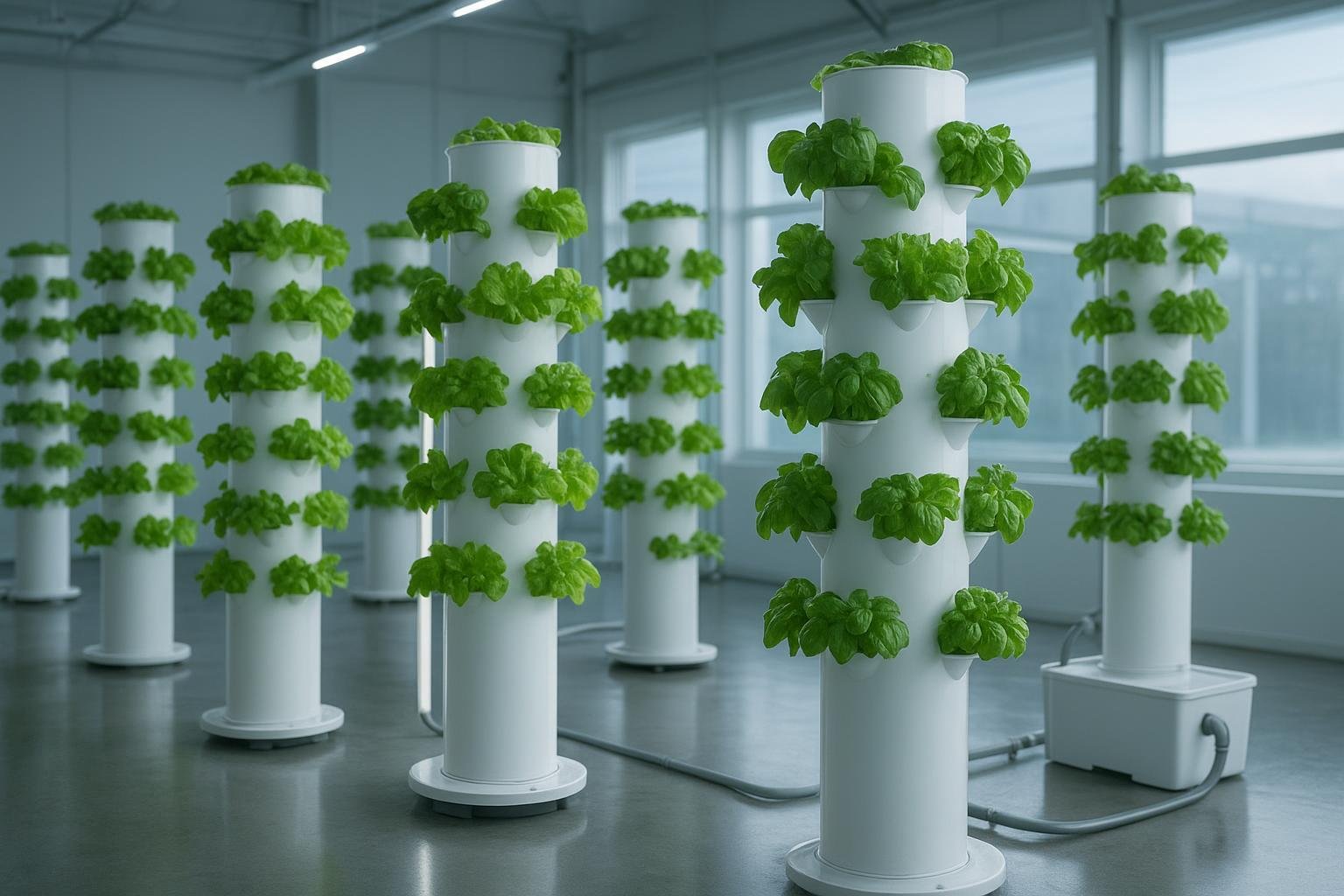
If you manage an urban farm, greenhouse, or vertical ag project, a hydroponic tower can compress more plant sites into less floor space while keeping water and energy use predictable. This 2026 guide blends a quick buying framework with deep, operations‑level practices—so you can spec, install, and run towers with commercial reliability.
Key takeaways
Hydroponic towers recirculate nutrient solution from a reservoir up a central riser and back by gravity, enabling dense vertical planting with controlled inputs.
Prioritize four “non‑negotiables” when buying: predictable water/energy use, yield per area with year‑round scheduling, food‑safe materials/certifications, and simple, reliable maintenance.
Start with extension‑backed baselines: leafy greens pH around 5.5–6.0 and EC in the ~1.0–1.5 mS/cm range; schedule routine sanitation and solution changes.
Use data to plan capacity: peer‑reviewed research in vertical NFT shows lettuce densities over 40 plants/m² with double‑digit kg/m² per cycle when designed well.
Build an OPEX model that includes lighting (largest load), pumping, climate, labor, and nutrients; validate assumptions before scaling.
Quick Buying Guide: Choose the Right Hydroponic Tower in 2026
If your search intent is partly transactional, here’s a compact way to compare options before you go deep. Focus on: total plant sites per footprint, real reservoir capacity, pump head/flow at height, integrated lighting needs for indoor deployments, serviceability (access, cleaning), and verifiable material/electrical certifications.
Capacity & footprint
Why it matters: Determines yield per square foot.
What good looks like: ≥20–30 sites per 0.5–1.0 m², with unobstructed service access.
Reservoir & turnover
Why it matters: Buffers EC/temperature swings and reduces dry-outs.
What good looks like: 30–50+ L per tower, with roughly ~1× system volume turnover per hour.
Pump & head
Why it matters: Ensures even distribution at height.
What good looks like: Rated flow at your actual head height, plus accessible filtration and an efficient motor.
Lighting for indoor deployments
Why it matters: Often the largest OPEX driver and a primary lever on crop quality.
What good looks like: LED bars/panels sized to target DLI/PPFD, with timers and uniform canopy uniformity.
Materials & certifications
Why it matters: Food contact and electrical safety.
What good looks like: Food-grade plastics/metals; documentation for NSF/ANSI 61 where applicable; UL/ETL marks for electrical components.
Serviceability & warranty
Why it matters: Uptime, cleaning time, and parts availability.
What good looks like: Tool-less access, removable lines, a spare-parts list, and clear SOPs.
How to proceed next: shortlist 2–3 models and do a side‑by‑side using your exact head height, ambient climate, and labor model. For deeper model‑by‑model analysis, see the planned cluster article “Best hydroponic tower systems”.
How a Hydroponic Tower Works
A hydroponic tower is a recirculating system. Nutrient solution sits in a reservoir, a submersible pump pushes it up a central riser to distribution points or emitters, and gravity returns the solution down the tower body to the reservoir. Net pots (typically with inert media) hold plants along the vertical surfaces. Indoors, LEDs supply photosynthetically active radiation; in greenhouses, towers rely on sunlight with or without supplemental light.
Well‑balanced designs include filtration to capture particulates, equal‑pressure manifolds to avoid top‑heavy flow, and accessible lines for sanitation. Expect to size the pump by actual head height (distance from reservoir waterline to the highest emitter) and select based on the manufacturer’s performance curve at that head. A practical rule of thumb for many recirculating systems is to target roughly a full system turnover about once per hour, then adjust by crop and heat load. Guidance on head/turnover methodology is consistent with extension materials such as the Oklahoma State University aquaponics pump notes in the publication HLA‑6721 (2016/2017).
Curious about doing this from the ground up? We’ll cover components below, and a dedicated build tutorial is planned in “Building a hydroponic tower”.
Components and Sizing That Actually Matter
Reservoir: Larger volumes buffer pH, EC, and temperature swings. For small towers, 30–50+ liters per tower is common; commercial stacks go higher. Opaque lids and easy‑lift access help keep biofilm down and maintenance fast.
Pump and head: Read the pump curve at your true head. Add modest safety margin for filters and bends. Favor quiet, efficient models with replaceable impellers and a simple pre‑filter.
Distribution path: A central riser plus balanced laterals or drip heads should deliver even flow across heights. Include quick disconnects and union fittings so lines can be purged and sanitized.
Filtration: A simple mesh/foam pre‑filter stops debris before emitters. In commercial settings, inline screens or cyclonic filters reduce clogging and cut downtime.
Lighting (indoor deployments): Specify to target crop DLI/PPFD, not just wattage. Uniform coverage beats raw output. Timers matter. Where electricity prices fluctuate, dynamic dim/photoperiod strategies can reduce cost without hurting yield, as discussed in the perspective from Frontiers (2024) on resource‑aware environmental control in controlled‑environment agriculture.
Sensors and control: At minimum, monitor pH, EC, and water temperature. Flow sight‑glasses or simple in‑line indicators give early warning of partial blockages.
Neutral example for context: The small‑footprint towers offered by SPRINGS FAITH are positioned for greenhouse or indoor use with a wheeled base and an integrated reservoir; the site describes models with stacked planting modules and optional LED kits. Where the brand claims “up to 95% water savings,” treat this as first‑party marketing unless you can replicate it under your operating conditions and document the method. Always request component specifications and any available compliance documentation.
Crop Planning: Densities, Yields, and Fit
Most teams begin towers with leafy greens and herbs (lettuce, basil), then evaluate compact fruiting crops. Your two planning levers are planting density and cycle time.
Peer‑reviewed evidence shows vertical NFT modules can deliver both higher density and strong cycle yields for lettuce compared with horizontal layouts. In a 2025 study, researchers reported pyramidal vertical modules hitting roughly 42 plants per square meter and cycle yields around 14 kg/m² for common lettuce cultivars, outperforming a horizontal comparison module; details appear in the open‑access article from Frontiers in Plant Science (2025).
A simple planning snapshot for a hydroponic tower garden that mirrors vertical NFT behavior:
Crop | Indicative density (plants/m² of floor) | Indicative cycle yield (kg/m²) | Notes |
|---|---|---|---|
Lettuce (butterhead/romaine types) | 33–42 | 13–14+ | Based on vertical NFT pyramidal modules (study conditions); tower airflow/lighting will shift the optimum |
Basil (sweet Genovese type) | 25–35 | — | Keep pH 5.5–6.5; prune to avoid shading; yield varies widely by harvest strategy |
Choose crops with compact morphology and shorter photoperiod demands first. For expanded crop lists, pruning methods, and cultivar tips, see the forthcoming cluster article “Plants for vertical hydroponics”.
Water, Nutrients, and Energy Management
pH and EC baselines for leafy greens are well established in extension literature. Cornell’s controlled‑environment hydroponics guidance recommends maintaining solution pH roughly 5.5–6.0 for lettuce and checking daily, with routine top‑offs between full changes. Penn State Extension details nutrient solution programs and recipes that commonly place leafy‑green EC in the ~1.0–1.5 mS/cm range (recipe‑dependent) and emphasize regular monitoring and documentation.
Daily ops: Check pH, EC, reservoir level/temperature; verify pump flow and aeration if used. Top off with water or dilute solution to stabilize EC; log readings.
Full changes: Weekly to biweekly for small recirculating systems, then tune by crop load and water quality. Sanitize exposed channels and fittings on a cadence.
Water‑use perspective: Hydroponics generally uses less water than soil because of recirculation and reduced percolation. A 2021 controlled study on tomatoes reported per‑plant water consumption substantially lower in hydroponic treatments compared with soil in both polytunnel and glasshouse settings, with the deep‑water configuration consuming the least among tested methods. While tomatoes are not lettuce, the mechanism—closed‑loop management—helps explain typical reductions. Treat any numeric savings claims as system‑ and climate‑specific.
Energy modeling 101: Lighting is typically the largest energy load in an indoor gardening system. Translate your crop’s light requirement (daily light integral, DLI) into target PPFD at canopy and then into fixture wattage and hours. From there, kWh/month = fixture watts × hours/day × days/1000. Use this with your tariff to simulate OPEX under different photoperiods and dimming levels. Perspectives on dynamic control from Frontiers (2024) note opportunities to shift or trim light input without hurting yield when carefully managed.
Authoritative resources to consult as you tune these ranges include the Cornell CEA guide to hydroponics for leafy greens (2020) and Penn State Extension’s nutrient solution programs and recipes (2024). For energy‑aware control concepts, see the 2024 Frontiers in Science perspective on dynamic environmental control. For water‑use comparisons in a controlled crop, review the 2021 tomato hydroponics vs. soil study (PMCID: PMC7885021). And for vertical density/yield evidence, see the 2025 Frontiers in Plant Science study on vertical NFT lettuce performance.
Maintenance SOPs and Troubleshooting for Uptime
Uptime comes from routine. Think in three cadences and write them into an SOP that your team can actually follow.
Daily: Measure pH/EC; inspect leaves and stems; confirm uniform flow across heights; check reservoir level and temperature; wipe any splash‑zone surfaces. Log issues.
Weekly (or every 7–10 days): Refresh the solution; clean pre‑filters and inspect emitters; remove dead roots or plant material; sanitize light‑exposed channels and lids; verify timers and dimming schedules.
Monthly/at changeovers: Deeper sanitation—drain, wash with warm soapy water to remove organic matter, then sanitize with a food‑grade disinfectant according to the label; rinse if required; inspect pumps, unions, and seals; review performance logs and adjust setpoints.
If you are subject to produce‑safety rules, align SOPs with recognized frameworks: the University of Minnesota Extension outlines small‑scale hydroponics sanitation steps, while the University of Vermont Extension summarizes produce‑safety considerations for hydroponic and aquaponic facilities. For a step‑by‑step troubleshooting and maintenance checklist, we’ll expand in the cluster guide “Hydroponic tower care”.
Compliance checkpoints: For water‑contact materials, buyers often look for documentation related to NSF/ANSI 61. For electrical components (pumps, lights, timers), UL or ETL marks indicate third‑party safety compliance in North America. You can learn what NSF/ANSI 61 covers and how to verify listings in the NSF overview (2024), and confirm UL/ETL marks via NRTL directories as described by Intertek’s explainer.
Budgeting, OPEX, and Simple ROI
Treat each tower (or bank) as a mini profit center and model both CAPEX and OPEX with conservative ranges.
Inputs to model:
CAPEX: tower hardware, reservoir, pump, filters, plumbing, LEDs, sensors/controllers, installation labor, spares, commissioning, and a contingency.
OPEX: electricity (lighting + pumps + climate), water, nutrients/consumables, labor hours (planting, harvesting, sanitation), seed/plug costs, and replacement parts.
Yield and price: plant sites × cycles/year × survival rate × average grams/plant; price by channel (retail, CSA, restaurant, institutional).
Example sketch: Suppose a hydroponic tower has 28 sites in 0.8 m² of floor space indoors. With a 35‑day lettuce cycle, 10 cycles/year, 90% survival, and 220 g per head, that’s ~5.5 kg per cycle and ~55 kg/year per tower. If lighting draws 150 W for 16 h/day and the pump draws 20 W for 24 h/day, monthly energy is ≈ (0.15 kW × 16 × 30) + (0.02 kW × 24 × 30) ≈ 72 kWh. At $0.15/kWh, that’s about $10.80/month in electricity for that tower (climate excluded). Build your model with your tariffs, labor, and actual densities.
Risk notes: Be explicit about assumptions (photoperiod, dimming, density, sellable grades, shrink). Validate yields with small A/B pilots before scaling. If you rely on certifications for market access, obtain documentation early to avoid procurement delays.
FAQs
Q: Can a hydroponic tower run without supplemental light indoors?
A: Not effectively. Indoors, plan for LEDs sized to your crop’s DLI. In greenhouses, assess seasonal light maps and consider supplemental lighting in winter to keep cycle times stable.
Q: What pH/EC should I hold for mixed greens and basil?
A: Many operators keep pH between 5.5 and 6.0 for lettuce and basil, with EC near 1.0–1.5 mS/cm depending on recipe and stage. Monitor daily and adjust by cultivar response.
Q: How do I vet “food‑grade” claims?
A: Ask for materials data sheets and any relevant NSF/ANSI 61 documentation for water‑contact components. For electrical devices, inspect for UL/ETL marks and confirm in official directories.
Q: Will hydroponic towers save 95% water?
A: Savings vary by design and climate. Treat any percentage as context‑dependent. Peer‑reviewed comparisons in other crops (e.g., tomato) show significant reductions vs. soil under controlled conditions; quantify your own system before stating numbers publicly.
References & Next Steps
Selected references used in this guide:
Cornell Controlled Environment Agriculture. See the 2020 guide to hydroponics for leafy greens for pH/EC baselines and solution‑management practices.
Penn State Extension. Read the 2024 nutrient solution programs and recipes overview for EC/recipe context and monitoring routines.
Frontiers in Science. A 2024 perspective on resource‑aware environmental control in vertical farming is here: Dynamic environmental control without sacrificing yield.
Frontiers in Plant Science. For vertical lettuce densities/yields, see the 2025 vertical NFT study.
National Library of Medicine. Water‑use comparison data appear in the 2021 hydroponic vs. soil tomato study (PMCID: PMC7885021).
NSF. Material safety scope and verification steps are explained in NSF/ANSI 61 (2024) overview. UL/ETL mark acceptance is summarized in Intertek’s NRTL explainer.
Next steps: Shortlist your candidate towers, run a one‑month pilot to validate yields and OPEX, and formalize your SOPs. If you want a compact, wheeled footprint with modular planting stacks for greenhouse or indoor use, review the component documentation and certifications of vendors like SPRINGS FAITH before procurement.
Related Posts
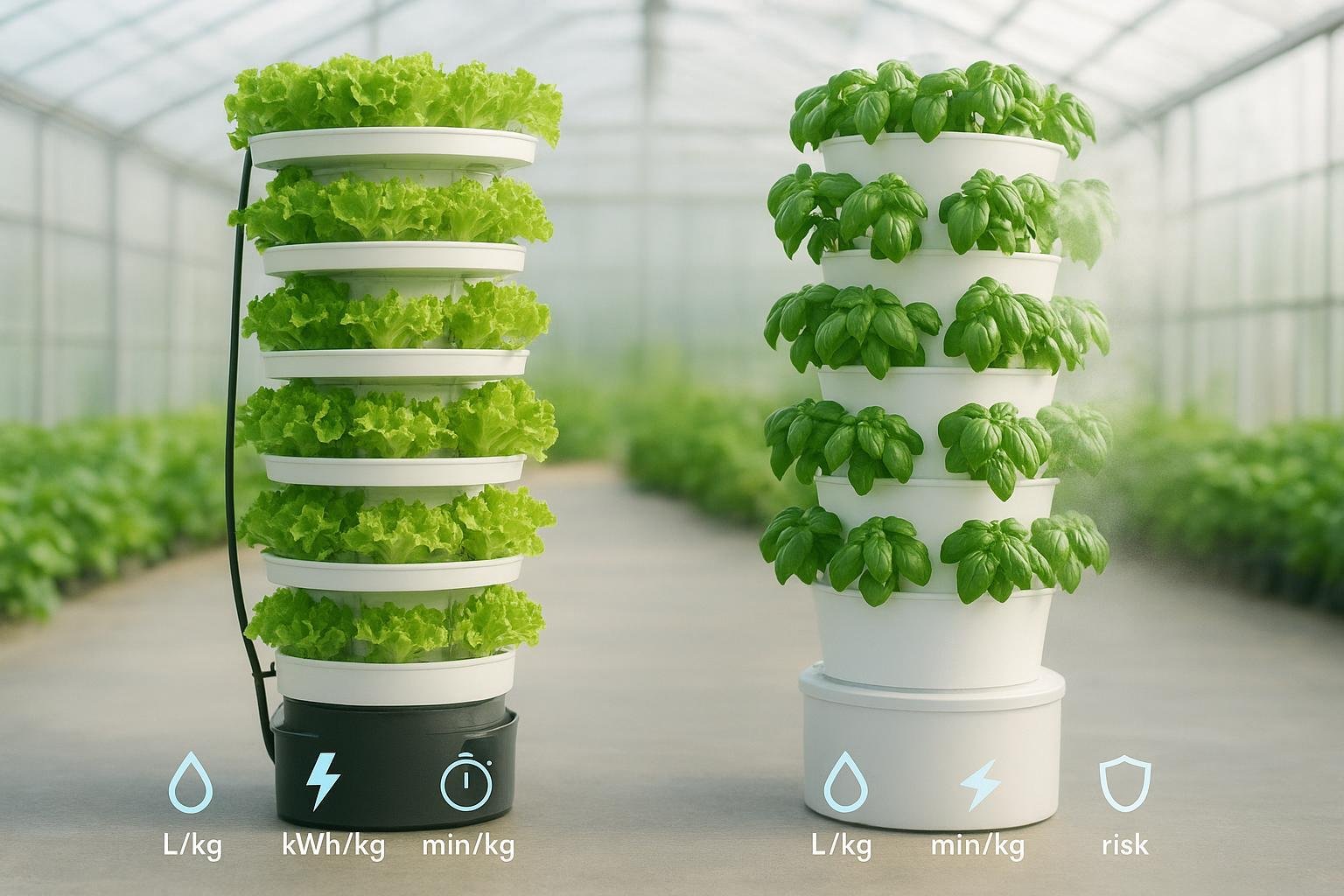 Hydroponic vs Aeroponic Towers (2026): Which System Is Better for Your Plants?
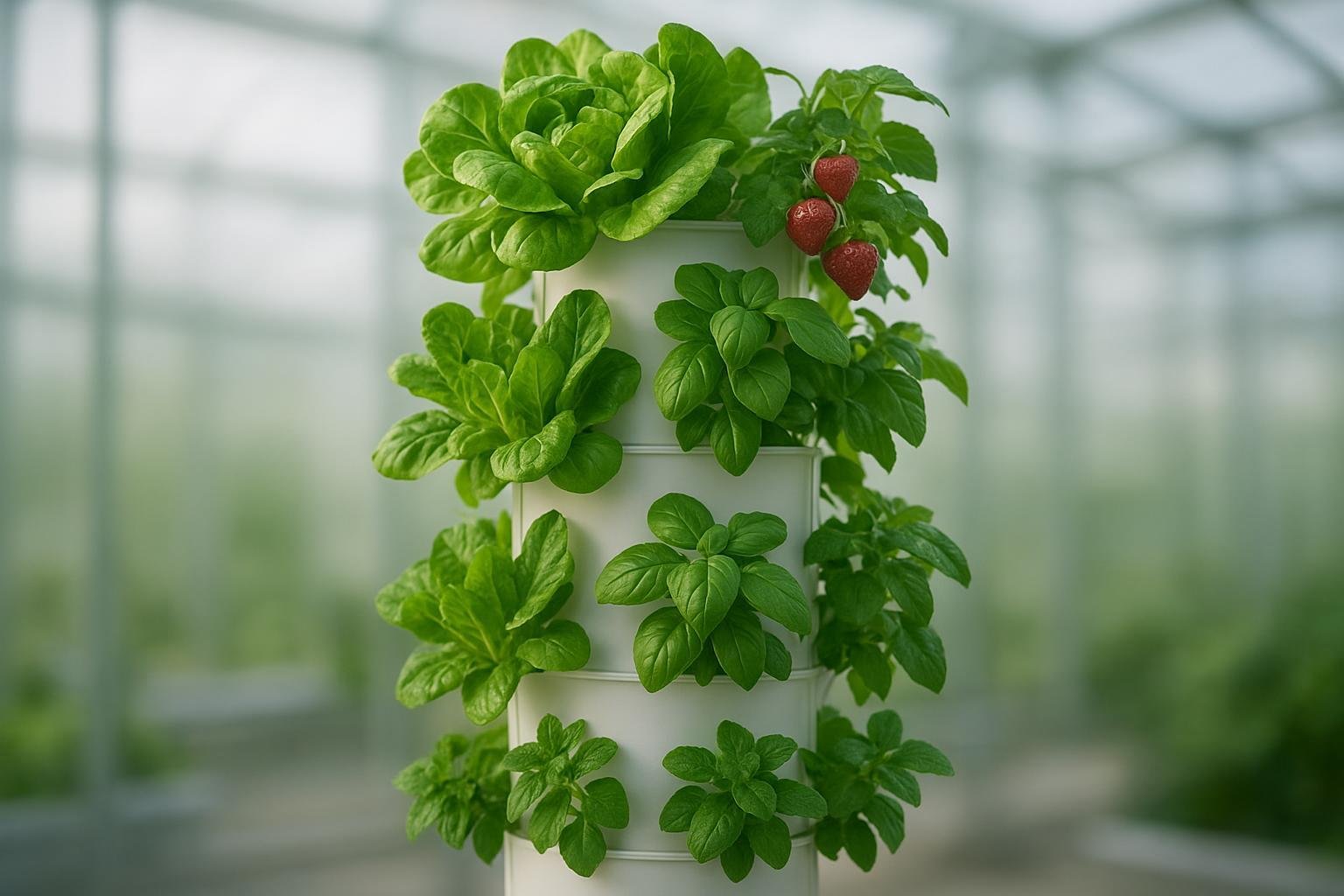 What Can You Grow in a Hydroponic Tower? 15 Best Plants for Vertical Growth
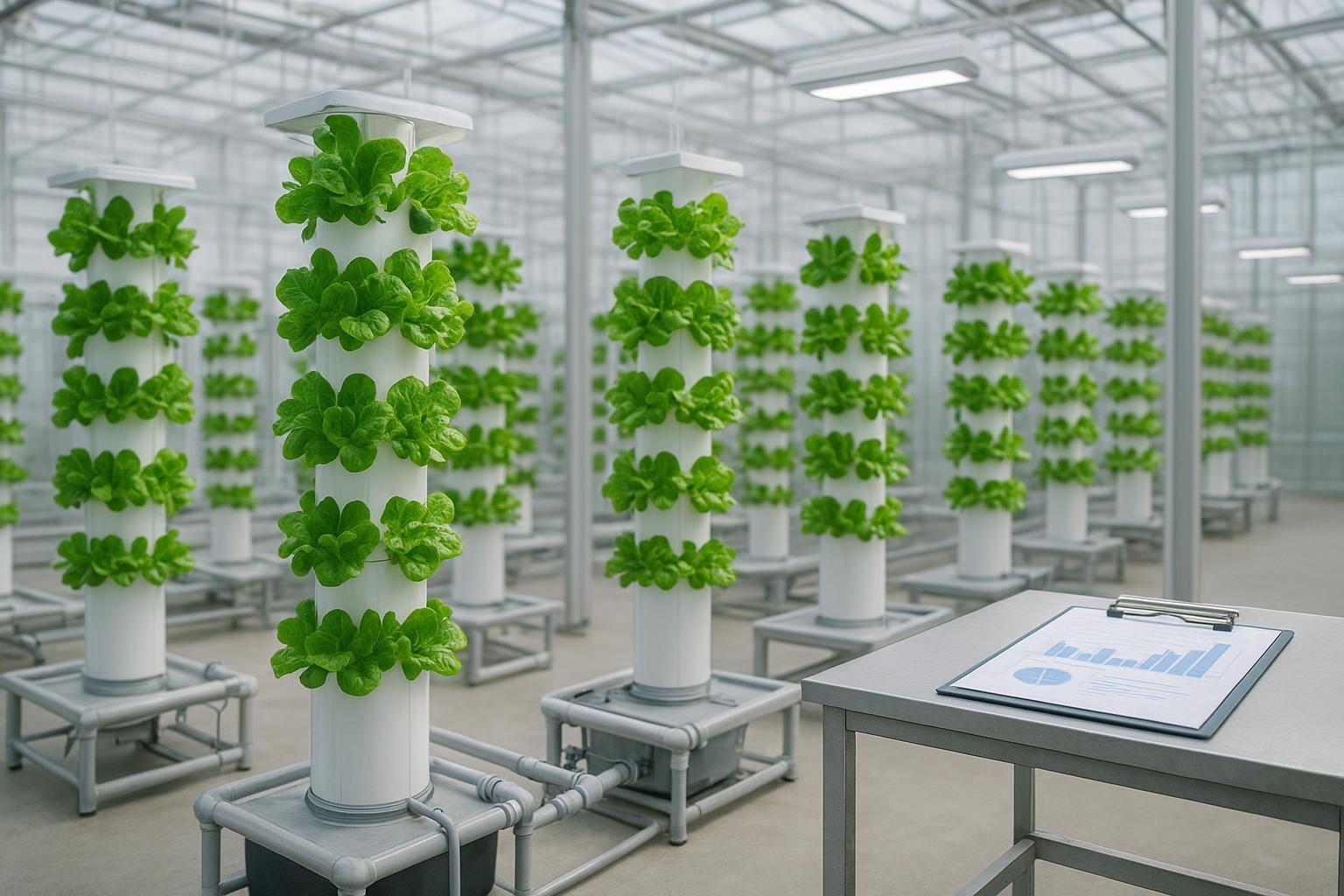 Hydroponic Tower Cost Analysis: Is It Worth the Investment? (Plus DIY Options)