
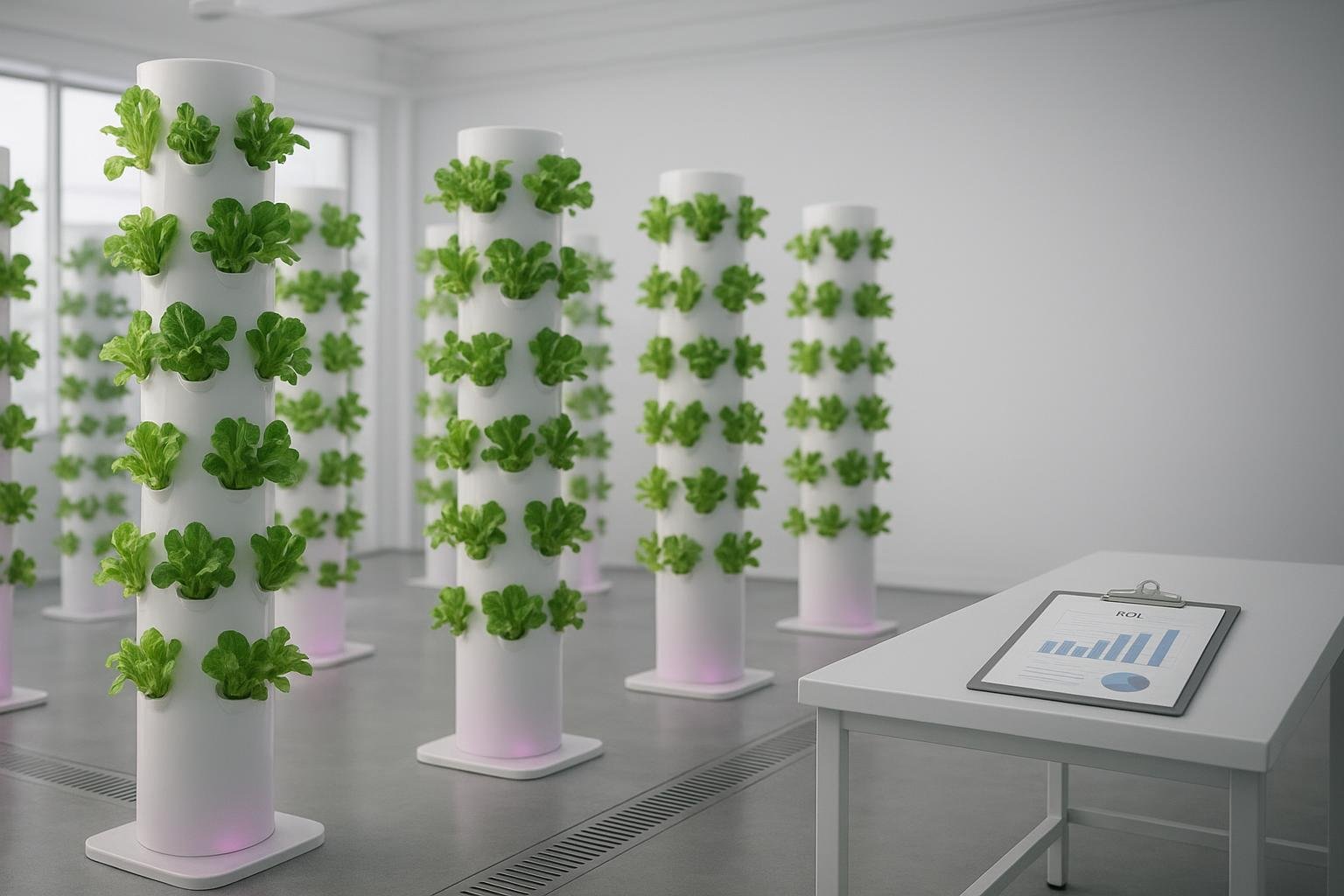
If you are weighing a capital spend this quarter, the real question isn’t whether a hydroponic garden tower is cool tech—it’s whether it pays back, holds steady on OPEX, and fits your footprint. In this guide, we evaluate a hydroponic garden tower through four decision metrics that investors and operators actually use: payback period in months, unit production cost, water savings versus soil, and yield per square meter per year. We also include three ROI examples—growth-stage urban farm, greenhouse retrofit, and prosumer scale—so you can map assumptions to your context.
Key takeaways
Payback can be attractive when space is tight and output is contracted; sensitivity to crop price and energy is decisive.
Unit production cost hinges on labor pattern, lighting intensity, and uptime; model it before you buy.
Peer-reviewed studies report 50–64% less water use for hydroponic lettuce compared with soil, driven by recirculation.
Yield per square meter per year must be modeled transparently from sites per tower, grams per plant, and cycles per year.
Get pricing and a project quote
Share your footprint, crop mix, and target output. We’ Il respond with aconfiguration starting point and a quote range.
Quick verdict: When a hydroponic garden tower makes sense
A hydroponic garden tower shines in locations where space is scarce, water is costly or restricted, and labor can be organized around vertical harvest and maintenance. Towers convert height into plant sites, often improving revenue per square meter when horizontal expansion is impossible. They also recirculate solution, trimming the water bill and supporting a controlled root-zone.
There are cases where an NFT channel layout or a horizontal raft system can outperform a hydroponic garden tower. For large single-crop lettuce programs with broad floor plates, horizontal DWC or raft systems may keep CAPEX per site lower and streamline cart-based labor. For long runs of uniform leafy greens, NFT can scale efficiently with simpler channel cleaning routines. The best fit depends on your footprint, labor model, energy pricing, and crop mix.
The four decision metrics that drive ROI
Payback period in months
Payback period translates risk into time. Build it from the bottom up: CAPEX per tower, plant sites per tower, grams per plant, cycles per year, expected selling price, and OPEX lines for energy, labor, nutrients, water, and parts. Then run a sensitivity test at plus or minus 20% for price and yield. The shorter the payback in your base case and the more resilient it is in downside sensitivity, the stronger the business case.
Unit production cost in dollars per kilogram
Unit cost captures whether you can win or at least tie local wholesale. Bundle energy, labor, consumables, water, and maintenance, then divide by net saleable kilograms. If your hydroponic garden tower unit cost beats the price you pay distributors—or the price your buyers commit to—you have room for margin as you scale.
Water savings with evidence
Closed-loop hydroponics recirculates nutrient solution and reduces runoff and evaporation. For lettuce and leafy greens, peer-reviewed research reports substantial reductions in water use versus soil: multiple trials summarized in 2023–2024 literature point to roughly 50–64% savings under controlled comparisons. See the synthesis in the Frontiers series: according to the authors in the 2023 greenhouse lettuce performance analysis and the 2024 environmental factors paper, hydroponic systems delivered markedly higher water productivity for lettuce due to recirculation and reduced losses. Read the details in the authors’ discussions in the Frontiers Plant Science articles: the 2023 greenhouse lettuce performance analysis and the 2024 environmental factors synthesis are available as open-access resources.
The 2023 greenhouse lettuce performance discussion is summarized in the peer-reviewed article titled Greenhouse Lettuce Performance and Hydroponic Advantages in water productivity published by Frontiers in Plant Science (2023). For full context, see the open-access article here: Frontiers in Plant Science greenhouse lettuce analysis.
The 2024 environmental factors paper references trials reporting a 64% reduction in water use for hydroponic lettuce compared to soil; see the open-access article here: Frontiers in Plant Science environmental factors for lettuce.
For qualitative orientation beyond peer review, the University of Minnesota notes that hydroponics typically requires less water than soil systems, reflecting the same recirculation logic in small-scale setups. See the University of Minnesota Extension overview: Small-scale hydroponics guidance.
Yield per square meter per year
There is no single universal yield number because cultivars, lighting, climate control, plant density, and harvest weight vary. The reliable approach is to model yield from first principles:
Sites per tower × towers per square meter of floor space × grams per plant × cycles per year ÷ 1,000 = kg per square meter per year.
A practical reference for tower geometry and site counts comes from Oklahoma State University’s extension build guide, which illustrates typical tower layouts and plant site density. Review the construction context to ground your site-count math: OSU Extension vertical tower build guide.
Hydroponic garden tower ROI worked examples
These examples are assumption-based and designed for planning. Replace inputs with your actual quotes, utility rates, and contracts. Prices are in USD.
Model conventions: In the scenarios below, OPEX is shown as total OPEX per year for the whole scenario (all towers combined). Payback uses Payback months = CAPEX ÷ (Revenue − OPEX) × 12. If Revenue − OPEX ≤ 0, there is no payback in that base case.
Because many urban growers sell leafy greens as heads or retail packs (not bulk kilograms), the revenue examples use an equivalent per-head/per-pack assumption (e.g., “$X per head equivalent”). The yield math (sites × grams × cycles) is still shown so you can sanity-check output, then swap in your own contract price per head/pack.
Scenario B: Growth-stage urban farm expansion
Assumptions: 80 towers, 28 sites per tower, 160 g per plant at harvest, 9 cycles per year for leafy greens, average selling price $12/kg via mixed retail and restaurant accounts. CAPEX per tower installed $1,600. Total annual OPEX (all towers) $2,240 (energy, labor allocation, nutrients, water, parts).
Scenario C: Greenhouse retrofit at production scale
Assumptions: 240 towers, 28 sites per tower, 170 g per plant, 10 cycles per year, average price $10/kg on wholesale contracts. CAPEX per tower installed $1,350 due to economies of scale. Total annual OPEX (all towers) $6,000 (energy, labor allocation, nutrients, water, parts).
Scenario D: Prosumer or home pilot
Assumptions: 2 towers, 20 sites per tower, 120 g per plant, 10 cycles per year, price proxy $10/kg equivalent saved retail purchase. CAPEX per tower $900. Total annual OPEX (both towers) $120.
Here’s the math in a mobile-friendly summary (same assumptions, no table).
Scenario B — Urban Farm (Wholesale contracts, base case planning model)
Towers: 80; Sites/tower: 28; Cycles/year: 9
Equivalent sales unit: 20 heads/tower/cycle (assumption for contracted wholesale sizing)
Annual heads: 14,400
Equivalent price: $10 per head → Revenue: $144,000/yr
Total OPEX: $64,000/yr
Net cash flow: $80,000/yr
CAPEX: $128,000
Payback: 19 months
Scenario C — Greenhouse Retrofit (Base case planning model)
Towers: 240; Sites/tower: 28; Cycles/year: 10
Equivalent sales unit: 22 heads/tower/cycle
Annual heads: 52,800
Equivalent price: $8 per head → Revenue: $422,400/yr
Total OPEX: $260,000/yr
Net cash flow: $162,400/yr
CAPEX: $324,000
Payback: 24 months
Scenario D — Prosumer/Home Pilot (Base case planning model)
Towers: 2; Sites/tower: 20; Cycles/year: 10
Equivalent sales unit: 16 heads/tower/cycle
Annual heads: 320
Equivalent value: $4 per head → Value: $1,280/yr
Total OPEX: $180/yr
Net cash flow: $1,100/yr
CAPEX: $1,800
Payback: 20 months
Notes and formulas: Annual kg = Towers × Sites/tower × g/plant × cycles ÷ 1,000. Revenue = Annual kg × price. OPEX is total per year for the scenario. Net cash flow = Revenue − OPEX. Payback months = CAPEX ÷ (Revenue − OPEX) × 12. Replace numbers with your quotes.
Sensitivity matters. In most urban deployments, energy and crop price drive variance.
Scenario B sensitivity (illustrative, one variable: price ±20%)
Price −20%: Revenue = $115,200/yr → Payback ≈ 26 months
Base case: Revenue = $144,000/yr → Payback ≈ 19 months
Price +20%: Revenue = $172,800/yr → Payback ≈ 15 months
This sensitivity holds OPEX constant and shows how contract pricing alone can shift payback. In practice, yield and labor efficiency can move the range further.
Hydroponic garden tower versus NFT and horizontal systems
A hydroponic garden tower optimizes vertical real estate. It is often chosen when operators must push output per square meter, support ergonomic harvest, and manage a strict water budget. Towers concentrate plant sites into small footprints and can integrate well with aisle-based labor. Risks include shading if lighting distribution is uneven and higher per-site structure cost versus long horizontal runs.
NFT channels remain a workhorse for leafy greens. Long, parallel channels are relatively simple to fabricate, inspect, and sanitize; they favor conveyor-like workflows and predictable head heights for flow. However, NFT relies on horizontal space and can struggle when rents or retrofits cap floor area.
Horizontal DWC and raft systems excel in greenhouses that can spare footprint. Large water volumes offer thermal buffering, and rafts simplify movement, seeding to harvest. Yet they may commit more floor space and can be less compatible with multi-crop vertical stacking.
Bottom line: choose a hydroponic garden tower when footprint is the bottleneck and water recirculation is a priority; choose NFT or raft when floor space is abundant and per-site CAPEX must be minimized.
Engineering callouts you should not skip
Lighting. For lettuce and leafy greens under LEDs, many operators target photosynthetic photon flux density in the neighborhood of 200–300 μmol·m⁻²·s⁻¹ with long photoperiods around 16 hours to reach an appropriate daily light integral. One peer-reviewed basil study showed mass gains up to ~600 μmol·m⁻²·s⁻¹ with the best light-use efficiency nearer 250 μmol·m⁻²·s⁻¹, illustrating the energy–yield trade-off that also informs leafy-green practice. See the authors’ results in the open-access paper published by Frontiers in Plant Science in 2020: LED PPFD response in basil and efficiency context. For practical home and small-farm guidance on photoperiod and fixture selection, Purdue’s guide provides accessible baselines: Purdue guide to home hydroponics for leafy greens.
Pump and reservoir method. Start from required flow per tower or per manifold branch, then add head height and friction losses to choose a pump with adequate margin. Ensure check valves and accessible isolation points for maintenance. Buffer reservoir volume so that diurnal uptake and evaporation do not swing EC and pH beyond targets; Oklahoma State’s tower construction reference is helpful for understanding geometry and plumbing context: OSU Extension vertical tower build guide.
Record keeping. Keep a simple log for EC, pH, temperature, and visual health cues by zone. This is cheap insurance against drift, helps troubleshoot yield variance, and supports compliance.
Food safety and compliance in soilless operations
If you sell produce, you still operate under food-safety expectations. The FDA’s Produce Safety Rule under the Food Safety Modernization Act sets minimum standards for growing, harvesting, packing, and holding produce. One supervisor must complete a recognized training, and you must control agricultural water quality, sanitation, worker hygiene, and records. Read the official overview: FDA FSMA Final Rule on Produce Safety.
Buyers may also request third-party audits. USDA’s GAP/GHP audits verify your on-farm practices against buyer-driven criteria and are commonly renewed annually. See the USDA program page: USDA GAP and GHP audits. For hydroponic and aquaponic specifics—like when nutrient solution counts as agricultural water and sanitation best practices—the UVM and NECAFS guidance is a practical read: Produce safety in hydroponic and aquaponic operations.
Quick compliance cues to build into your SOPs:
Keep solution and harvest logs, cleaning and calibration records, and worker training certificates.
Define water testing cadence per your risk profile and local regulations.
Standardize sanitation, line flushes, and contact-surface disinfection without compromising plant health.
Practical example box — how a SPRINGS FAITH hydroponic garden tower fits an ROI worksheet
Consider a mid-block urban site with rent pressure and a ceiling height that allows two vertical rows of towers per aisle. A hydroponic garden tower array is laid out in mirrored rows to maximize walkable access and ensure consistent PPFD on all tower faces with supplemental side lighting on wider aisles. Start the worksheet by entering plant sites per tower, quoted CAPEX per installed tower module, and per-tower OPEX for your region’s electricity, minimal water, nutrients, labor allocation, and wear parts. Then set your base case grams per plant and cycles per year by crop type.
In this configuration-focused example, you would calculate annual kilograms from first principles, price them using your signed accounts, and compare net proceeds against CAPEX. If your payback months at base case fall within target and still clear your hurdle in a downside scenario, the case for a hydroponic garden tower solidifies. Where operators need vendor documentation for commissioning and maintenance planning, they often consult product pages and resource hubs. For a neutral reference point on commercial tower systems and modular layouts, see SPRINGS FAITH’s website: SPRINGS FAITH commercial hydroponic tower systems. Use any listed specifications as inputs to your model rather than as performance promises, and validate them against your site’s utilities and crop plan.
Method note: The ROI scenarios in this article are simplified planning models. Before purchasing equipment, validate assumptions (crop price, yield, labor, and energy) with your own utility rates, buyer contracts, and an engineering/ag-econ review where appropriate.
Sources and further reading
Water productivity and environmental comparisons for lettuce are accessible in open-access, peer-reviewed discussions: see the greenhouse lettuce performance article and the environmental factors synthesis in Frontiers in Plant Science (2023–2024) linked above. For small-scale hydroponics orientation, the University of Minnesota’s extension page provides practical context. Lighting decisions benefit from both peer-reviewed LED efficiency work in basil and Purdue’s accessible guide to leafy-greens photoperiod and fixture basics. For tower geometry and plumbing context, the Oklahoma State University build guide is useful. For compliance and buyer expectations, the FDA FSMA Produce Safety Rule, USDA GAP/GHP overview, and UVM/NECAFS hydroponic safety page are authoritative starting points.
Next steps
Download or build your ROI sheet, populate it with your quotes and contracts, and pressure-test the downside. If you want a starting ROI spreadsheet versioned with key input fields (CAPEX/site count/yield/cycles/energy), request it from SPRINGS FAITH so you can plug in your local rates and buyer terms. If you need a neutral configuration starting point for a hydroponic garden tower layout, explore the resources on SPRINGS FAITH’s site and request a specification sheet to model against your utilities and crop mix.
About this guide: SPRINGS FAITH Editorial Team (reviewed by operators with 5+ years of CEA/greenhouse experience).
Related Posts
 Hydroponic vs Aeroponic Towers (2026): Which System Is Better for Your Plants?
 What Can You Grow in a Hydroponic Tower? 15 Best Plants for Vertical Growth
 Hydroponic Tower Cost Analysis: Is It Worth the Investment? (Plus DIY Options)