
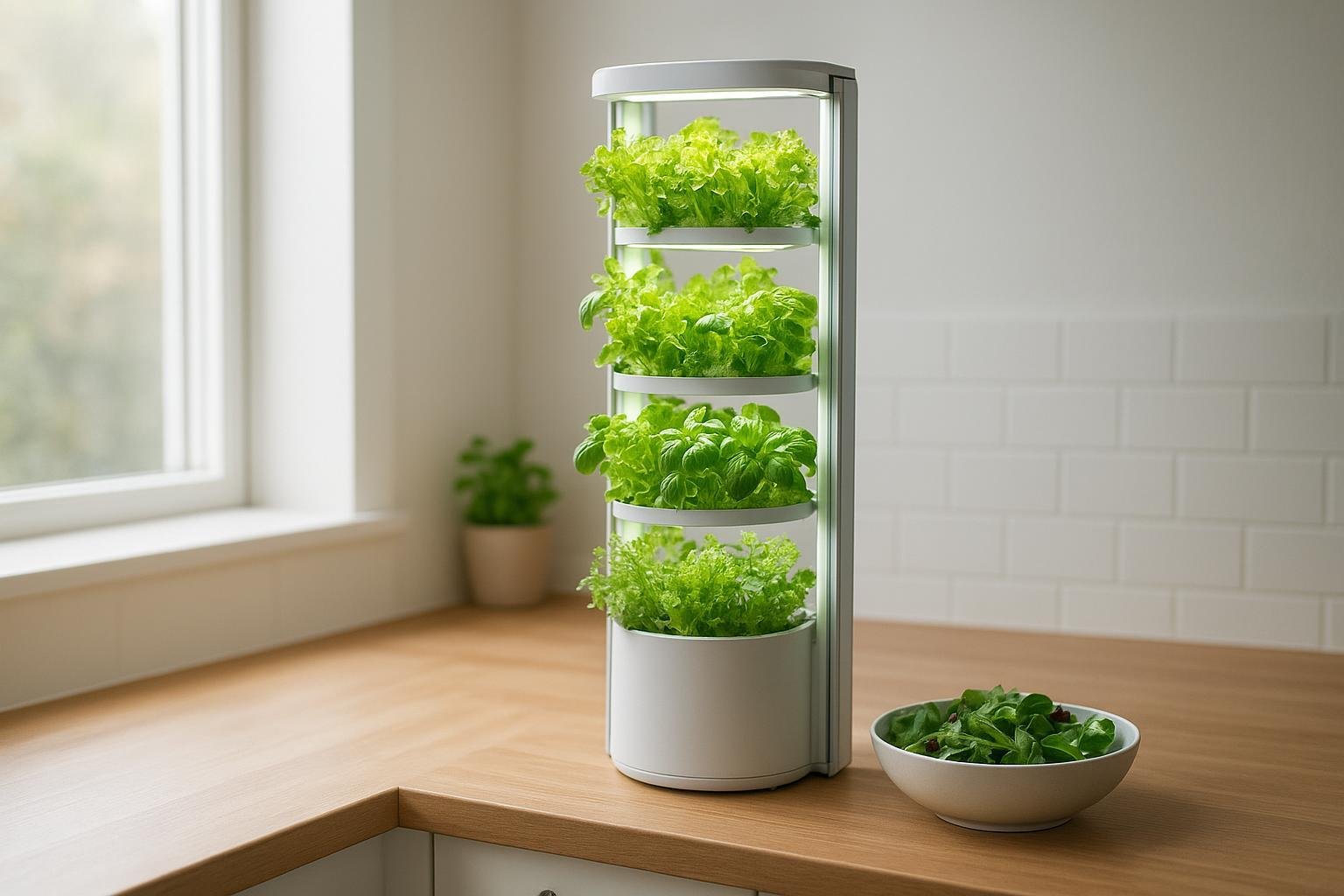
If you want fresh, crunchy greens without turning your kitchen into a science project, a salad tower can look like the perfect shortcut. The trick is picking a system that actually fits your space, keeps maintenance light, and produces predictable bowls of salad each week. This guide translates specs into simple kitchen decisions—footprint, yield, upkeep, and cost—so your first salad tower is an easy win, not another gadget that gathers dust.
Key takeaways
A salad tower is a vertical hydroponic system that recirculates nutrient solution, which can use far less water than soil setups when managed well, and it concentrates production in 2–4 sq ft of floor space.
For leafy greens, plan 12–16 hours/day of LED light, pH around 5.5–6.5, EC roughly 1.2–1.8 mS/cm, full reservoir changes about every 1–2 weeks, and quick wipe-downs to prevent algae and odors.
To match weekly needs, translate plant sites to bowls/week: many 20–36 site towers can support several salads per week with staggered “cut-and-come-again” harvests.
Compare against countertop hydroponics (smaller, tidy, fewer sites) and soil planters (simple but messier and less water-efficient indoors) before you buy.
Keep costs transparent: estimate electricity with a simple kWh formula and plan a small monthly budget for nutrients and occasional parts.
Quick buyer quiz: what size fits your kitchen?
How many salads do you want per week? Solo diners often target 2–4 bowls; couples 4–8; families 6–12+. That target drives plant-site count.
What footprint and height will actually fit? Measure the corner or wall you’ll use. Many salad towers occupy 2–4 sq ft and may need cabinet clearance above 5–6 feet.
How much routine you can commit? If you can check pH/EC weekly and change water every 1–2 weeks, a tower is reasonable. If you prefer ultra-minimal touch, a smaller countertop system may be wiser.
Salad tower vs. countertop hydroponics vs. indoor soil planters
Below is a kitchen-focused snapshot. Exact numbers vary by product; use this to narrow the field before comparing specific models.
Criteria | Salad tower (vertical hydroponic) | Countertop hydroponics | Indoor soil planters |
|---|---|---|---|
Typical footprint | 2–4 sq ft floor | <2 sq ft counter | Variable; trays or pots |
Plant capacity | ~20–36 sites common | ~6–30 sites per unit | Flexible but less dense |
Water use | Closed-loop recirculation; can use ~85–90% less than conventional soil when well-managed | Similar recirculation per device | Higher water use and evap; manual watering |
Maintenance | pH/EC checks 1–2×/week; full change 1–2 weeks; periodic cleaning | Similar or lower per unit | Watering, pests/gnats, soil cleanup |
Cleanliness/odor | Low if light excluded from reservoir and solution is refreshed | Generally tidy | Soil mess; fungus gnats possible |
Energy | LEDs 12–16 h/day; small pump intermittent | Integrated LEDs; some publish kWh/month | LEDs needed indoors for comparable yield |
Upfront cost (CAPEX) | Mid to higher for larger towers | Wide range from budget to premium | Low for pots; LEDs add cost |
Best for | Maximizing yield per sq ft | Minimal footprint and tidy look | Familiar method; herb pots |
For water-use context, institutional and extension sources describe hydroponic systems as using roughly 85–90% less water than conventional soil when efficiently managed in closed loops; see the framing in the USDA’s overview of controlled water use and the FAO’s aquaponics note on “up to ~90% reduction” in some systems: the nuance is in system design and management, so treat these as directional ranges rather than guarantees. See the discussion in the USDA’s International Day of Forests feature on efficient food production and FAO’s summary on aquaponics water conservation.
According to the United States Department of Agriculture, controlled systems can substantially reduce water use compared with conventional methods; see the context in the USDA’s feature on efficient food production in arid regions with recirculating agriculture for an 85% framing of savings in well-managed cases: USDA’s overview of efficient water use in controlled systems.
The Food and Agriculture Organization notes aquaponic/hydroponic recirculation can reduce water use by around 90% versus soil contexts in certain implementations; see: FAO’s Every drop counts explainer on aquaponics water savings.
How a salad tower works (and why it’s kitchen-friendly)
A salad tower stacks plant sites vertically and pumps nutrient solution from a reservoir to the top; gravity returns it to the tank. This concentrates production in a small footprint and makes yields more predictable with steady light and nutrition. University and extension guides emphasize four fundamentals: keep pH in range so nutrients stay available; maintain EC (nutrient strength) appropriate for leafy greens; provide a long daily photoperiod under LEDs; and refresh/clean the system on a cadence to prevent algae and off-odors. For home leafy greens, a practical target pH is about 5.5–6.5 and EC roughly 1.2–1.8 mS/cm, with a 12–16 hour LED day; see the ranges and context in the University of Florida IFAS lettuce and CEA notes and Cornell’s home CEA guide: UF/IFAS hydroponic lettuce guidance (HS1422) and Cornell CEA’s Guide to Home Hydroponics for Leafy Greens. For a hands-on tower build that reveals internal mechanics and cleaning touchpoints, see Oklahoma State University’s step-by-step design: OSU Extension’s vertical hydroponic tower build (HLA‑6724).
The selection checklist that actually matters
You don’t need to memorize jargon; treat a salad tower like a compact appliance. Match these specs to your space and routine.
Spec | What to look for | Why it matters |
|---|---|---|
Footprint & height | 2–4 sq ft; height clearance below cabinets | Fits your corner; avoids splash and blocked airflow |
Plant sites | ~20–36 for households; fewer for solo users | Maps to bowls/week when stagger-harvesting |
Reservoir access | Easy to drain/refill; light‑tight | Faster water changes; less algae/odor |
Lighting | Built-in or add-on LEDs; 12–16 h/day capability | Reliable growth; crisp leaves |
Pump duty & noise | Intermittent cycles; quiet operation | Kitchen comfort; fewer hums/vibrations |
Materials & safety | Food-safe plastics; sturdy base | Food contact confidence; stability |
Maintenance cadence | Clear manual with 1–2 week change guidance | Predictable routine; safer produce |
CAPEX/OPEX | Transparent price; nutrient/electricity estimates | Avoid cost surprises |
Real-world yield math: bowls per week
Think in bowls, not just plant sites. Baby leaves for a side salad weigh roughly 60–80 g per bowl. With cut‑and‑come‑again harvesting, many small towers produce a few hundred grams per week when dialed in; beginners may see less at first. For perspective, a large commercial-style cabinet like the Fork Farms Flex Farm (far bigger than a kitchen unit) cites 25+ lb per 28 days across 288 sites in a controlled environment—useful only to illustrate how plant count and environment scale yield; smaller home towers are a different category entirely. See the manufacturer’s description for context: Fork Farms’ Flex Farm production overview.
Household | Suggested plant sites | Typical weekly harvest (leafy greens) | Bowls/week (60–80 g each) |
|---|---|---|---|
Solo cook | 12–20 | ~120–250 g | ~2–4 |
Couple | 20–30 | ~200–400 g | ~3–6 |
Family (3–4) | 30–36 | ~300–500 g | ~4–8 |
Ranges assume stable 12–16 h/day light, pH ~5.5–6.5, EC ~1.2–1.8 mS/cm, and staggered harvesting. See extension guidance for leafy greens targets and photoperiod: UF/IFAS HS1422 for lettuce parameters and Cornell CEA’s home hydroponics guide.
Cost clarity: a simple way to estimate electricity and monthly spend
If a manufacturer publishes kWh/month, multiply by your local rate. For example, Gardyn reports about 47 kWh/month for its 30‑site unit; using the recent U.S. residential average price of roughly 16.5¢/kWh, electricity would be about $7.76/month (0.165 × 47). See the device reference and the energy price context here: Gardyn’s product and comparison pages on energy use and EIA’s residential electricity price overview.
If only component wattage is known, use: (LED watts × hours/day + pump watts × hours/day) × 30 ÷ 1000 × price/kWh. For example, a 60 W LED for 14 h/day plus a 6 W pump for 8 h/day at $0.165/kWh is roughly (60×14 + 6×8)×30/1000×0.165 ≈ $4.45/month. Add nutrients ($5–$15/month depending on brand/volume) and occasional parts (media, filters) for a transparent OPEX picture.
For a sense of countertop alternatives: Rise cites 65 W per level on its modular garden; capacity starts at 16 plants per level and can expand via tray lids. See: Rise Gardens’ product and FAQ specifications.
Setup and your first 30 days
Start simple. Place the salad tower where it won’t block cabinet doors or walkways. Fill and mix nutrients per the label, then set your light timer to 12–16 hours/day. Plant mostly fast, non-bolting greens (e.g., butterhead, romaine, baby kale, arugula) and a few herbs. Check pH after mixing and adjust slowly toward ~5.5–6.5. In week one, watch water level and top off with clean, pH‑adjusted water. By the end of week two, do your first full reservoir change. As roots lengthen, keep the reservoir covered to exclude light and wipe any splashes on the shell. Stagger sowing dates by 7–10 days so you can harvest a little every few days.
For crop-specific ranges and maintenance fundamentals, extension resources are reliable reference points: UF/IFAS hydroponic lettuce notes (HS1422) and Cornell CEA’s home hydroponics guide. For a quick lighting sanity check (12–16 h/day under LEDs, close to the canopy), see the consumer-friendly framing in UC ANR’s indoor greens note: UC ANR’s primer on indoor greens lighting.
Maintenance SOP you can actually follow
Keep it clean and predictable. Following label directions and your device manual is non‑negotiable.
Task | Cadence | What “good” looks like |
|---|---|---|
Top off reservoir | Every 1–3 days as needed | Water level steady; EC/pH stable |
Check pH & EC | 1–2×/week | pH ~5.5–6.5; EC ~1.2–1.8 mS/cm for leafy greens |
Full solution change | Every 1–2 weeks | Fresh, clear solution; no off‑odors |
Wipe & cover | Weekly | Reservoir opaque; no light leaks or algae |
Clean & sanitize | Monthly or per crop cycle | Clean first; then sanitize food‑contact parts at label rates; rinse and air‑dry |
For parameters and cadences, see extension guidance on pH/EC and water changes: UF/IFAS HS1422 and related CEA notes and Cornell CEA’s home hydroponics guide. For food‑contact sanitation, follow label directions (e.g., diluted bleach at food‑contact concentrations or hydrogen‑peroxide/peroxyacetic blends), use test strips, rinse, and air‑dry; see a practical overview at University of Minnesota Extension’s small-scale hydroponics safety notes.
Troubleshooting quick-help
Symptom | Likely cause | First checks/fixes |
|---|---|---|
Yellowing leaves | Low nutrients or pH out of range | Measure EC/pH; adjust to targets; refresh solution |
Bitter or bolting lettuce | Too warm or too much light intensity | Lower temp if possible; raise LEDs; choose bolt‑resistant varieties |
Algae or odor | Light leak or overdue water change | Opaque reservoir; clean and sanitize; restore 1–2 week change cadence |
Pump noise or poor flow | Clogged filter or low water | Clean intake; top off; verify timer cycles |
For a deeper understanding of tower internals and maintenance points, OSU’s vertical tower build guide includes helpful diagrams: OSU Extension’s HLA‑6724 vertical tower guide.
Next steps (and one neutral supplier note)
If you’ve measured your space, mapped bowls/week, and sketched a maintenance routine that fits your life, you’re ready to shortlist models and compare published specs (plant sites, footprint, reservoir access, lighting, and any energy data). As you explore suppliers, you’ll find consumer countertop brands as well as engineering‑grade tower providers that can also adapt to home use. Disclosure: SPRINGS FAITH is our product; its commercial tower systems and home vertical gardens can be assessed with the same criteria described here (capacity, footprint, reservoir access, and maintenance fit). Learn more at SPRINGS FAITH.
FAQ
What’s the minimum commitment to keep a salad tower healthy? Plan to check pH and EC once or twice a week, top off the reservoir as needed, and change the solution every 1–2 weeks. Wipe splashes and keep the reservoir light‑tight to prevent algae.
Will a kitchen salad tower smell? It shouldn’t. If you refresh the solution on schedule, keep light out of the reservoir, and clean/sanitize monthly or between crop cycles, you’ll avoid the usual odor triggers. If you notice a smell, change the water immediately and inspect for algae or root issues.
Can countertop systems replace a tower? Yes for smaller appetites or ultra‑compact spaces. Devices like Gardyn (30 sites, with a published ~47 kWh/month figure) and modular systems like Rise (16+ sites per level) are tidy and effective, but total capacity is lower unless you add more units. See their official pages for current specs: Gardyn’s product details and Rise Gardens product page.
References and further reading: For water‑use framing in recirculating systems, see the contextual overviews by the USDA on efficient water use in controlled agriculture and the FAO’s note on aquaponics saving up to ~90% water. For home leafy‑greens parameters and practical cadences, rely on UF/IFAS HS1422 hydroponic lettuce guidance and Cornell CEA’s home hydroponics guide. For lighting heuristics see UC ANR’s indoor greens primer. For a transparent electricity‑cost estimate, consult the U.S. EIA residential price overview. For system mechanics and DIY context, study OSU Extension’s vertical tower guide HLA‑6724.
Related Posts
 Hydroponic vs Aeroponic Towers (2026): Which System Is Better for Your Plants?
 What Can You Grow in a Hydroponic Tower? 15 Best Plants for Vertical Growth
 Hydroponic Tower Cost Analysis: Is It Worth the Investment? (Plus DIY Options)