
If you need a low‑risk way to validate yield, water savings, and predictable energy costs before scaling, a small hydroponic garden is your best lab. This guide is written for urban‑farm and greenhouse teams building a pilot/training unit that mirrors commercial workflows without the commercial price tag.
Key takeaways
A small hydroponic garden can mirror production workflows for leafy greens while keeping OPEX transparent and controllable.
Start with proven formats: DWC for simplicity and tolerance; NFT or vertical towers for efficient recirculation and space use.
Operate within starter targets: pH ~6.0–6.5 and EC ~1.4–1.8 mS/cm for lettuce; 12–14 hours of light at roughly 250–450 µmol·m⁻²·s⁻¹.
Audit energy with first‑principles math: convert PPFD and hours into kWh, then into dollars using local rates.
Treat water efficiency qualitatively at first: closed‑loop recirculation typically reduces water use vs. soil; confirm with your own meters and logs.
Build SOPs early: sanitation, calibration, and reservoir checks are what translate a good pilot into reliable scale.
What is a small hydroponic garden?
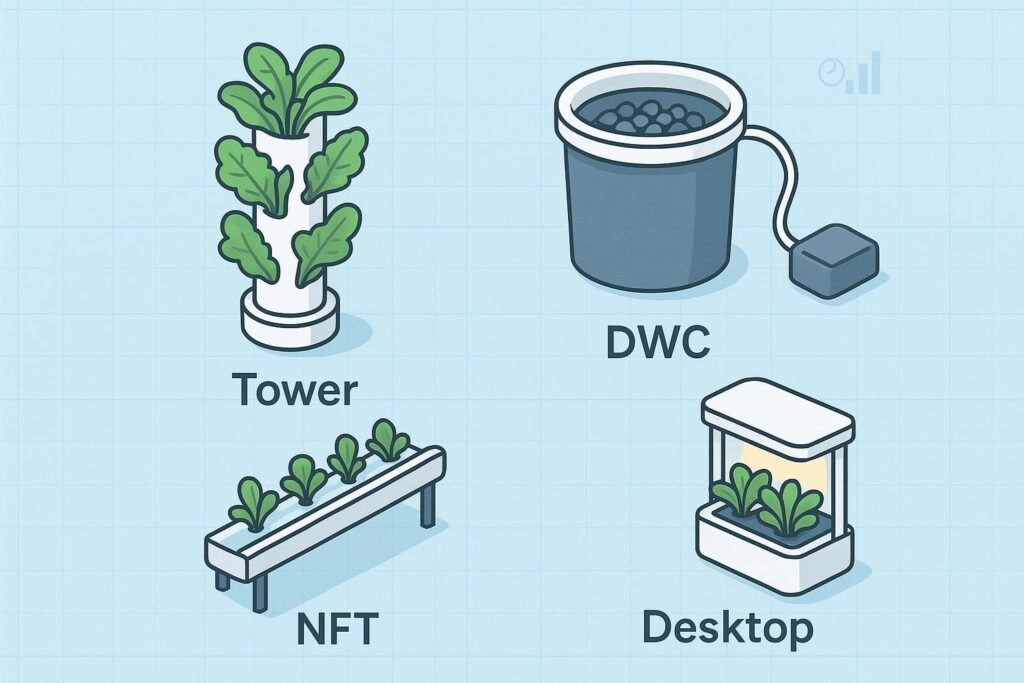
A small hydroponic garden is a compact, recirculating system that delivers water and nutrients directly to roots without soil. For pilot units and training benches, three formats dominate:
Deep Water Culture (DWC): Plants sit on rafts or net pots over an aerated reservoir. Very forgiving and inexpensive; ideal for beginners. Cornell’s controlled environment team documents DWC for home‑scale leafy greens with practical tools and timelines in its 2020 guide to home hydroponics for leafy greens, a handy reference for pilots that mimic small production flows (Cornell CEA guide).
Nutrient Film Technique (NFT): A thin film of solution flows through channels past roots. Efficient and neat, but more sensitive to pump interruptions. The University of Minnesota characterizes NFT along with other small‑scale hydroponics options, noting strengths and considerations for compact builds (UMN small‑scale hydroponics overview).
Kratky and passive variants: Non‑circulating, low‑maintenance approaches suited to micro pilots and education. Limited control and scalability compared with active systems (UMN overview above).
Vertical towers are a space‑efficient expression of recirculating hydroponics and can be used as a single‑unit pilot when vertical footprint is more available than floor space. Choice depends on your goals, budget, and staffing: DWC for tolerance and simplicity; NFT/towers for throughput per square foot with tighter monitoring.
Quick‑start blueprint (leafy greens focus)
Bill of materials (compact):
1 reservoir/tote (40–80 L) with lid and net‑pot openings
Air pump + stones (for DWC) or small submersible pump (for NFT/tower)
LED grow light(s) with adjustable height/drive
pH and EC/ppm meter (calibration solutions included)
Nutrient salts or a complete hydroponic nutrient
Food‑safe tubing, valves, and fittings; basic timer(s)
Sanitation kit (brushes, peroxide or peracetic acid per local guidance), gloves
Setup (numbered for SOP clarity):
Sanitize the reservoir, lines, and tools; rinse thoroughly.
Fill with clean water; add nutrients to reach EC in the lettuce range; adjust pH to ~6.0–6.5.
Seed in plugs; transplant when roots are visible and plugs hold together.
Set photoperiod to 12–14 h/day; position fixtures to reach target PPFD at canopy.
Verify flow/aeration; label the unit; start a daily log (pH, EC, temp, visual notes).
Top up with water daily; adjust EC and pH as needed; keep solution cool and oxygenated.
Safety and quality: Keep electrical components above floor level and use GFCI outlets; avoid warm, stagnant reservoirs; clean between cycles to prevent biofilm and algae.
Starter operating parameters (lettuce-centric)
Solution chemistry for small systems: The UF/IFAS extension guide for lettuce in small hydroponic systems recommends roughly pH 6.0–7.0 and EC 1.4–1.8 mS/cm, which works well for many leafy greens in pilot units (UF/IFAS HS1422).
Crop timing: Lettuce is a short‑cycle crop. UF/IFAS frames it as roughly 50–60 days in small systems, while Cornell CEA’s home hydroponics timeline documents a 35‑day example under adequate conditions, showing how environment and cultivar compress cycles (UF/IFAS HS1422; Cornell CEA guide).
Lighting basics: The University of Minnesota suggests 12–14 hours per day and positions 250–450 µmol·m⁻²·s⁻¹ as an effective indoor band for lettuce and herbs; adjust fixture height to manage intensity and heat (UMN lighting guidance).
DLI examples (not targets, for math only):
PPFD (µmol·m⁻²·s⁻¹) | Hours/day | DLI (mol·m⁻²·d⁻¹) |
|---|---|---|
250 | 12 | 10.8 |
300 | 14 | 15.1 |
400 | 14 | 20.2 |
The math used is straightforward:
Energy math you can audit
Your lighting drives most of the bill; pumps are usually a rounding error in comparison. Use efficacy from your LED’s datasheet (µmol/J) to convert light into watts, then into kWh and dollars using your local rate or national averages from the U.S. Energy Information Administration.
Worked example (single 1 m² bench):
Choose a target PPFD: 300 µmol·m⁻²·s⁻¹ for 14 h/day.
Assume fixture efficacy: 2.5 µmol/J (example value; check your datasheet).
Power density: 300 ÷ 2.5 ≈ 120 W/m².
Daily energy: 120 W × 14 h = 1.68 kWh/day.
Monthly (30 days): ≈ 50.4 kWh.
Cost: Using the 2024 U.S. commercial average of 12.75¢/kWh, lighting ≈ $6.43/month; residential 16.48¢/kWh would be ≈ $8.31/month. A small circulation pump (say 10 W, 24/7) adds ≈ 7.2 kWh/month (<$1 at commercial average). Prices from the EIA’s Electric Power Monthly and Short‑Term Energy Outlook provide current and outlook averages (EIA retail price table; EIA STEO averages).
Reality check: If your fixture is more efficient (e.g., 3.0 µmol/J), power drops; if you run higher PPFD or longer hours, costs rise. Log kWh with a plug‑in meter to verify.
Water and sanitation: what to expect and control
Hydroponic systems recirculate solution, so pilots often use substantially less water than comparable soil beds because leaching and evaporation losses are minimized. The University of Minnesota’s overview notes lower water use as a benefit of hydroponics, but avoid quoting percentages until you verify with local trials and authoritative studies (UMN small‑scale hydroponics overview).
Sanitation rhythm for pilots:
Between cycles: Drain, scrub, and sanitize reservoirs, channels, and tools; rinse thoroughly.
Weekly: Wipe splash zones; inspect and purge any biofilm; keep lids opaque to suppress algae.
Daily: Record pH, EC, and temperature; top up with water; observe roots and leaves for early stress.
Follow your local extension’s disinfection guidance for concentrations and contact times once you adopt a specific sanitizer; incorporate it into a written SOP and staff training.
OPEX you can predict (monthly view)
Expect lighting to dominate operating cost, with pumps, meters, and fans as minor contributors. Nutrients are typically a second‑tier cost, and water is often negligible for pilots.
Typical pilot line items for a 1–2 m² small hydroponic garden:
Electricity: Lighting ~40–100 kWh/month depending on PPFD/photoperiod/efficacy; pumps/fans ~5–15 kWh.
Nutrients: ~$5–$20/month depending on brand, concentration, and top‑up volume.
Water: Usually <$5/month in most municipalities for small pilots.
Consumables: Seed, plugs, cleaning supplies, and calibration solutions.
Use your logged EC adjustments and top‑up volumes to refine nutrient cost per cycle. Keep a simple spreadsheet that ties PPFD setpoints and hours to kWh and dollars; EIA’s sector averages (commercial vs. residential) are useful for scenario testing (see EIA links above).
Troubleshooting and scaling notes
Common failure modes and quick checks:
Algae/biofilm: Opaque lids, regular sanitation, and minimal light leaks into reservoirs.
pH/EC drift: Calibrate meters; measure at the same time daily; adjust in small increments.
Pump/flow interruption (NFT/towers): Add a simple audible alarm or Wi‑Fi plug alert; consider a backup pump.
Heat stress: Increase airflow; raise fixtures; ensure solution stays cool and oxygenated.
From pilot to array:
Standardize a daily log and a weekly sanitation routine.
Define setpoints (pH/EC/PPFD/hours) in a one‑page SOP and tape it near the unit.
Before adding more towers/channels, confirm your staffing can maintain logging and cleaning discipline; then replicate the unit as a cell.
Practical options and a neutral brand mention
Single‑unit vertical towers and compact DWC/NFT benches are common pilot choices. For teams that prefer a modular, recirculating vertical format that can scale by adding identical cells, a commercial‑grade tower unit can serve as a training platform. Disclosure: SPRINGS FAITH is our product. Its tower systems and home vertical garden options are designed for water‑efficient recirculation and predictable operation in compact footprints; see the brand homepage for general context (SPRINGS FAITH). Keep selection criteria objective: footprint, flow reliability, serviceability, and local electrical/water access.
Sources you can trust
University of Minnesota Extension’s overview of small‑scale hydroponics outlines system options and key considerations for compact builds, which helps frame trade‑offs for pilots (UMN small‑scale hydroponics overview).
Cornell CEA’s home hydroponics guide provides practical DWC/NFT timelines and tools you can adapt to training units (Cornell CEA guide to home hydroponics for leafy greens).
UF/IFAS specifies lettuce‑appropriate EC and pH for small systems and frames typical cycle windows (UF/IFAS HS1422: Growing Lettuce in Small Hydroponic Systems).
The University of Minnesota’s lighting guidance suggests 12–14 hours/day and a 250–450 µmol·m⁻²·s⁻¹ band suitable for indoor lettuce/herbs, useful for setting starter light schedules (UMN lighting guidance).
The U.S. EIA provides current and outlook electricity prices to turn your PPFD and hours into transparent monthly costs (EIA retail price table; EIA STEO averages).
Related Posts
 Hydroponic vs Aeroponic Towers (2026): Which System Is Better for Your Plants?
 What Can You Grow in a Hydroponic Tower? 15 Best Plants for Vertical Growth
 Hydroponic Tower Cost Analysis: Is It Worth the Investment? (Plus DIY Options)