
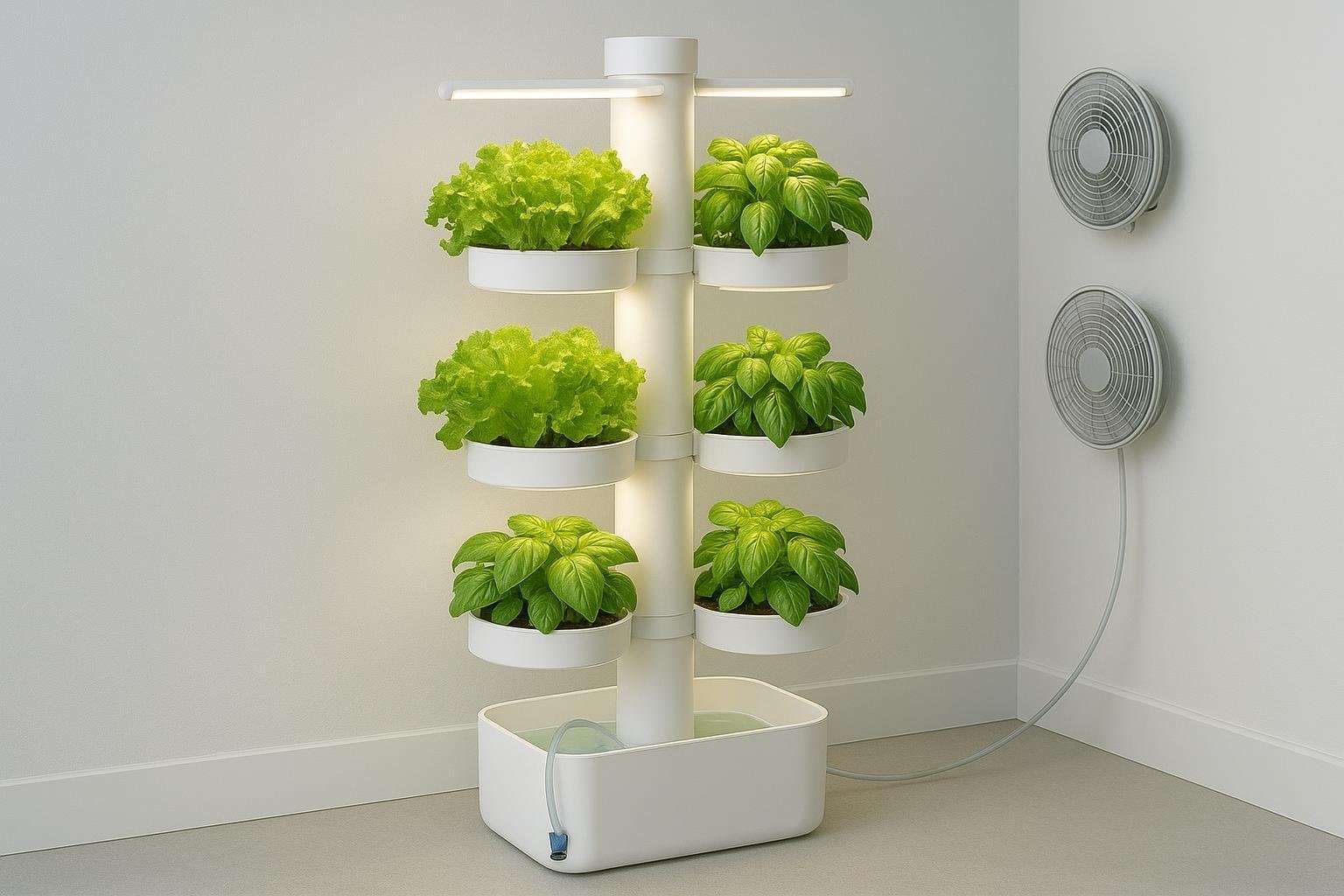
 Growing indoors with a hydroponic tower can be highly productive when you pair closed-loop water circulation with well-planned lighting. This guide is written for urban/vertical farm operators, institutional greenhouses, and serious home growers who need consistent yields, predictable energy and water use, and fast SOP onboarding. We focus on measurable targets—PPFD/DLI for lights, pH/EC for nutrients, irrigation duty cycles, reservoir temperature and dissolved oxygen, sanitation/IPM routines—and the KPIs to track so your “tower with lights” becomes a reliable production unit.
Key takeaways
- Target PPFD ~200–300 µmol·m⁻²·s⁻¹ for leafy greens with a ~16-hour photoperiod to reach a DLI ~12–17 mol·m⁻²·day⁻¹; verify with a quantum sensor and tune by cultivar and density.
- Keep solution pH ~5.8–6.2 (lettuce 6.0–7.0; basil 5.5–6.0) and EC ~1.0–1.8 mS/cm depending on crop and stage; log daily and adjust in small increments.
- Start irrigation at continuous or long duty cycles during lights-on for drip/trickle towers (e.g., 15–30 minutes per hour); verify uniform return flow and root health.
- Maintain reservoir temperature ~18–23°C with DO ~7–8 mg/L; opaque reservoirs and airflow reduce algae and disease.
- Track KPIs: harvest weight per tower per cycle, DLI logs, pH/EC trends, reservoir temp/DO, irrigation uptime, and lighting kWh/kg via a simple formula.
Quick start: Your hydroponic tower with lights setup
You’ll need a recirculating hydroponic tower, LED fixtures compatible with vertical mounting, a reservoir (opaque if possible), a submersible pump sized to your tower height, timers/controllers, and meters for pH, EC, and ideally DO. Add a quantum sensor to measure PPFD at different heights and a couple of small circulation fans to keep leaves dry.- Bill of materials (essential): tower body/modules, reservoir (≥40–80 L for small setups), submersible pump matched to head height, LED fixtures/rails with mounting hardware, pH/EC meter, nutrient concentrates, tubing/fittings, power timers.
- Recommended: DO meter, inline coarse filter/screen, aeration stone, calibration fluids (pH 4/7, conductivity standard), sanitation supplies (brushes, peroxide or hypochlorite per label).
- Optional: Data logger for light/temps, backup pump, UPS for pumps/controllers, additional sensors (temperature probes, float switch).
- Place the tower on a level surface; confirm reservoir lid fits and blocks light.
- Fill reservoir with clean water; mix nutrients to target EC; set pH in range.
- Prime the pump and run a leak test for 5 minutes; inspect return flow uniformity.
- Mount LEDs; set photoperiod on the timer (e.g., 16 hours) and measure PPFD at two or three canopy heights.
- Position fans to keep gentle airflow across leaves without desiccation.
Step-by-step setup and first run
- Site and assemble (30–60 minutes)
- Place the tower where you can access reservoir and plumbing. Avoid light leaks into the reservoir.
- Assemble modules per manufacturer instructions. Verify vertical alignment so emitters don’t drip outside channels.
- Check that all fittings are snug; run a dry fit before filling.
- Reservoir fill and nutrient mix (15–25 minutes)
- Fill to the recommended level, leaving headroom for splash.
- Add nutrients and measure EC; start at the low end for seedlings and increase later.
- Adjust pH using small, measured additions; stir and re-check after 2–3 minutes.
- Pump commissioning (10–20 minutes)
- Prime the pump and run the system for at least 10 minutes.
- Inspect for leaks and confirm uniform wetting of all towers.
- Add aeration if DO is low (air stone or increased agitation).
- Lighting calibration (20–30 minutes)
- Mount fixtures at manufacturer-recommended distances. Aim for even coverage top-to-bottom.
- Set photoperiod (e.g., 16 hours on, 8 hours off) and measure PPFD across multiple tower faces.
- Adjust height/angle to keep PPFD uniform within ±10–15% across the vertical profile.
- Planting and first-week checks (20–40 minutes)
- Transplant disease-free seedlings with active roots. Seat plugs securely to avoid light hitting root zones.
- Monitor daily: pH/EC, reservoir temperature, DO, and leaf wetness. Weekly, top-off water, refresh nutrients (partial change), verify photoperiod/DLI, and spot-check PPFD; per cycle, perform a full drain/clean and recalibrate meters.
- Tune irrigation duty cycle to prevent pooling while keeping roots moist.
Lighting primer: PPFD, DLI, and photoperiod
Your hydroponic tower with lights depends on setting a clear Daily Light Integral (DLI) target and using PPFD and photoperiod to hit it. DLI is the total number of photons your plants receive per day. For lettuce and similar leafy greens indoors, operators commonly aim for the low-to-mid teens, often by running moderate PPFD for longer hours.- DLI context: Dutch Greenhouses describes winter lettuce targets around 12–14 mol·m⁻²·day⁻¹ in northern greenhouses with LED supplementation. See the definition in the Daily Light Integral glossary.
- Photoperiod × PPFD: MSU floriculture notes that different PPFD/photoperiod combinations can reach the same DLI; extended photoperiods at modest PPFD can maintain growth while keeping energy predictable. MSU’s guidance on delivery of DLI is summarized in their planning note.
- Target DLI = 15 mol·m⁻²·day⁻¹
- Photoperiod = 16 h → 16 × 3600 = 57,600 s
- Required average PPFD ≈ DLI × 1,000,000 / photoperiod seconds = 15,000,000 / 57,600 ≈ 260 µmol·m⁻²·s⁻¹
- Set fixtures to ~250–270 µmol·m⁻²·s⁻¹ at canopy and verify with a quantum sensor. Adjust by cultivar and density.
Nutrients and water management: pH/EC SOPs
Stable chemistry underpins healthy hydroponic growth. Keep pH and EC within crop ranges and adjust in measured steps.- Lettuce: pH 6.0–7.0; EC ~1.2–1.8 mS/cm. These ranges align with extension fundamentals in Penn State’s hydroponics primer and are echoed in industry charts.
- Basil: pH 5.5–6.0 (some guides extend slightly higher); EC ~1.0–1.6 mS/cm. See triangulated references like Aero-Gro’s herb parameters and their EC/pH recommendations chart.
Irrigation, pumps, and flow
Drip/trickle towers benefit from consistent wetting and robust return flow. Duty cycles are “typical ranges”—verify with your manufacturer and your crop.- Drip/trickle template: Continuous flow during lights-on, or long pulses such as 15–30 minutes per hour. Inspect roots and channels to avoid oversaturation.
- Aeroponic towers: General literature suggests short bursts (e.g., 30–120 seconds) followed by off intervals (3–15 minutes), but tower-specific timings require validated documentation; treat these as unverified for towers.
- Submersible pumps in the hundreds of L/h (e.g., ~1,500 L/h ≈ 400 GPH) are common for small/medium towers. Confirm the pump’s performance curve at your tower’s head height (often ~1.5–3 m) and account for friction losses.
- For high-pressure aeroponics, consult specs for 40–80 PSI systems. Always verify nozzle and pump compatibility.
Environmental control and sanitation
Keep the root zone cool and oxygenated, and reduce pathogen pressure through airflow and hygiene.- Reservoir temperature: Aim for ~18–23°C. Warmer solutions (>23–24°C) increase Pythium risk and reduce oxygen solubility. Peer-reviewed reviews of hydroponic pathogens cover these dynamics; see the overview in NIH/PMC hydroponic pathogen ecology.
- Dissolved oxygen (DO): Maintain ≥5–6 mg/L, targeting ~7–8 mg/L. Aerated hydroponic solutions commonly hold ~7.8 mg/L without stress; see context in this DO maintenance example.
- Airflow and spacing: Use circulation fans to prevent leaf wetness and stagnation; avoid overcrowding.
Troubleshooting matrix
| Symptom | Likely cause | Immediate action |
|---|---|---|
| Wilting during lights-on | Low reservoir level or pump failure | Refill reservoir; check pump, lines, and timers |
| Brown/slimy roots | High solution temp or low DO; biofilm | Cool solution, increase aeration; sanitize lines |
| Chlorosis (yellowing) | pH out of range; low iron; EC too low | Adjust pH to target; review nutrient recipe; raise EC slightly |
| Tip burn | High EC; poor airflow; calcium uptake issues | Lower EC; increase fan airflow; consider longer photoperiod at moderate PPFD |
| Uneven growth across tower | Non-uniform PPFD or irrigation | Reposition lights; verify PPFD uniformity; check emitter flow |
Data and KPIs: track what matters
Lighting energy intensity (kWh/kg):- Formula: kWh/kg ≈ (fixture kW × hours/day × days per crop) ÷ harvest kg.
- Example: Two 150 W fixtures (0.3 kW total) × 16 h/day × 28 days = 134.4 kWh. If harvest per cycle is 12 kg, lighting kWh/kg ≈ 11.2. This excludes HVAC and pumps; use it as a comparative KPI.
- Recirculating vertical systems frequently cut water use by ~70–95% vs soil due to minimized runoff and reuse. ICIMOD cites 70–95% savings for urban vertical farming; see their overview. Peer-reviewed syntheses echo similar savings for hydroponics/CEA; see PNAS Nexus review.
- Practical logging: Track top-off volumes per week and estimate L/plant/day. Size reservoirs to cover 5–7 days of demand with 10–20% margin.
- Log harvest weight per tower per cycle. Track DLI, pH/EC, and irrigation uptime alongside yields to correlate operational changes with results.
Scaling and next steps
For commercial stacks, add redundancy and automation:- Pump redundancy and alarmed float switches to prevent dry runs.
- Automated dosing for pH and EC with audit logs.
- Backup power for pumps/timers; staged lighting controls to flatten demand peaks.
- Sensor thresholds with alerts for reservoir temperature, DO, and photoperiod deviations.
Practical example (neutral)
Disclosure: SPRINGS FAITH is our product. A commercial-grade, closed-loop tower can be outfitted with LED rails at each tier and a submersible pump calibrated to the tower’s head height. In practice, operators set photoperiod to ~16 hours at a measured PPFD near 250 µmol·m⁻²·s⁻¹, maintain reservoir temperature around 20–22°C, and log pH/EC daily. When return flow is uniform and PPFD stays within ±10–15% across the column, yields stabilize and troubleshooting time drops. A neutral example of such a setup can be explored on SPRINGS FAITH’s homepage for system context without performance claims.Further reading
- Daily Light Integral (DLI) and lighting planning: Dutch Greenhouses glossary; MSU floriculture note on delivering DLI.
- Hydroponics pH/EC fundamentals and crop ranges: Penn State Extension primer; Aero-Gro crop parameter charts.
- Vertical tower assembly and pump basics: OSU Extension tower guide.
- Sanitation/IPM and biofilm/algae management: NIH/PMC pathogen ecology overview; SFA best practice on algae/biofilm.
Categories:
Related Posts
 Hydroponic vs Aeroponic Towers (2026): Which System Is Better for Your Plants?
Compare Hydroponic vs Aeroponic tower systems across yield, water, energy, labor, and downtime. Scenario-based guidance
 What Can You Grow in a Hydroponic Tower? 15 Best Plants for Vertical Growth
Discover 15 best plants for hydroponic towers—leafy greens, hydroponic herbs, and strawberries—with EC/pH, DLI, density
 Hydroponic Tower Cost Analysis: Is It Worth the Investment? (Plus DIY Options)
Comprehensive analysis of Hydroponic Tower Cost—CAPEX, electricity, nutrients, labor, maintenance—plus $200/$500/$1,000 DIY options and ROI