
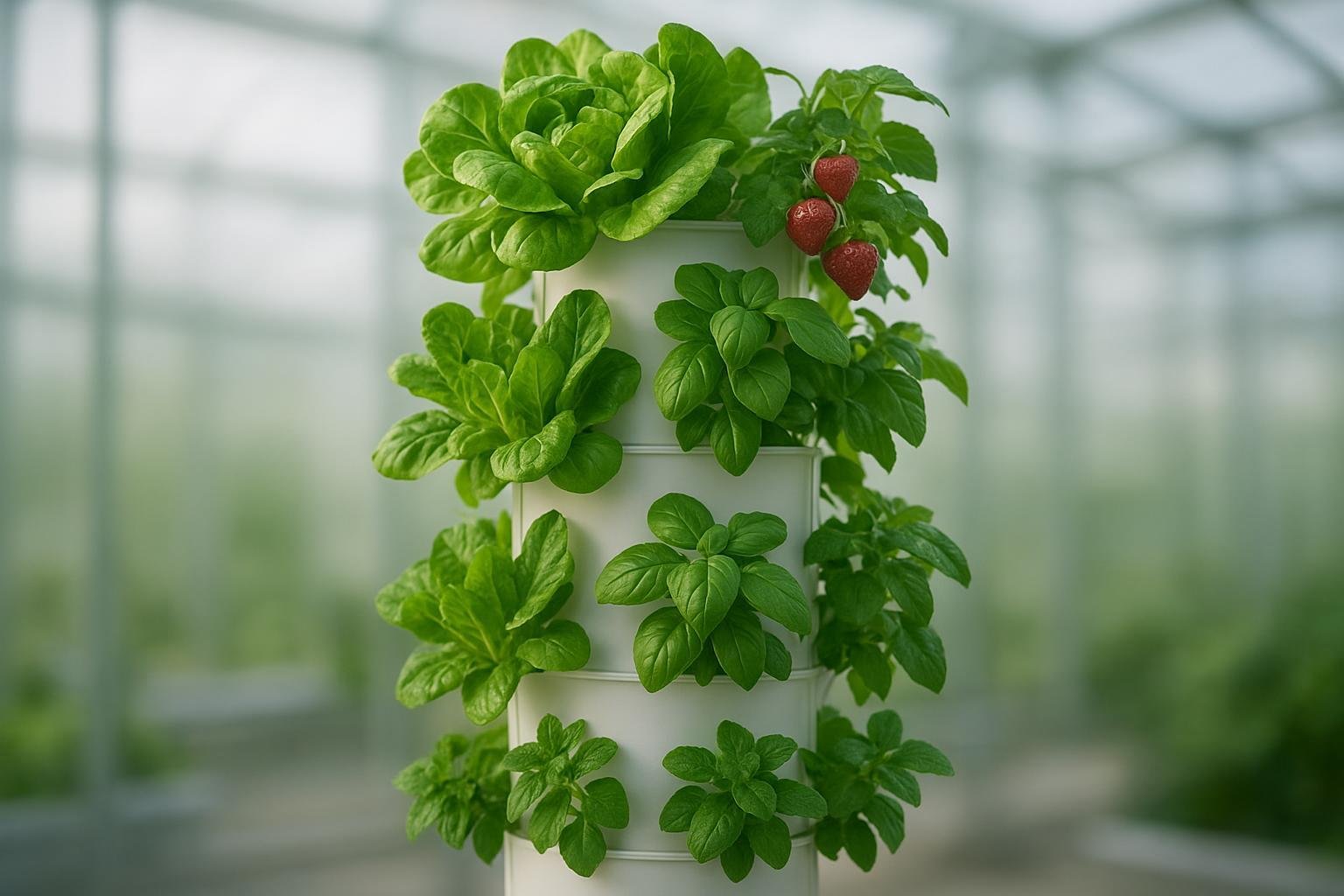
If you’re running a greenhouse, an indoor vertical farm, or a school lab, the right crops make all the difference in a hydroponic tower. Choose plants with the proper root architecture, light appetite, and growth cadence, and you’ll unlock predictable yields, faster turns, and cleaner SOPs. Pick the wrong ones and you’ll fight tip burn, bolting, or spindly vines that demand more labor than they return.
This guide ranks 15 proven crops for pocket-style vertical towers and gives you the parameters you actually need to run them: days to harvest, EC/pH ranges, DLI/PPFD targets, per-site density, placement by tower zone, and simple yield guidance—plus pros/cons and support needs. Where possible, we cite authoritative sources like Cornell CEA, MSU Floriculture, UF/IFAS, NCSU, and Grodan using descriptive anchors in-line.
Looking for a broader foundation before you pick crops? Start with Plants for vertical hydroponics for a systems-level overview, then come back here to dial in crop-by-crop setpoints.
Soft resource for planners (optional): If you’re comparing tower system specs and want to see how water-recirculating designs can support stable EC/pH across cycles, SPRINGS FAITH publishes neutral design notes focused on continuous production and modular scaling. The system is engineered to conserve water and emphasize predictable maintenance; explore the brand overview at SPRINGS FAITH to evaluate fit within your facility layout.
Key takeaways
Best “Plants for Hydroponic Tower” are compact leafy greens, culinary herbs, and select fruiting crops (with support). They align well with shallow vertical pockets and frequent irrigation.
Parameter anchors you can trust: Leafy greens commonly target 12–17 mol/m²/day DLI with pH near 5.8–6.2 and EC around 1.2–1.8 mS/cm; confirm locally with your climate and cultivars according to the Cornell CEA leafy-greens guide (2020).
Hydroponic herbs like basil tolerate higher light than lettuce; seedling research from MSU shows strong performance at higher light exposures relative to lettuce-class crops (MSU Floriculture lighting resources).
Growing Strawberries Vertically is feasible in towers, but fruiting requires higher light, careful EC/pH, runner management, and pollination support; NCSU documents soilless strawberry nutrition around pH ~5.5 and EC ~1.4 mS/cm as a program example (NCSU Extension, strawberry substrates).
Keep list operations simple: Match placement (top/middle/bottom) to crop light/heat tolerance to reduce disorders like tip burn and bolting.
Methodology: how we chose (and how to use this guide)
We ranked crops using a practical blueprint geared to tower operations. Each dimension below includes how we evaluate it and why it matters in pocket-style vertical systems. Weights sum to 100 to reflect decision impact for most commercial teams.
Tower-compatibility and root-zone fit — 18%: Compact root mass, tolerance to frequent irrigation, and reliable pocket fit.
Growth cycle speed and harvest frequency — 17%: Seed-to-transplant timing, transplant-to-harvest days, and cut-and-come-again potential.
Yield per site/tower stability — 16%: Grams/plant/week, heads/month, and uniformity across tower levels.
Resource efficiency (water, energy, nutrients) — 14%: Low EC success, light-to-biomass conversion, and recirculation benefits.
Operational complexity and support needs — 12%: Trellising, pruning, pollination, weekly SOP steps.
Quality and marketability — 12%: Flavor, texture, shelf-life, and price/kg in your channels.
Environmental tolerance and risk — 11%: Susceptibility to bolting, tip burn, or mildew; tolerance to pH/EC drift.
Evidence and sourcing
We anchor leafy-green DLI and pH targets to the Cornell CEA guide to leafy greens (2020) and lighting concepts from MSU Floriculture (2019–2025).
Strawberry nutrient examples come from NCSU Extension on soilless strawberry production.
Root-zone EC stability for fruiting crops references Grodan’s research notes on EC management.
Use this guide as a starting SOP. Local cultivars, climate control, and irrigation design will push you to fine-tune setpoints. When an extension-grade numeric wasn’t available, we mark values as “baseline” and explain why.
Parameters comparison table (scan this first)
Below is a unified snapshot of the 15 crops—days to harvest (from transplant), EC/pH, DLI targets, density guidance, and key notes. “Baseline” references widely accepted leafy-green norms or industry concepts where crop-specific extension numbers weren’t available in our research round. Always validate locally.
| Crop | Days to Harvest | EC (mS/cm) | pH | DLI (mol/m²/day) | Density (sites/column) | Notes / Support Needs |
|---|---|---|---|---|---|---|
| Butterhead lettuce | ~24–34 (+~11d seedling) | 1.4–1.8 | 5.8–6.5 | 12–17 | Medium | Mid/lower placement to reduce tip burn; no support |
| Romaine lettuce | ~35–45 | 1.4–1.8 | 5.8–6.5 | 12–17 | Medium | Mid placement; manage heat/light |
| Spinach | ~21–35 (baby) | 1.2–1.8 (baseline) | 5.8–6.2 | 10–14 | High | Cooler zones; avoid warm nutrient temps |
| Kale | ~30–45 (first cut) | 1.2–1.8 (baseline) | 5.8–6.5 | 12–18 | Moderate | Middle; continuous harvest |
| Swiss chard | ~30–45 (first cut) | 1.2–1.8 (baseline) | 5.8–6.5 | 12–18 | Moderate | Heat tolerant; minimal support |
| Arugula | ~21–30 | 1.2–1.8 (baseline) | 5.8–6.2 | 10–16 | High | Lower/middle for tenderness |
| Basil | ~30–40 (first cut) | ~1.2–1.8 (herb baseline) | 5.8–6.2 | ≥15 common | Moderate | Tolerates higher light; middle/top |
| Mint | ~21–35 (first cut) | ~1.2–1.8 (baseline) | 5.8–6.2 | 12–18 | Med–High | Vigorous; manage spread |
| Parsley | ~40–60 (first cut) | ~1.2–1.8 (baseline) | 5.8–6.2 | 12–18 | Moderate | Cooler middle/lower |
| Cilantro | ~25–35 (baby) | ~1.2–1.8 (baseline) | 5.8–6.2 | 10–14 | High | Bolts in heat/high DLI |
| Chives | ~35–50 (first cut) | ~1.2–1.8 (baseline) | 5.8–6.2 | 12–18 | Moderate | Clump-forming; easy |
| Strawberries | 8–10+ weeks to first fruit | ~1.4 (example) | ~5.5 | High vs greens | Low–Med | Top/adjacent; pollination & runner mgmt |
| Cherry tomatoes | 60–80+ | Manage stability | 5.5–6.5 | High | Low | Trellis required; top/adjacent |
| Sweet peppers | 70–90+ | Manage stability | 5.5–6.5 | High | Low | Trellis required; top/adjacent |
| Mini cucumbers | 55–75+ | Manage stability | 5.5–6.5 | High | Low | Trellis required; top/adjacent |
Parameter anchors: Leafy-greens DLI/pH guidance per Cornell CEA leafy-greens guide (2020). Lighting concepts for herbs and seedlings from MSU Floriculture resources. Strawberry soilless nutrition example from NCSU Extension. EC stability for fruiting from Grodan EC management overview.
Lighting and placement cheat sheet (PPFD ↔ DLI math included)
Leafy greens (lettuce class): target roughly 12–17 mol/m²/day indoors. In greenhouses, yields may improve into the upper teens depending on season and cultivar. Reference: Cornell CEA leafy-greens guide (2020) and MSU Floriculture lighting concepts.
Herbs: basil often thrives with higher light than lettuce; seedling studies demonstrate tolerance of high light when temperature and nutrition are tuned (MSU lighting resources).
Fruiting crops: expect higher DLI than greens; confirm setpoints via local trials and crop manuals. EC stability becomes more critical as fruit load increases (Grodan EC management).
Placement rules of thumb in towers (generalized):
Top: high-light, heavier or vining crops (strawberries, compact tomatoes/peppers/cukes with trellis).
Middle: versatile zone for leafies and herbs that like moderate light (romaine, kale, basil).
Bottom: tender greens and cool-preferring herbs (butterhead, spinach, cilantro) to reduce heat/light stress.
PPFD ↔ DLI conversion
Formula: DLI (mol/m²/day) = PPFD (µmol/m²/s) × photoperiod (h) × 3600 ÷ 1,000,000.
Example: 200 µmol/m²/s at 16 hours ≈ 200 × 16 × 3600 ÷ 1,000,000 ≈ 11.5 mol/m²/day.
Decision flow: Which crop fits your operation first?
Need fastest turnover and simple SOPs? Start with butterhead, romaine, arugula, or baby kale.
Chasing premium herb revenue with manageable labor? Basil, mint, parsley, chives.
Want showpiece fruit and agri-tourism pull? Pilot strawberries; add compact tomatoes/peppers/cukes only after dialing light and EC stability.
Running a mixed tower? Set pH ~5.8–6.2 and EC ~1.2–1.6 mS/cm; place tender greens low, herbs mid, fruiting high.
Mixed-planting rules (quick SOP box)
One reservoir, many needs: Pick compromise setpoints (pH 5.8–6.2; EC 1.2–1.6) and group crops by light/heat tolerance across tower levels.
Staggered transplanting: Start herbs 5–7 days after lettuce seedlings so canopies mature together.
Airflow first: Alternate larger-leaf pockets with finer herbs to reduce microclimate humidity spikes.
Weekly checks: Log pH drift, EC consumption, canopy temps, and leaf Ca issues; adjust irrigation frequency accordingly.
Best Plants for Hydroponic Tower Systems (ranked list of 15)
Below, each item follows the same card structure: positioning, cultivar examples, cycle (seed → transplant → harvest days), EC/pH, DLI/PPFD, density (sites/column), yield guidance, placement, best-for/not-for, pros/cons, support needs, and evidence links.
1) Butterhead Lettuce (e.g., Salanova hydroponic types)
Positioning (1 line): The most reliable head lettuce for pocket-style towers—fast, uniform, and gentle on EC.
Cultivar examples: Salanova Green Butter, Salanova Red Butter (hydroponic lines).
Seedling specs: 10–12 days in 1-inch plugs to 3–4 true leaves.
Cycle (days): ~11 seedling → ~24–34 to head from transplant under adequate DLI.
Temperature: Air 60–70°F ideal; nutrient 60–68°F to reduce Pythium risk.
EC & pH: EC 1.4–1.8 mS/cm; pH ~5.8–6.5 (lettuce guides allow up to ~7.0; many CEA growers hold 5.8–6.2).
DLI/PPFD: Target 12–17 mol/m²/day; example PPFD 180–260 µmol/m²/s at 16 h.
Density: Medium (don’t overpack—allow rosette expansion).
Yield guidance: 1 marketable head/site/cycle; 5–7 oz typical head ranges vary.
Placement: Middle to lower pockets to reduce heat/light stress and tip burn risk.
Best for / Not for: Best for predictable head runs; not for hot houses without cooling.
Pros / Cons: Pros—quick, uniform heads; low EC. Cons—tip burn/bolting under high DLI/heat.
Support needs: None.
Evidence links: Leafy-greens DLI/pH targets per Cornell CEA, 2020 leafy-greens guide; lettuce EC/pH practices per UF/IFAS HS1422; hydro head timing via Johnny’s hydroponic butterhead sheet.
2) Romaine Lettuce (compact types)
Positioning: Upright architecture fits pockets nicely; crunchy texture sells well.
Cultivar examples: Mini romaines and batavia/romaine hybrids.
Seedling specs: 10–12 days to transplantable size; avoid leggy starts.
Cycle: ~35–45 days from transplant to head (variety dependent).
Temperature: 60–70°F air; avoid >75°F to reduce bolting.
EC & pH: EC 1.4–1.8; pH 5.8–6.5 typical.
DLI/PPFD: 12–17 mol/m²/day; watch leaf edge heat loading.
Density: Medium; avoid shade on neighboring pockets.
Yield guidance: 1 head/site/cycle; strong for crunchy blends.
Placement: Middle pockets; allow airflow.
Best for / Not for: Best for romaine hearts and blends; not for poorly cooled summer houses.
Pros / Cons: Pros—marketable texture, durability. Cons—tip burn risk in heat/high DLI.
Support needs: None.
Evidence: Cornell CEA leafy-greens DLI/pH; UF/IFAS HS1422; timing example via Johnny’s hydro red batavia.
3) Spinach
Positioning: Cool-loving baby leaf that rewards moderate light and tight harvest cadence.
Cultivar examples: ‘Seaside’, ‘Space’, baby-leaf lines.
Seedling specs: 12–18 days to transplant; prefers cooler germination.
Cycle: ~21–35 days for baby leaf depending on temp and cultivar.
Temperature: 55–65°F air; avoid warm nutrients.
EC & pH: Baseline EC ~1.2–1.8; pH 5.8–6.2.
DLI/PPFD: 10–14 mol/m²/day.
Density: High for baby leaf; harvest by cut-and-come-again.
Yield guidance: 1–3 cuts depending on vigor.
Placement: Lower or middle zones to temper heat/light.
Best for / Not for: Best for cool-season runs; not for hot greenhouses.
Pros / Cons: Pros—fast, nutrient-dense. Cons—bolts quickly in heat; sensitive root temps.
Support needs: None.
Evidence: Cornell CEA leafy-greens baseline; UF/IFAS hydro methods explainer, 2025.
4) Kale
Positioning: Durable leaf crop with forgiving parameters and long harvest window.
Cultivar examples: ‘Red Russian’, ‘Lacinato’.
Seedling specs: 10–14 days; transplant with sturdy stems.
Cycle: ~30–45 days to first cuts from transplant.
Temperature: 60–72°F air ideal.
EC & pH: Baseline EC ~1.2–1.8; pH 5.8–6.5.
DLI/PPFD: 12–18 mol/m²/day.
Density: Moderate; plan for ongoing leaf pull.
Yield guidance: Successive leaf harvests for weeks.
Placement: Middle zones for airflow and light balance.
Best for / Not for: Best for bunched greens programs; not for micro-pocket systems.
Pros / Cons: Pros—resilient, steady biomass. Cons—older leaves toughen; aphids under dense canopies.
Support needs: None.
Evidence: Cornell CEA leafy-greens guide; UF/IFAS CV265 concepts.
5) Swiss Chard
Positioning: Heat-tolerant leafy with showy petioles—reliable in mixed towers.
Cultivar examples: ‘Bright Lights’, ‘Fordhook Giant’.
Seedling specs: 10–14 days; thin to strongest starts.
Cycle: ~30–45 days to first cuts.
Temperature: 60–75°F air; handles warmth better than lettuce.
EC & pH: Baseline EC ~1.2–1.8; pH 5.8–6.5.
DLI/PPFD: 12–18 mol/m²/day.
Density: Moderate; avoid shading neighbors.
Yield guidance: Repeated cuts; trim large leaves for airflow.
Placement: Middle zones.
Best for / Not for: Best for warm-season towers; not for ultra-tight spacing.
Pros / Cons: Pros—resilient, colorful. Cons—leaf size can crowd pockets.
Support needs: Minimal.
Evidence: Cornell CEA leafy-greens DLI; UF/IFAS hydro methods explainer, 2025.
Soft, mid-list resource (after item 5): Want a “printable” tower parameters worksheet without relying on a download? Copy these fields into a spreadsheet and use it at shift handoff:
Date + crop + cultivar + tower level (top/middle/bottom)
Photoperiod (h) + PPFD (µmol/m²/s) + calculated DLI (mol/m²/day)
Reservoir EC (mS/cm) + pH + nutrient temperature (°F/°C)
Irrigation schedule (on/off, pulses/day) + top-off volume
Notes on disorders (tip burn/bolting/mildew) + corrective action
Harvest: grams per site, % culls, and days since transplant
If you log this for 3–4 consecutive cycles, you’ll have enough data to tighten your “baseline” setpoints into crop- and facility-specific SOP ranges.
6) Arugula
Positioning: Peppery salad green with lightning-fast baby-leaf turns.
Cultivar examples: ‘Astro’, wild arugula types.
Seedling specs: 7–10 days; transplant young for tender leaves.
Cycle: ~21–30 days to baby leaf.
Temperature: 60–70°F air.
EC & pH: Baseline EC ~1.2–1.8; pH 5.8–6.2.
DLI/PPFD: 10–16 mol/m²/day.
Density: High; harvest early and often.
Yield guidance: Multiple cuts; maintain short intervals.
Placement: Lower/middle for tenderness.
Best for / Not for: Best for fast salad programs; not for hot seasons without cooling.
Pros / Cons: Pros—quick cycles, premium mixes. Cons—pungency spikes and bolting under heat/high DLI.
Support needs: None.
Evidence: Cornell CEA leafy-greens DLI/pH; MSU edibles page.
7) Basil (Genovese & hydro-suited types)
Positioning: The revenue engine among hydro herbs when light and pruning SOPs are on point.
Cultivar examples: ‘Genovese’, ‘Nufar’, Thai basil.
Seedling specs: 10–14 days; transplant at 3–4 true leaves; pinch early for branching.
Cycle: ~30–40 days to first cut; ongoing pruned harvests thereafter.
Temperature: 70–78°F air; avoid cold drafts.
EC & pH: Herb baseline EC ~1.2–1.8; pH ~5.8–6.2.
DLI/PPFD: Production ≥15 mol/m²/day common; seedlings handle higher light well per MSU with proper climate.
Density: Moderate; allow branching space.
Yield guidance: Biweekly cuts; maintain 3–4 node structure for continuous yield.
Placement: Middle to top; basil tolerates higher light/heat relative to lettuce.
Best for / Not for: Best for restaurants/retail herbs; not for cool/dim houses.
Pros / Cons: Pros—high value, fast biomass. Cons—downy mildew risk; needs sanitation and airflow.
Support needs: None.
Evidence: MSU lighting resources on seedlings/indoor growing; Cornell CEA leafy guide for pH/DLI framing.
8) Mint
Positioning: Vigorous culinary herb that rebounds fast after cutting.
Cultivar examples: Spearmint, peppermint.
Seedling specs: Often easier via cuttings/plugs; 10–14 days establishment.
Cycle: ~21–35 days to first cut.
Temperature: 65–75°F air.
EC & pH: Herb baseline EC ~1.2–1.8; pH 5.8–6.2.
DLI/PPFD: 12–18 mol/m²/day.
Density: Medium to high; watch for pocket overrun.
Yield guidance: Frequent cuts; avoid woody stems.
Placement: Middle zones.
Best for / Not for: Best for beverage/herb programs; not for tiny-pocket units.
Pros / Cons: Pros—resilient, aromatic. Cons—can crowd neighbors; sanitation matters.
Support needs: None.
Evidence: Cornell CEA baseline pH/DLI context; MSU edibles.
9) Parsley
Positioning: Bunching staple with good shelf life and steady regrowth.
Cultivar examples: Curly and flat-leaf.
Seedling specs: 14–21 days; slower germination; consider primed seed.
Cycle: ~40–60 days to first cut.
Temperature: 60–70°F air.
EC & pH: Herb baseline EC ~1.2–1.8; pH ~5.8–6.2.
DLI/PPFD: 12–18 mol/m²/day.
Density: Moderate; avoid clumping.
Yield guidance: Regular cutbacks; bunch by weight.
Placement: Middle to lower in warmer houses.
Best for / Not for: Best for retail bunching; not for ultra-fast turns.
Pros / Cons: Pros—durable and forgiving. Cons—slower to first cut.
Support needs: None.
Evidence: Cornell CEA pH/DLI baselines; UF/IFAS methods explainer.
10) Cilantro (Coriander)
Positioning: Cool-preferring herb perfect for quick baby-leaf turns.
Cultivar examples: ‘Santo’, slow-bolt types.
Seedling specs: 7–10 days; direct-seeding into plugs works; keep cool.
Cycle: ~25–35 days to baby leaf.
Temperature: 55–65°F air.
EC & pH: Herb baseline EC ~1.2–1.8; pH 5.8–6.2.
DLI/PPFD: 10–14 mol/m²/day.
Density: High for baby leaf.
Yield guidance: Stagger sowing; harvest young.
Placement: Lower/middle to minimize heat and bolting.
Best for / Not for: Best for cool houses; not for hot/dry seasons without control.
Pros / Cons: Pros—fast, fragrant. Cons—bolts fast in heat/high DLI.
Support needs: None.
Evidence: Cornell CEA leafy/herb baselines; MSU edibles.
11) Chives
Positioning: Compact, clump-forming herb that fits small pockets well.
Cultivar examples: Common chives; garlic chives.
Seedling specs: 10–14 days; clump multiple seedlings per plug.
Cycle: ~35–50 days to first cut.
Temperature: 60–70°F air.
EC & pH: Herb baseline EC ~1.2–1.8; pH 5.8–6.2.
DLI/PPFD: 12–18 mol/m²/day.
Density: Moderate; plan for scissors harvest.
Yield guidance: Regular trims maintain tenderness.
Placement: Middle zones.
Best for / Not for: Best for steady garnish programs; not for maximum biomass goals.
Pros / Cons: Pros—compact and tidy. Cons—slower establishment from seed.
Support needs: None.
Evidence: Cornell CEA leafy/herb baseline; UF/IFAS methods explainer.
12) Strawberries (day-neutral cultivars like ‘Albion’, ‘Seascape’)
Positioning: The star fruit for towers—high-value, customer-pleasing berries when light and climate are dialed.
Cultivar examples: ‘Albion’, ‘Seascape’, ‘Monterey’ (evaluate locally).
Transplant specs: Use tray plugs or conditioned bare-roots; remove first flowers to build canopy.
Cycle: Establishment to first harvest often 8–10+ weeks depending on plug/bare-root and climate.
Temperature: 60–75°F air; avoid humid stagnation.
EC & pH: NCSU soilless nutrition example pH ~5.5 and EC ~1.4 mS/cm; adjust K/Ca at fruit set.
DLI/PPFD: Higher than leafy greens; supplement indoors and in winter greenhouses.
Density: Low–medium per column; allow airflow and access.
Yield guidance: Log kg/tower/season; prune runners to sustain fruiting.
Placement: Upper zones for stronger light and drier canopy; manage pollination.
Best for / Not for: Best for premium retail and agritourism; not for dim houses.
Pros / Cons: Pros—strong price and appeal. Cons—labor (pollination/runner mgmt), humidity sensitivity.
Support needs: Occasional tie-backs; pollination support (bees/hoverflies or manual brush indoors).
Evidence: NCSU strawberry soilless nutrition program example; UF/IFAS hydro pH/EC concepts.
13) Cherry Tomatoes (compact, supported)
Positioning: A premium, high-light vining crop best run adjacent to towers with trellis anchors.
Cultivar examples: Dwarf/compact indeterminates.
Transplant specs: Hardened starts with stout stems; install trellis from day 1.
Cycle: ~60–80+ days to first fruit from transplant.
Temperature: 68–78°F air.
EC & pH: Keep EC stable; prevent BER with adequate Ca; pH ~5.5–6.5.
DLI/PPFD: High vs. greens; map PAR to budgeting.
Density: Low per column; provide trellis lanes.
Yield guidance: Strong per plant with pruning and high light.
Placement: Top or adjacent rows with trellis.
Best for / Not for: Best for premium boxes/education; not for low-labor programs.
Pros / Cons: Pros—excellent retail pull. Cons—labor and energy heavier.
Support needs: Required (trellis/prune weekly).
Evidence: Grodan EC management; pH concept per Cornell CEA leafy-greens guide.
14) Sweet Peppers (compact, supported)
Positioning: Advanced fruiting crop for teams comfortable with trellising and climate control.
Cultivar examples: Snack-size/compact bells.
Transplant specs: Install trellis clips early; manage bifurcations.
Cycle: ~70–90+ days to first harvest from transplant.
Temperature: 70–80°F air; avoid cold snaps.
EC & pH: Maintain EC stability; pH ~5.5–6.5.
DLI/PPFD: High; confirm locally with PAR mapping.
Density: Low per column.
Yield guidance: Good fruit sets with strong light and careful fertigation.
Placement: Top/adjacent with trellis anchors.
Best for / Not for: Best for premium retail; not for minimal-labor ops.
Pros / Cons: Pros—colorful, high value. Cons—EC/VPD swings reduce quality; labor heavier.
Support needs: Required.
Evidence: Grodan pepper research note; pH framing per Cornell CEA hydro guide (conceptual).
15) Mini Cucumbers (compact, supported)
Positioning: High-appeal snacking cukes that can thrive under strong light and disciplined training.
Cultivar examples: Mini/salad types with shorter internodes.
Transplant specs: Provide string/clip on install; manage lateral growth.
Cycle: ~55–75+ days to first harvest.
Temperature: 70–80°F air; keep humidity in check to deter PM.
EC & pH: Maintain stable EC; pH ~5.5–6.5.
DLI/PPFD: High; plan PAR budget before committing.
Density: Low per column; give trellis room.
Yield guidance: Solid throughput with training and IPM vigilance.
Placement: Top/adjacent with trellis.
Best for / Not for: Best for showpiece crops and tastings; not for low-energy budgets.
Pros / Cons: Pros—consumer favorite; fast once fruiting. Cons—PM risk and pruning workload.
Support needs: Required.
Evidence: Grodan EC management overview; pH framing per Cornell CEA leafy-greens guide (conceptual).
Mini case study: Logging stability to improve yield
Setup: One tower column of 28 sites running a mixed program—butterhead (low), basil (mid), strawberries (top)—with pH 5.9–6.1 and EC 1.4–1.6 mS/cm.
What we logged: Daily PPFD (by level), DLI, nutrient temp, pH/EC drift, harvest weight per site.
What changed: Increasing mid-level PPFD from ~160 to ~210 µmol/m²/s at 16 h (DLI ~9.2 → ~12.1) raised basil cut weight ~14% over three cycles; butterhead tip burn dropped after lowering bottom PPFD to ~150 µmol/m²/s and adding airflow.
Takeaway: Simple light balancing by level plus EC/pH drift control improved uniformity and reduced culls.
Pricing note (seeds, plugs, and operating inputs)
Seeds/plugs: Seed prices for hydro lettuce, basil, and other herbs vary by pelleting, priming, and vendor; strawberry plug or bare-root costs vary by cultivar, season, and quantity. Because page-level 2025–2026 USD citations fluctuate and were not captured in our research round, treat prices as “from” ranges verified directly with your supplier on the date you purchase.
Nutrients/electricity: Electricity depends on PPFD targets, fixture efficacy, and hours/day; nutrients scale with EC setpoints and irrigation frequency. Track these alongside yield to build a per-kg COGS view.
Disclaimer: All prices are subject to change; record vendor, SKU, date, and quantity for internal audits.
FAQ (parameter-first, evidence-linked)
Can you grow fruiting crops (tomatoes/peppers/cucumbers) in towers?
Yes, but treat them as advanced: they require higher light (DLI well above greens), trellising, pruning, and careful EC stability to avoid disorders like BER in tomatoes. For EC management principles, see the Grodan EC management overview.
What EC/pH ranges work for mixed plantings in a tower?
For mixed leafy greens and hydroponic herbs, many operators succeed near EC ~1.2–1.8 mS/cm with pH around 5.8–6.2 as a compromise, aligning with the Cornell CEA leafy-greens guide (2020). Modify for specific cultivars after trials.
How do I prevent lettuce tip burn and bolting in towers?
Keep DLI within 12–17 mol/m²/day, ensure Ca availability (don’t overdrive EC with imbalanced formulas), and avoid heat spikes at the canopy. Middle/lower placement reduces stress. Reference lettuce practices from UF/IFAS HS1422 and DLI framing from Cornell CEA.
Where should I place strawberries in a tower?
Upper zones typically offer stronger light and drier canopies that strawberries appreciate. Keep pH near ~5.5 and EC around ~1.4 mS/cm as an NCSU soilless nutrition example, and manage runners/pollination. See NCSU substrate guide.
How much light (PPFD/DLI) do I need indoors?
For lettuce-class greens, 12–17 mol/m²/day commonly performs well indoors. Convert your PPFD to DLI using: DLI = PPFD × hours × 3600 ÷ 1,000,000. Example: 200 µmol/m²/s at 16 h ≈ 11.5 mol/m²/day. Background from Cornell CEA leafy-greens guide (2020) and MSU lighting resources.
Next steps (soft CTA)
Build your crop plan: Pick 4–6 starters from this list, set conservative EC/pH and DLI targets, and log days and yield per site for four consecutive cycles.
Standardize SOPs: Document seed-to-transplant timing, pruning cadence (for herbs), and quality checks (leaf size, Brix where relevant).
Calibrate lighting: Use the PPFD↔DLI conversion to verify your photoperiod and intensity by tower level.
Explore design fit: If you’re evaluating modular, water-recirculating tower systems for continuous production, review neutral design notes and layout options at SPRINGS FAITH to see if the approach aligns with your scaling plan.
Author note: This list synthesizes extension-backed targets and industry best practices where available. Treat values as starting ranges and refine them with your local cultivars, climate, and QA data.
Related Posts
 Hydroponic vs Aeroponic Towers (2026): Which System Is Better for Your Plants?
 Hydroponic Tower Cost Analysis: Is It Worth the Investment? (Plus DIY Options)